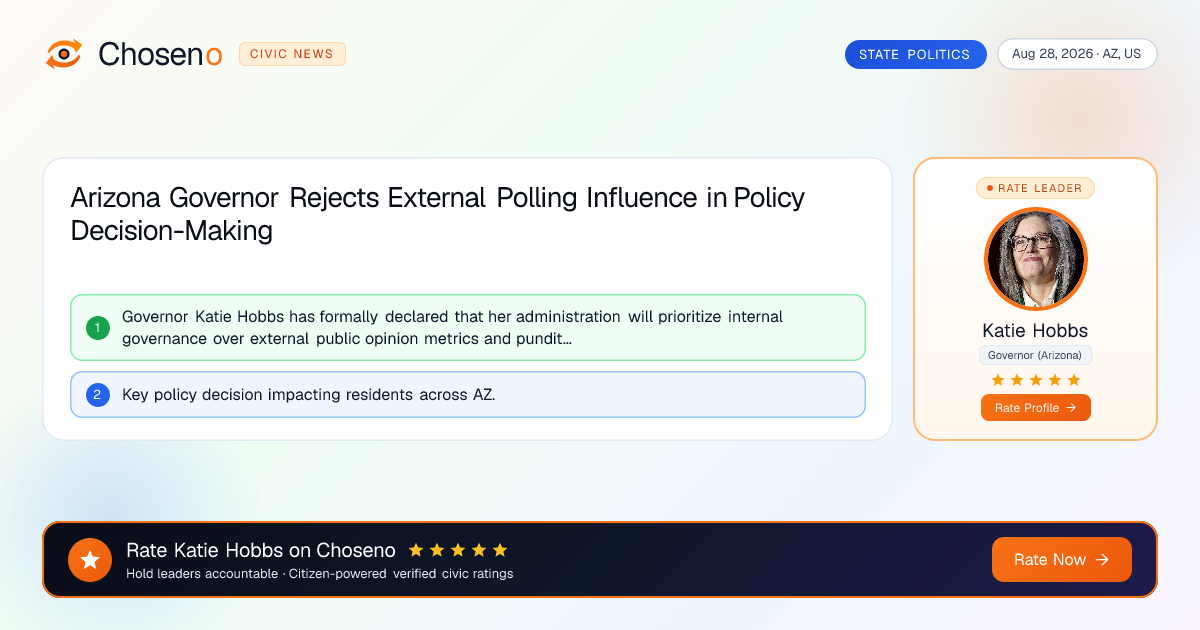
Arizona Governor Rejects External Polling Influence in Policy Decision-Making
Governor Katie Hobbs has formally declared that her administration will prioritize internal governance over external public opinion metrics and pundit commentary. This shift in executive strategy carries no direct immediate fiscal impact but signals a change in how the Governor intends to approach future legislative priorities.
Choseno Civic News Desk August 28, 2026 1 min read AZ, US
Dateline Lead
PHOENIX, AZ — Governor Katie Hobbs has publicly stated her intention to disregard external polling data and pundit analysis when determining the direction of her administration. According to reporting by KTAR News 92.3 FM, the Governor emphasized a commitment to her own decision-making process rather than reacting to outside commentary.
Policy & Taxpayer Impact
The announcement represents a shift in executive communication and strategy. While the decision does not involve a direct appropriation of state funds, it alters the methodology by which the Governor evaluates policy proposals. Taxpayers are affected insofar as the administration’s legislative priorities may now diverge from broader public sentiment or media-driven narratives.
Political & Legal Stakes
The political stakes involve the Governor's autonomy in navigating a polarized legislative environment. By distancing her office from public opinion metrics, Hobbs is asserting executive independence. This approach carries the risk of creating a disconnect between the executive branch and the electorate, potentially complicating future legislative negotiations.
The Debate
Proponents of this approach argue that it allows for principled, long-term governance that is not subject to the volatility of short-term public opinion or media cycles. Conversely, critics contend that ignoring polling data may lead to a lack of responsiveness to the needs and concerns of the citizenry, potentially alienating voters who expect their representatives to be guided by the collective will of the public.
Public Accountability Context
As the Governor moves forward with this stated policy, citizens are encouraged to monitor how specific legislative outcomes align with the needs of their communities. The administration's refusal to be swayed by external metrics places a higher burden on voters to engage directly with the Governor's office to ensure their priorities are represented in the state's policy agenda.
Rate the people mentioned in this article

Related Coverage in State Politics
See all State Politics newsState Politics
US Aug 28, 2026
Flock Camera Deployment Becomes Central Point of Contention in Texas Gubernatorial Campaign
The integration of Flock automated license plate recognition technology has transitioned into a significant policy debate within the Texas governor's race. The discourse centers on the balance between enhanced law enforcement surveillance capabilities and the preservation of individual privacy rights.
Read full article
State Politics
US Aug 28, 2026
Weiser and Lopez Face Off in First Colorado Gubernatorial Debate
Colorado gubernatorial candidates Phil Weiser and independent candidate Lopez participated in their first formal debate. The event proceeded with Republican candidate Marx notably absent from the stage.
Read full article