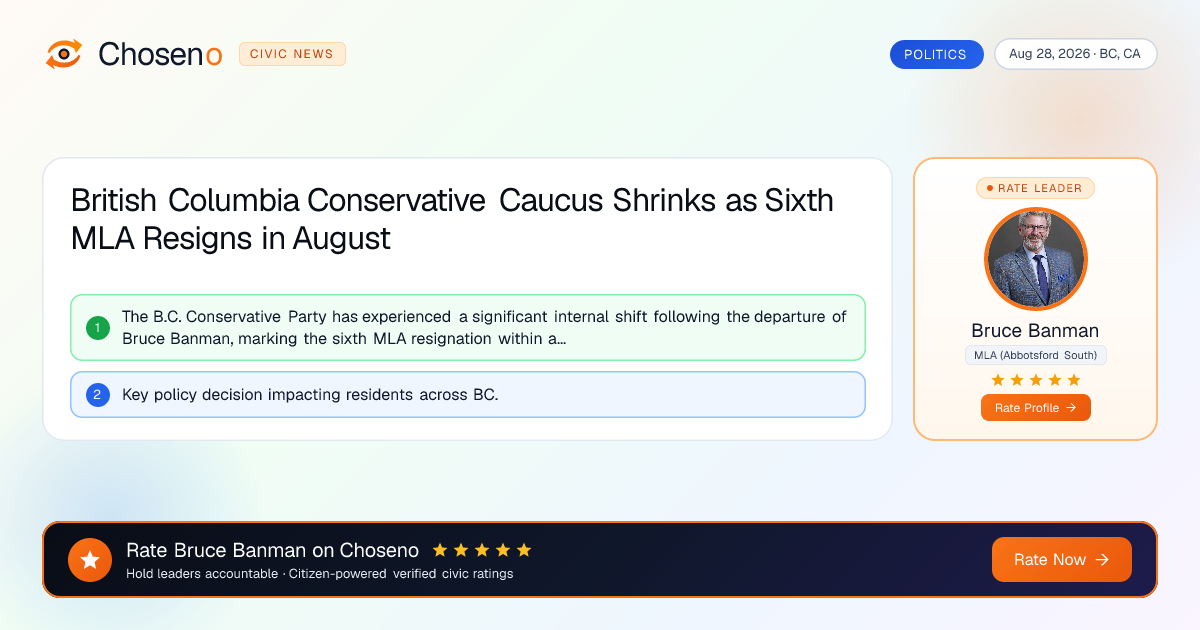
British Columbia Conservative Caucus Shrinks as Sixth MLA Resigns in August
The B.C. Conservative Party has experienced a significant internal shift following the departure of Bruce Banman, marking the sixth MLA resignation within a single month. This ongoing turnover raises questions regarding party stability and the potential impact on legislative operations in the province.
Choseno Civic News Desk August 28, 2026 2 min read BC, CA
Dateline Lead
VICTORIA, BC — The British Columbia Conservative caucus has seen its membership decline further following the resignation of Bruce Banman. This departure represents the sixth MLA to exit the party within the month of August, signaling a period of intense internal volatility for the provincial opposition.
Policy & Taxpayer Impact
While the resignation does not immediately alter the provincial budget or specific tax policies, the loss of six MLAs in a short timeframe impacts the administrative efficiency of the official opposition. Taxpayers fund the operations of the Legislative Assembly, and high turnover rates among elected officials can lead to disruptions in committee work and the continuity of legislative oversight functions.
Political & Legal Stakes
The resignation of Banman carries significant weight due to his public criticism of party leadership. According to reporting by CTV News, Banman explicitly stated that he considers John Findlay "unelectable." This public rift highlights deep-seated divisions within the party structure that could influence voter perception and the party's ability to present a unified front in future legislative sessions.
The Debate
Proponents of the current party leadership maintain that the caucus remains focused on its core platform and that personnel changes are a natural part of political evolution. Conversely, critics and departing members argue that the leadership under Findlay is failing to provide the necessary direction to win public support, citing the string of resignations as evidence of a fundamental disconnect between the party's current trajectory and its electoral viability.
Public Accountability Context
Citizens are observing a rapid transformation of the B.C. Conservative caucus, which directly affects the balance of power in the legislature. As these departures continue, the public is left to evaluate whether the party can stabilize its internal operations or if the ongoing resignations will lead to a broader realignment of political representation in the province.
Rate the people mentioned in this article

Related Coverage in Politics
See all Politics newsPolitics
US Aug 28, 2026
Teton County Conservative Bextel Reaffirms Gubernatorial Campaign
Teton County resident Bextel has officially confirmed the continuation of her campaign for governor. The announcement maintains the current field of candidates vying for the state's highest executive office.
Read full article
Politics
CA Aug 28, 2026
China National Building Material Leadership Transition Confirmed Following Chairman Resignation
The China National Building Material Company has officially announced the resignation of its chairman. This leadership change at the state-backed entity carries potential implications for international supply chain stability and global construction material markets.
Read full article

Politics
US Aug 28, 2026
Evolving US Cabinet Market Standards Demand Dual-Finish Production from Southeast Asian Suppliers
The United States cabinet market is shifting its procurement expectations, requiring Southeast Asian manufacturers to adapt to complex dual-finish requirements. This transition impacts international trade dynamics and supply chain logistics for North American home improvement sectors.
Read full article