California EV Rebate Program Depleted in Four Days Following Tesla Surge
California's electric vehicle rebate funding was fully exhausted within four days due to a rapid influx of applications linked to Tesla. This depletion leaves subsequent applicants without access to state-subsidized financial incentives for the remainder of the current cycle.
Choseno Civic News Desk August 28, 2026 1 min read CA, US
Dateline Lead
SACRAMENTO, CA — The state of California saw its electric vehicle (EV) rebate program funding reach total exhaustion within a four-day window. According to reporting by scanx.trade, the rapid depletion of these financial resources follows a significant spike in demand, specifically tied to Tesla vehicle acquisitions.
Policy & Taxpayer Impact
The rebate program is designed to lower the barrier to entry for consumers transitioning to zero-emission vehicles. With the funds now depleted, the immediate taxpayer impact is the cessation of state-funded financial assistance for new applicants. This creates a sudden fiscal gap for residents who were planning their vehicle purchases based on the availability of these state-backed incentives.
Political & Legal Stakes
The speed at which these funds were exhausted raises questions regarding the sustainability of current state incentive models. Policymakers are now faced with the challenge of determining whether to reallocate funds from other environmental initiatives or to allow the program to remain dormant until the next fiscal cycle, potentially slowing the state's aggressive transition to electric transportation.
The Debate
Proponents of the rebate program argue that such incentives are essential to meeting California's climate goals and accelerating the adoption of clean energy vehicles. Conversely, critics suggest that the program's structure is vulnerable to market volatility and that the rapid depletion demonstrates a need for more targeted, means-tested distribution rather than a first-come, first-served model that can be overwhelmed by high-volume manufacturers.
Public Accountability Context
As the state navigates the fallout of this depletion, citizens are encouraged to monitor upcoming legislative sessions for potential budget adjustments. The event highlights the tension between ambitious environmental policy targets and the practical limitations of state-funded subsidy programs when faced with high consumer demand.
Related Coverage in State Policy
See all State Policy newsState Policy
US Aug 28, 2026
$14.8 Billion Surplus Coexists With New Mexico Ranking Last in Quality of Life Metrics
New Mexico maintains a $14.8 billion financial reserve while simultaneously occupying the lowest national rankings for key quality of life indicators. This fiscal disparity highlights a growing tension between state savings and the delivery of essential public services.
Read full article
State Policy
US Aug 28, 2026
New Jersey Data Center Framework Establishes Four-Pillar Community Oversight Policy
Governor Mikie Sherrill has finalized a four-pillar regulatory plan governing data center development across New Jersey. The policy aims to shift decision-making authority back to local municipalities regarding infrastructure expansion.
Read full article
State Policy
US Aug 28, 2026
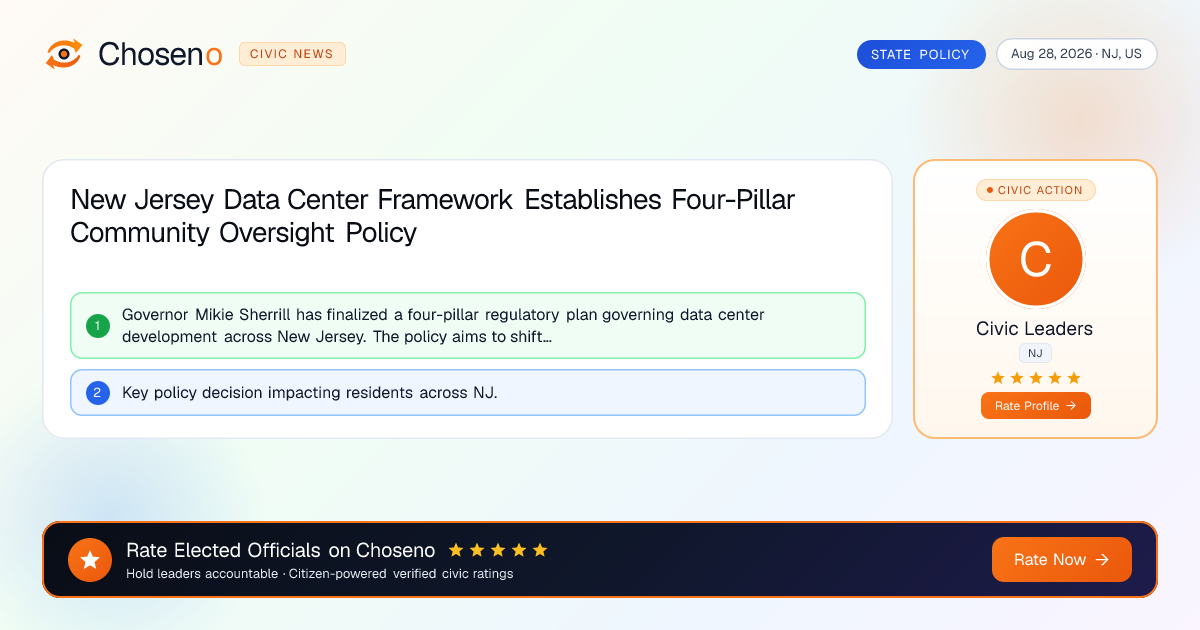
Advocacy Groups Urge New York Legislative Action to Prohibit Octopus Farming and Wild Animal Circuses
The Animal Welfare Institute is calling on Governor Kathy Hochul to enact state-level bans on commercial octopus farming and the use of wild animals in traveling circuses. These proposed policy shifts aim to address ethical concerns regarding animal welfare and environmental sustainability within New York state jurisdiction.
Read full article