California Legislature Sends Emergency Rent Price-Gouging Expansion to Governor Gavin Newsom
Senate Bill 1365 heads to the governor's desk, expanding California's 10% emergency rent-increase cap to long-term leases under Penal Code Section 396 amid landlord opposition.
Choseno Civic News Desk September 4, 2026Updated September 6, 2026 3 min read California, US
What do you think of the people in this story? Rate them anonymously — tap a face below.
The California Legislature has granted final approval to Senate Bill 1365, sending legislation to Governor Gavin Newsom's desk that significantly expands the state's emergency rent-gouging prohibitions to encompass long-term residential leases. The bill, authored by Democratic state Senator Ben Allen of Santa Monica, amends California Penal Code Section 396 to close longstanding statutory loopholes and protect displaced tenants from sudden rent escalations following declared states of emergency across California.
Under current California statutory law, Penal Code Section 396 automatically prohibits landlords, hoteliers, building operators, and consumer merchants from raising prices by more than ten percent immediately following an official presidential, gubernatorial, or municipal emergency proclamation. However, existing criminal code definitions previously restricted covered residential housing protections to rental agreements with initial terms of one year or less, creating an ambiguity that housing advocates argued allowed property owners to circumvent emergency caps on multi-year lease renewals.
Senate Bill 1365 formally eliminates the one-year limitation, bringing all rental dwellings under statutory price-gouging restrictions regardless of the initial lease duration. The legislation also establishes rigorous evidentiary criteria governing how residential rental housing providers may defend rent increases exceeding the ten percent threshold. Landlords seeking to justify higher adjustments must prove that increases were contractually finalized prior to the emergency proclamation or demonstrate that higher rates directly reflect verified capital improvement and repair expenses incurred beyond ordinary property maintenance.
The state Senate concurred in Assembly amendments on a decisive twenty-seven to ten roll call vote on the final day of the legislative calendar. An earlier iteration of the bill had proposed expanding antitrust enforcement powers for municipal city attorneys under California's Cartwright Act, but lawmakers stripped those provisions during committee negotiations while preserving the criminal code amendments affecting residential rental housing.
The measure faces intense opposition from property owner organizations, including the California Apartment Association and allied regional real estate groups. In formal opposition filings submitted to the Legislature and the Governor's Office, industry representatives argued that the expansion inappropriately subjects routine commercial pricing negotiations to criminal misdemeanor penalties, which carry potential sentences of up to one year in county jail and fines reaching ten thousand dollars. Industry groups contended that California already enforces comprehensive tenant protections through the Tenant Protection Act of 2019, cautioning that overlapping criminal restrictions could deter property owners from financing post-disaster property rehabilitation.
Supporters of the legislation countered that catastrophic wildfires, seasonal flooding, and mudslides across California have repeatedly displaced low-income and working-class families into predatory rental markets. Legislative sponsors maintained that establishing uniform ten percent caps across all lease structures is essential to prevent opportunistic price hikes and ensure community stability during prolonged post-disaster recovery periods.
Legal analysts emphasize that local district attorneys and municipal prosecutors will receive clearer statutory authority to initiate civil or criminal proceedings against exploitative rental practices following major climate emergencies. Governor Newsom has until September 30 to sign or veto the enrolled measure. If signed into law, the expanded price-gouging protections will take effect on January 1, establishing stricter compliance guidelines for residential property managers navigating declared natural disasters across California.
Rate the people mentioned in this article

Related Coverage in Public Safety & Law
See all Public Safety & Law newsPublic Safety & Law
US Sep 5, 2026
Justice Department Seeks Gag Order Against Former DC Councilmember Trayon White Over Jury Video
Federal prosecutors file an emergency motion accusing former D.C. councilmember Trayon White of attempting to taint the jury pool ahead of his upcoming federal bribery trial.
Read full article
Public Safety & Law
US Sep 4, 2026
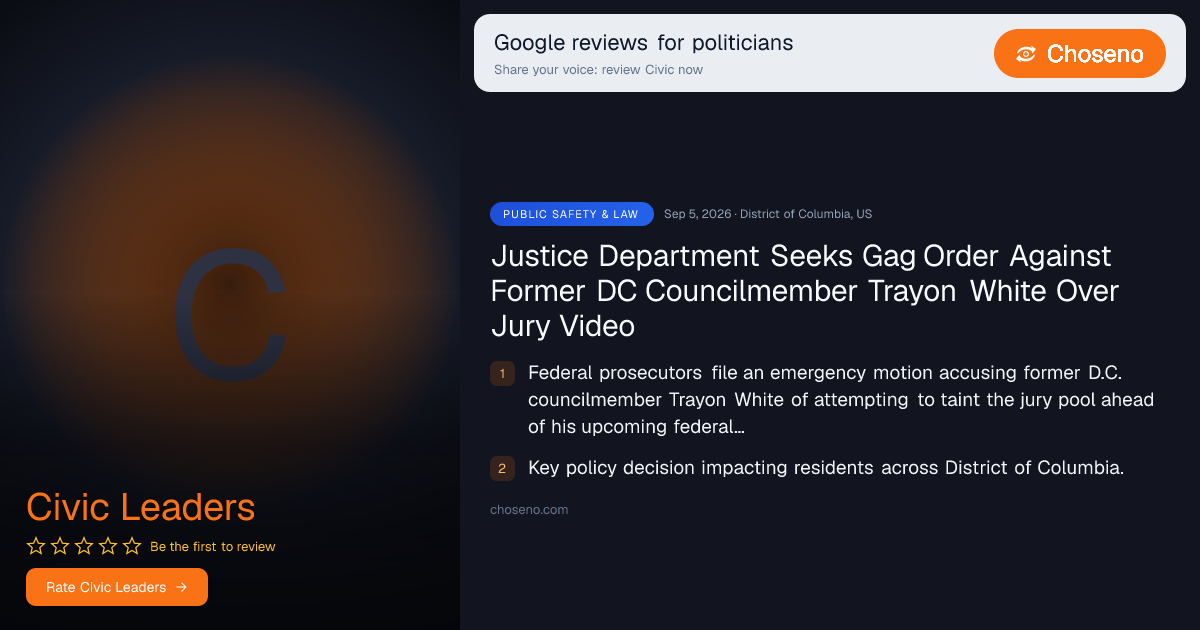
Delaware Governor Matt Meyer Enacts Firearm Dealer Licensing and Ghost Gun Enforcement Package
Governor Matt Meyer signs Senate Bill 300 and companion measures in Newark, creating state police oversight for gun retailers, mandating ghost gun serialization, and establishing a permanent violence prevention office.
Read full article
Public Safety & Law
US Sep 4, 2026
New York City Mayor Issues Executive Order 21 Designating September 11 as Official Day of Remembrance and Service
Mayor Eric Adams signs Executive Order 21, formally establishing September 11 as an annual citywide day of remembrance and civic service across all municipal agencies.
Read full article