California Natural Resources Agency Expands Emergency Fuel Breaks as San Andreas Fault Ridge Under Scrutiny
Governor Gavin Newsom authorized $64 million for mechanical fuel thinning along vulnerable Central Coast and Bay Area fault ridges following new geological slip surveys.
Choseno Civic News Desk August 23, 2026 1 min read CA, US
★ Choseno Civic Briefing
Key Leaders
SACRAMENTO, CA — Governor Gavin Newsom and the California Department of Forestry and Fire Protection (CAL FIRE) announced an emergency allocation of $64 million on Sunday morning to construct strategic shaded fuel breaks across the Santa Cruz Mountains and Diablo Range along the San Andreas fault corridor.
Wildfire Risk and Geological Terrain
The executive action follows recent geological monitoring data indicating accelerated surface creep along fault ridges south of the San Francisco Bay Area, which has altered hillside drainage patterns and dried out dense underbrush in high-risk wildland-urban interface (WUI) zones.
CAL FIRE crews and regional fire safe councils will immediately deploy heavy mastication machinery, prescribed grazing herds, and selective tree-thinning teams across 14,000 acres in San Mateo, Santa Clara, and San Benito counties to prevent utility ignitions from spreading into contiguous canopy fires.
Community Protection and Infrastructure Safeguards
The fuel break network is engineered to protect vital transportation corridors including Highway 17 and high-voltage transmission lines supplying Silicon Valley tech campuses and residential communities.
Local fire chiefs in Los Gatos, Saratoga, and Watsonville commended the expedited funding, emphasizing that defensive ridgeline buffers provide firefighters with defensible anchor points during severe Diablo wind events.
Project Execution and Environmental Permitting
The projects operate under the California Vegetation Treatment Program (CalVTP) environmental impact report, allowing work to commence without multi-year permitting delays. Initial mastication contracts will begin operations on September 8.
Sources
Rate the people mentioned in this article
Related Coverage in Environment
See all Environment newsEnvironment
US Aug 22, 2026
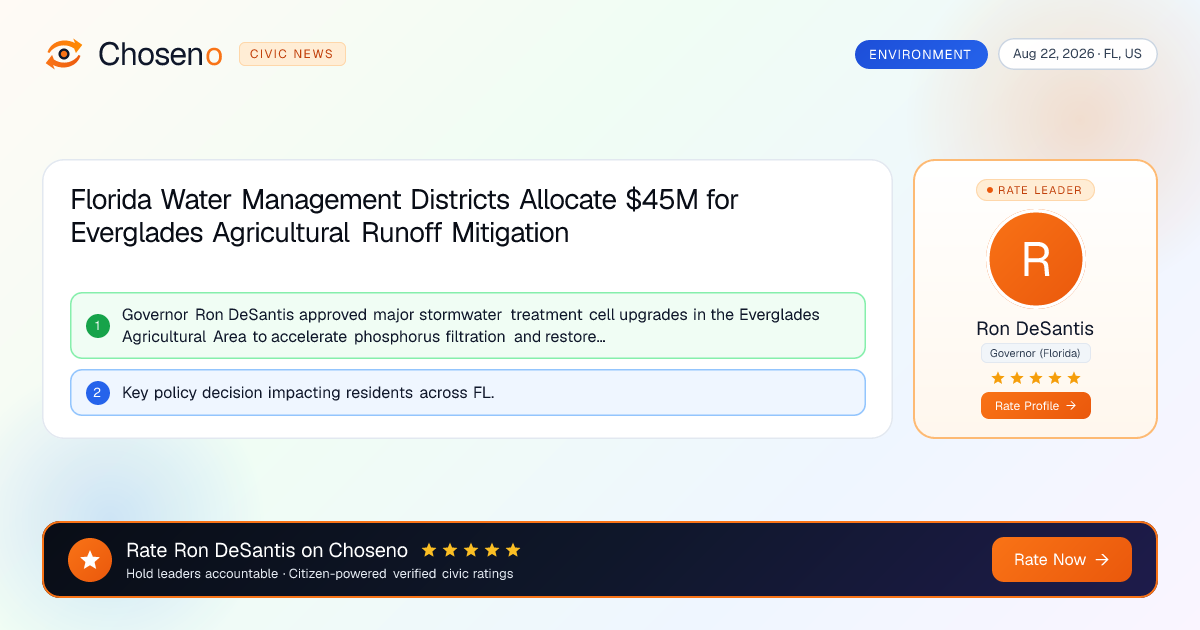
Florida Water Management Districts Allocate $45M for Everglades Agricultural Runoff Mitigation
Governor Ron DeSantis approved major stormwater treatment cell upgrades in the Everglades Agricultural Area to accelerate phosphorus filtration and restore southern flow paths.
Read full article
Environment
US Aug 22, 2026
Washington State Department of Ecology Enforces New Runoff Standards for Commercial Ports
State environmental regulators issued updated water quality discharge permits for major Puget Sound marine terminals, requiring advanced filtration for tire wear chemicals and heavy metals.
Read full article
Environment
US Aug 22, 2026
Arizona Department of Water Resources Mandates Groundwater Replenishment Rules for Pinal County
State water regulators enacted strict rules requiring suburban housing developments in Pinal County to demonstrate physical 100-year renewable surface water supplies.
Read full article