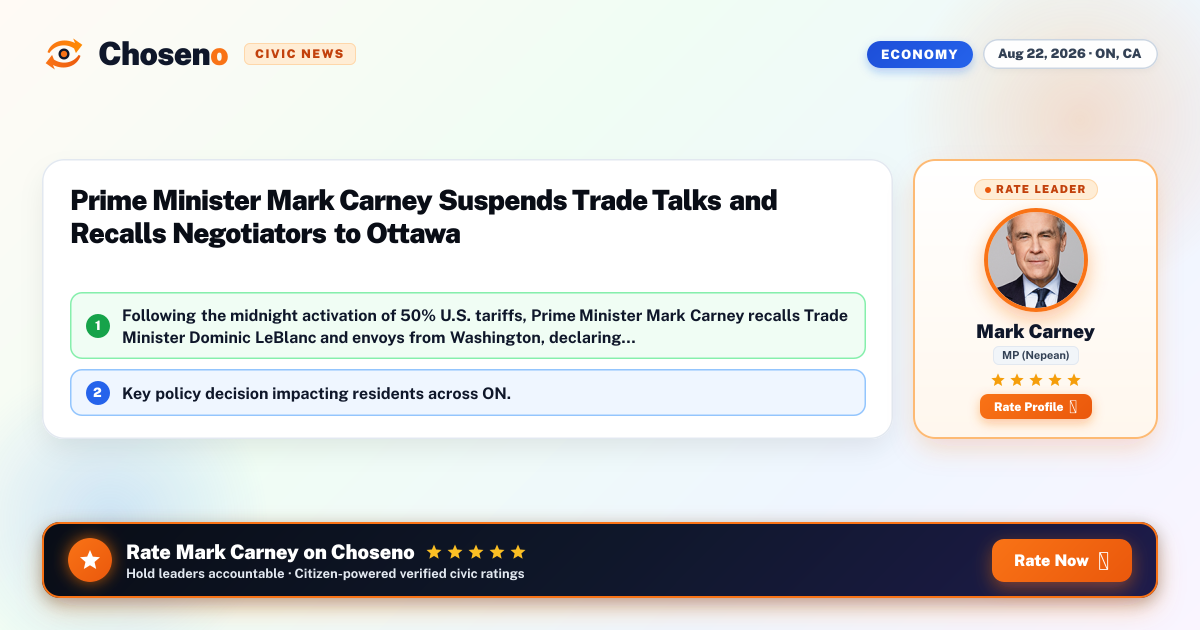
Prime Minister Mark Carney Suspends Trade Talks and Recalls Negotiators to Ottawa
Following the midnight activation of 50% U.S. tariffs, Prime Minister Mark Carney recalls Trade Minister Dominic LeBlanc and envoys from Washington, declaring U.S. demands unfair and uneconomic.
Choseno Trade & Foreign Policy Desk August 22, 2026 1 min read ON, CA
★ Choseno Civic Briefing
Key Leaders
OTTAWA, ON — Prime Minister Mark Carney announced Saturday morning that Canada has formally suspended bilateral trade negotiations with the United States, ordering Trade Minister Dominic LeBlanc and Canada’s negotiating delegation to return to Ottawa immediately.
Negotiation Suspension and Diplomatic Breakdown
The dramatic move follows the midnight expiration of a bilateral deadline that triggered 50 percent punitive U.S. tariffs on roughly $28 billion in Canadian goods. Prime Minister Carney stated that last-minute conditions introduced by the Office of the U.S. Trade Representative (USTR)—including demands to eliminate provincial liquor monopolies and dismantle dairy supply management quotas—rendered a mutually beneficial agreement impossible.
"Canada will not negotiate under duress or accept terms that undermine our national economic sovereignty," Carney stated during an address from the National Press Theatre. "Our negotiating team represented Canada with firmness and integrity, but Washington chose confrontation over cooperation."
Economic Contingency Measures and Support for Exporters
Carney announced that the federal cabinet’s emergency economic committee will meet over the weekend with the Canadian Chamber of Commerce, the Canadian Manufacturers & Exporters, and labor unions to finalize targeted liquidity facilities for affected exporters.
Ottawa will unveil a comprehensive retaliatory tariff schedule early next week matching the U.S. duties dollar-for-dollar across strategic agricultural and manufactured goods from politically sensitive U.S. congressional districts.
Sources
Rate the people mentioned in this article


Related Coverage in Economy
See all Economy newsEconomy Breaking
US Aug 22, 2026
U.S. National Debt Crosses Historic $40 Trillion Milestone as Borrowing Costs Surge
Treasury Department debt clock marks historic fiscal threshold, sparking renewed legislative calls from congressional budget leaders for statutory deficit reduction caps.
Read full article
Economy
US Aug 22, 2026
Back-to-School Costs Surge 8.4% as Apparel and Tech Equipment Strain U.S. Household Budgets
National Retail Federation survey indicates average K-12 family spending will top $895 this autumn, driving increased consumer reliance on short-term installment debt.
Read full article

Economy
US Aug 22, 2026
Texas Leads Nation with 165,600 Nonfarm Jobs Added as Comptroller Releases Annual Report
Comptroller report highlights record corporate relocations, technology manufacturing expansions, and oil and gas infrastructure investments across Texas metropolitan hubs.
Read full article