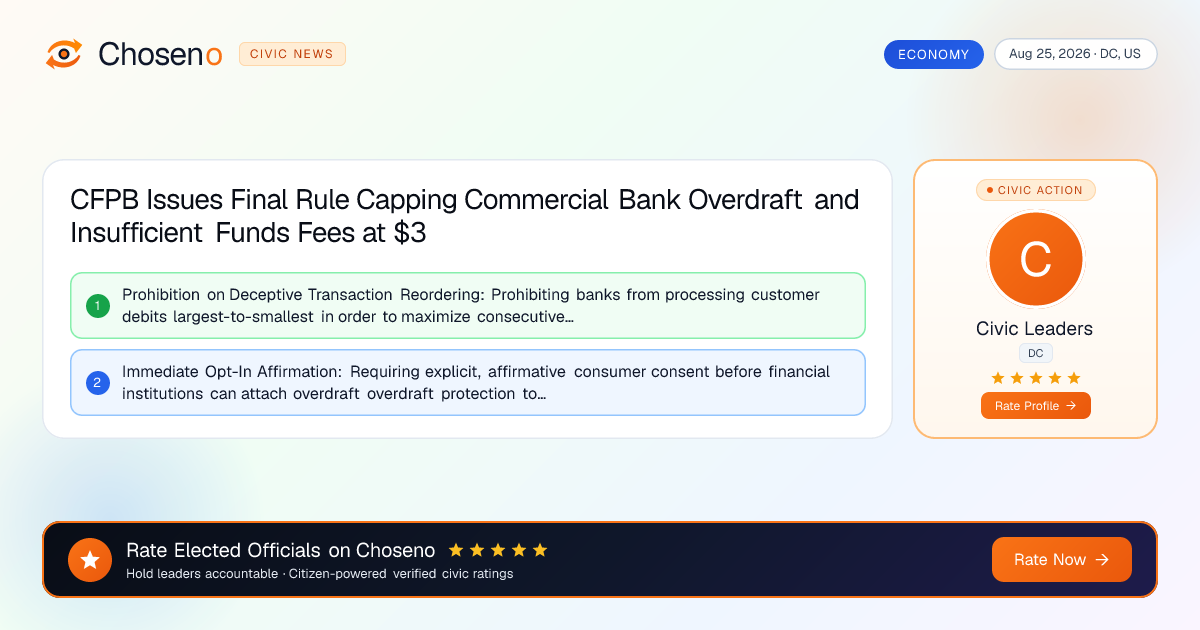
CFPB Issues Final Rule Capping Commercial Bank Overdraft and Insufficient Funds Fees at $3
Consumer Financial Protection Bureau Director Rohit Chopra finalizes a landmark rule reining in excessive $35 bank overdraft fees, capping benchmark fees at $3 and saving consumers $3.5 billion annually.
Choseno Banking & Financial Desk August 25, 2026 2 min read DC, US
★ Choseno Civic Briefing
Key Leaders
WASHINGTON — Consumer Financial Protection Bureau (CFPB) Director Rohit Chopra announced on Monday the finalization of a comprehensive federal rule closing a decades-old regulatory loophole that exempted very large commercial banks with assets exceeding $10 billion from the Truth in Lending Act when issuing overdraft credit lines.
The landmark regulation establishes benchmark overdraft fee caps of $3 to $14—down from typical bank fees of $35—or requires commercial banks to offer overdraft services as regulated, transparent consumer credit lines with clear annual percentage rate (APR) disclosures and ability-to-pay assessments.
Saving Working Families $3.5 Billion in Exploitative Bank Surcharges Federal consumer financial data revealed that the vast majority of commercial bank overdraft fees are harvested from a vulnerable subset of low-income checking account holders living paycheck to paycheck, who frequently incur $35 penalties on minor debit card transactions as small as a $4 cup of coffee.
"For decades, America's largest banks exploited an outdated regulatory loophole to turn overdraft into a multi-billion-dollar predatory junk-fee profit machine," CFPB Director Rohit Chopra said in Washington. "By requiring transparent disclosures and setting benchmark fees based on actual processing costs, this rule puts an end to exorbitant $35 penalty charges and saves American families more than $3.5 billion every single year."
Core Regulatory Provisions Under the finalized CFPB rule:
- Benchmark Fee Options: Financial institutions with over $10 billion in assets may adopt a statutory $3 cost-based benchmark fee, a tiered fee based on direct institutional cost recovery, or provide conventional open-end credit lines.
- Prohibition on Deceptive Transaction Reordering: Prohibiting banks from processing customer debits largest-to-smallest in order to maximize consecutive overdraft fee triggers.
- Immediate Opt-In Affirmation: Requiring explicit, affirmative consumer consent before financial institutions can attach overdraft overdraft protection to retail checking accounts.
Consumer advocacy coalitions and civil rights organizations commended the CFPB's decisive action, noting that reasonable fee caps protect vulnerable households from involuntary bank account closures.
Related Coverage in Economy
See all Economy newsEconomy
US Aug 25, 2026
Governor JB Pritzker Allocates $140 Million for Modernizing Illinois Advanced Metal Casting Foundries
Illinois Governor JB Pritzker and DCEO announce $140 million in capital grants from the Rebuild Illinois program to retool twelve commercial metal casting foundries with automated 3D sand-printing and electric arc induction furnaces.
Read full article

Economy
US Aug 25, 2026
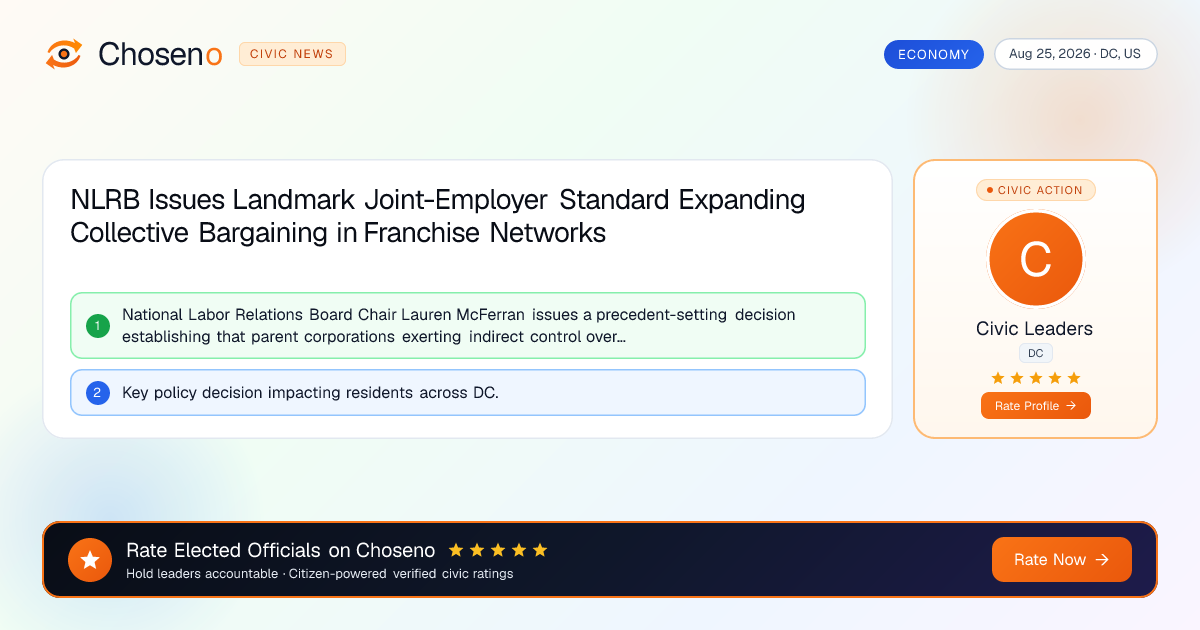
NLRB Issues Landmark Joint-Employer Standard Expanding Collective Bargaining in Franchise Networks
National Labor Relations Board Chair Lauren McFerran issues a precedent-setting decision establishing that parent corporations exerting indirect control over wages and scheduling share joint-employer liability with franchisees.
Read full article
Economy
US Aug 25, 2026
Mayor London Breed Directs $60 Million for San Francisco Downtown Ground-Floor Retail and Arts Conversions
San Francisco Mayor London Breed and the Board of Supervisors authorize $60 million from the Downtown Economic Vitality Fund to convert vacant commercial storefronts into culinary incubators, artist studios, and local retail boutiques.
Read full article