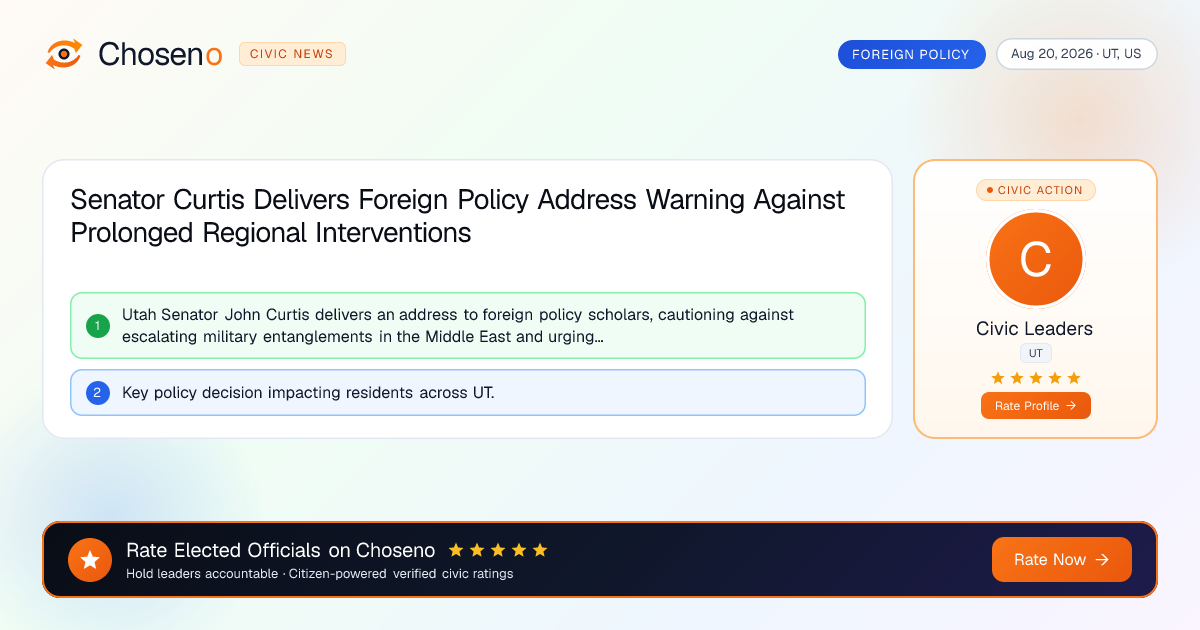
Senator Curtis Delivers Foreign Policy Address Warning Against Prolonged Regional Interventions
Utah Senator John Curtis delivers an address to foreign policy scholars, cautioning against escalating military entanglements in the Middle East and urging congressional authorization checks.
Choseno Foreign Affairs Bureau August 20, 2026 1 min read UT, US
★ Choseno Civic Briefing
SALT LAKE CITY, UT — U.S. Senator John Curtis addressed international affairs scholars and civic leaders at the Hinckley Institute of Politics Thursday afternoon, delivering a major foreign policy address urging Congress and the executive branch to exercise strategic restraint regarding escalating military tensions in the Middle East.
Constitutional War Powers and Strategic Restraint
Drawing parallels between current geopolitical crises and historical military interventions over the past half-century, Senator Curtis argued that open-ended military entanglements without defined strategic end-states risk depleting national defense resources and destabilizing global energy supply routes. Curtis asserted that under Article I, Section 8 of the U.S. Constitution, the executive branch must seek explicit congressional Authorization for Use of Military Force (AUMF) before deploying American combat assets into expanded regional conflicts.
Curtis emphasized that strong diplomatic deterrence, robust bilateral security partnerships, and targeted economic sanctions remain America's most effective instruments to prevent wider wars.
Bipartisan Congressional Reactions
Foreign policy analysts and conservative and moderate lawmakers praised Curtis’s address for fostering a serious debate on constitutional war powers ahead of the fall congressional session.
Curtis affirmed that maintaining military readiness requires focusing defense investments on core deterrence priorities in the Indo-Pacific and European theaters.
Legislative Action on War Powers
Curtis announced plans to co-sponsor bipartisan legislation when the Senate reconvenes in September to sunset outdated 2002 war authorizations and strengthen congressional oversight.
Related Coverage in Foreign Policy
See all Foreign Policy news
Foreign Policy
CA Aug 20, 2026
Canada and European Allies Issue Joint Condemnation of West Bank E1 Settlement Expansion
Canada joins the UK, France, Germany, and Italy in a formal diplomatic statement condemning settlement construction plans in the E1 corridor that sever territorial contiguity.
Read full article
Foreign Policy
CA Aug 20, 2026
Prime Minister Carney and Mexican President Sheinbaum Reaffirm Trilateral CUSMA Unity
Prime Minister Mark Carney confers with Mexican President Claudia Sheinbaum to coordinate joint trade defenses and protect North American supply chain integration.
Read full article
Foreign Policy
US Aug 20, 2026
State Department Imposes Targeted Financial Sanctions on Ten Cuban State Enterprises
U.S. Secretary of State Marco Rubio announces new Treasury and State Department sanctions on ten Cuban military-owned commercial entities to restrict foreign currency flows.
Read full article