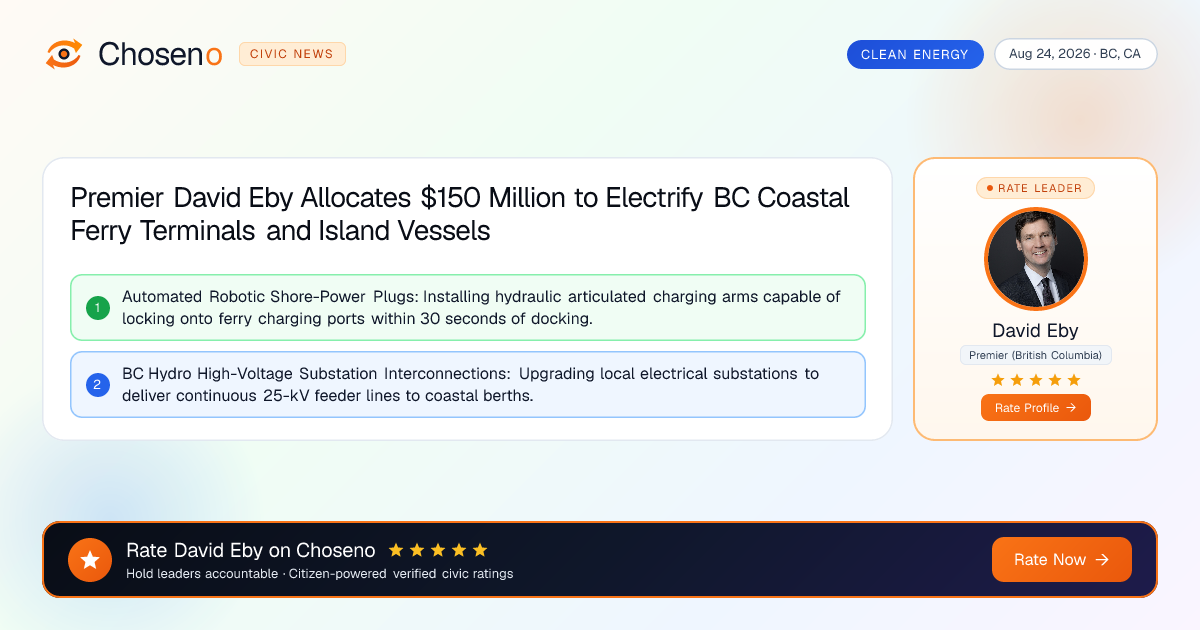
Environment Minister Steven Guilbeault Finalizes Clean Electricity Regulations Compliance Framework
Environment and Climate Change Minister Steven Guilbeault issues finalized Clean Electricity Regulations (CER), establishing emissions-intensity standards for thermal power plants while granting extended reliability flexibilities for provincial grids.
Choseno Environmental Policy Desk August 24, 2026 2 min read QC, CA
★ Choseno Civic Briefing
Key Leaders
MONTREAL — Minister of Environment and Climate Change Steven Guilbeault published the finalized text of the federal Clean Electricity Regulations (CER) on Monday, establishing performance-based greenhouse gas emissions intensity standards for thermal electricity generating stations while introducing expanded flexibility mechanisms to protect regional power grid reliability.
The finalized regulatory standards, promulgated under the Canadian Environmental Protection Act (CEPA), mandate that fossil-fuel generating units achieve an emissions intensity limit of 30 tonnes of CO2 per gigawatt-hour by 2035, while establishing tailored compliance pathways for natural gas units equipped with carbon capture and storage (CCS) or operating as emergency peaking assets during extreme weather events.
Balancing Decarbonization with Grid Reliability and Affordability Federal environmental modeling projects that transitioning to a net-zero electricity grid by 2035 will eliminate over 340 million metric tons of cumulative greenhouse gas emissions while positioning Canada to export clean electricity to the northern United States.
"Canadians want clean, reliable, and affordable electricity to power their homes, businesses, and electric vehicles," Minister Steven Guilbeault said in Montreal. "Following extensive technical consultations with provincial utilities, system operators, and industry leaders, these finalized regulations establish a clear, achievable standard for decarbonizing our electricity sector while providing provincial power operators with the operational flexibility needed to keep the lights on during extreme cold snaps and heat waves."
Key Regulatory Flexibility Mechanisms The finalized CER framework incorporates:
- 20-Year End-of-Prescribed-Life Provision: Units built before 2025 may operate unabated for up to 20 years from their commissioning date before becoming subject to emissions limits.
- Emergency Peaker Exemptions: Natural gas generation units operating under 450 hours per calendar year are exempt from emissions limits to serve as emergency winter backup.
- Carbon Capture Integration Credits: Providing compliance flexibilities for facilities achieving 90 percent carbon capture rates.
Clean energy advocacy coalitions commended the finalization of the regulations, while provincial power utilities noted that the amended emergency provisions provide a practical balance for system operations during extreme winter weather.
Rate the people mentioned in this article

Related Coverage in Clean Energy
See all Clean Energy newsClean Energy
US Aug 25, 2026
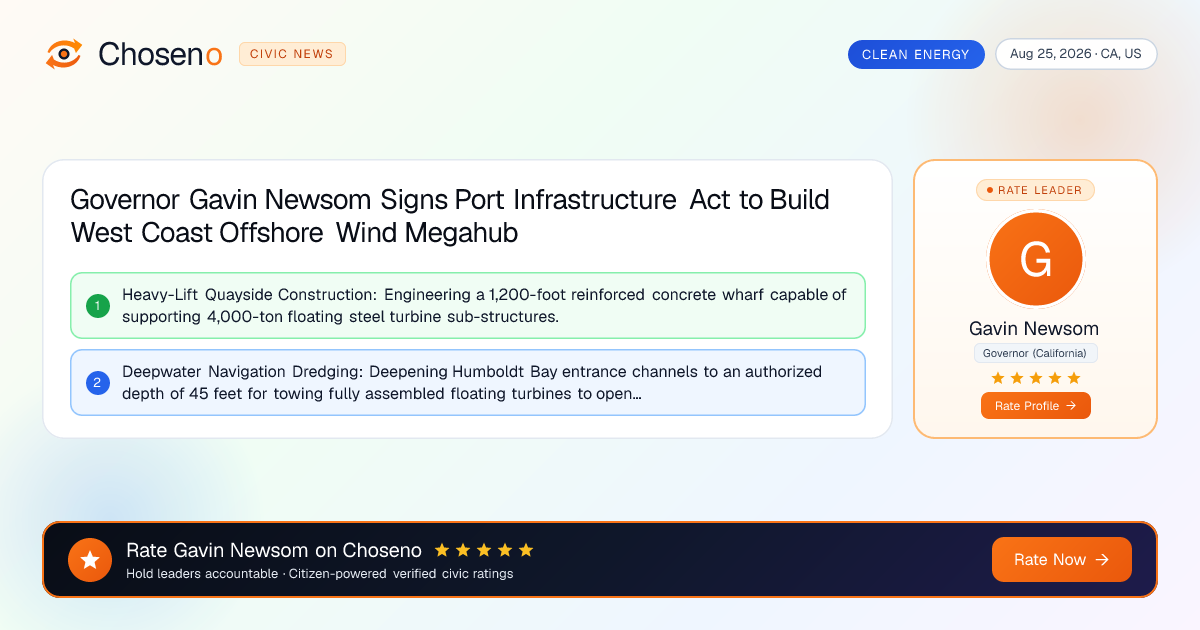
Governor Gavin Newsom Signs Port Infrastructure Act to Build West Coast Offshore Wind Megahub
California Governor Gavin Newsom and Senate President Pro Tem Mike McGuire enact Senate Bill 1285, appropriating $275 million to construct a heavy-lift deepwater offshore wind assembly terminal at Humboldt Bay.
Read full article
Clean Energy
CA Aug 25, 2026
Natural Resources Minister Jonathan Wilkinson Allocates $275 Million for Sustainable Aviation Fuel Plants
Natural Resources Minister Jonathan Wilkinson awards $275 million from the Clean Fuels Fund to construct three commercial-scale Sustainable Aviation Fuel (SAF) biorefineries utilizing agricultural canola oil and forestry residues in Alberta and Ontario.
Read full article
Clean Energy
CA Aug 24, 2026
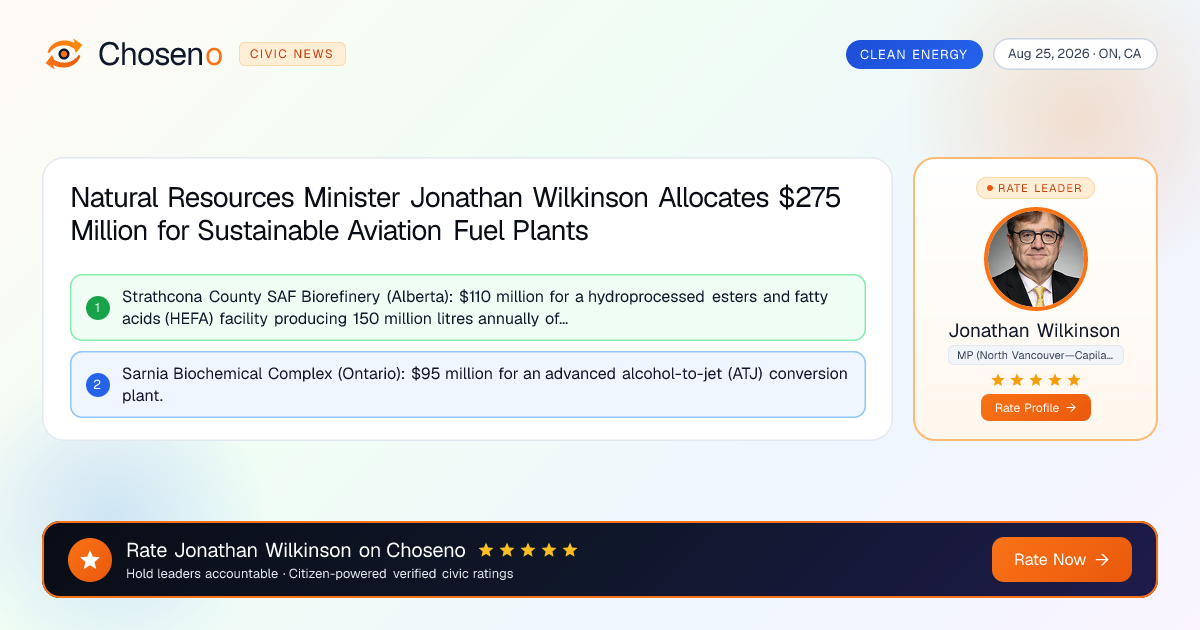
Premier David Eby Allocates $150 Million to Electrify BC Coastal Ferry Terminals and Island Vessels
British Columbia Premier David Eby and Transportation Minister Rob Fleming announce $150 million to install 10-megawatt rapid charging systems at five major BC Ferries terminals, enabling zero-emission hybrid-electric ferry sailings.
Read full article