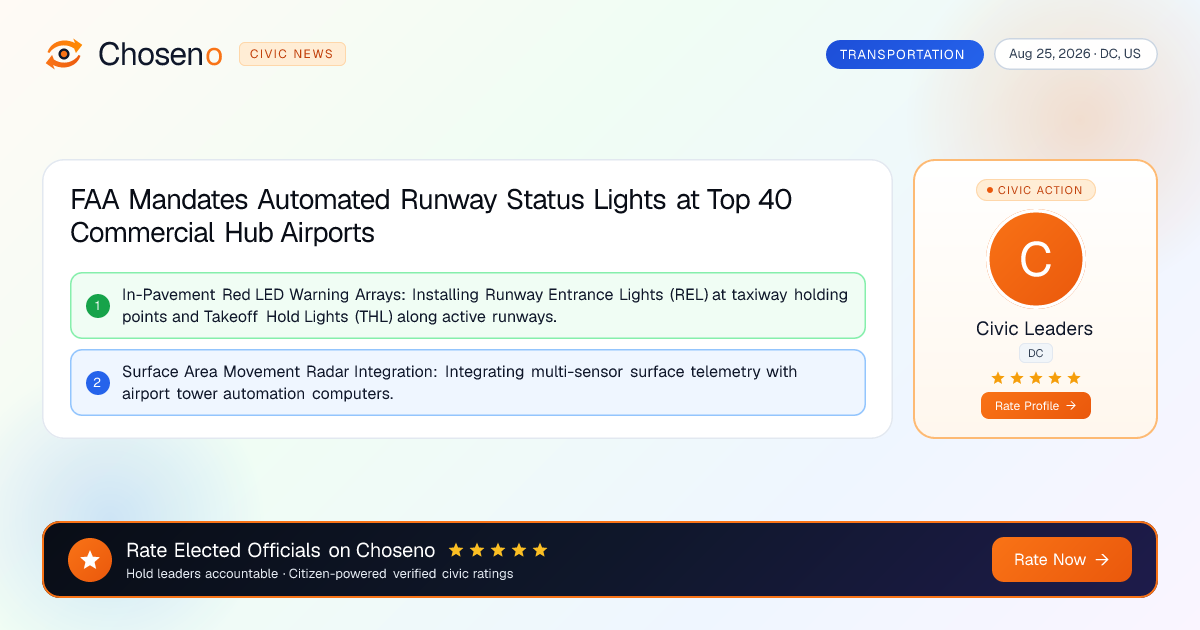
FAA Mandates Automated Runway Status Lights at Top 40 Commercial Hub Airports
Federal Aviation Administration Administrator Mike Whitaker issues a binding safety directive requiring forty major commercial airports to install automated in-pavement Runway Status Lights (RWSL) to prevent surface runway incursions.
Choseno Aviation Safety Desk August 25, 2026 2 min read DC, US
★ Choseno Civic Briefing
Key Leaders
WASHINGTON — Federal Aviation Administration (FAA) Administrator Mike Whitaker announced on Monday a binding federal safety directive and $420 million capital grant allocation through the Airport Improvement Program (AIP) to install automated in-pavement Runway Status Light (RWSL) systems and surface surveillance radar across forty major commercial hub airports nationwide.
The automated safety technology operates independently of air traffic control verbal transmissions, utilizing airport ground radar and multi-lateration sensors to illuminate high-intensity red LED lights embedded in runway pavement when high-speed aircraft are taking off or landing, warning taxiing pilots and ground vehicles that it is unsafe to cross or enter active runways.
Eliminating Catastrophic Airport Runway Incursions Following multiple high-profile near-miss runway incursions at major U.S. airports during periods of heavy fog and air traffic controller staffing shortages, aviation safety audits demonstrated that automated visual runway lights provide a vital layer of direct situational awareness for cockpit flight crews.
"Safety is the absolute cornerstone of American commercial aviation, and we are deploying the most advanced airfield technologies to ensure our runways remain the safest in the world," FAA Administrator Mike Whitaker said in Washington. "Runway Status Lights provide an immediate, automated visual stop sign directly in front of pilots. By mandating this proven safety technology across our top forty commercial airports, we are taking decisive action to eliminate near-miss incursions and protect the flying public."
Airfield Technology Deployments The safety directive finances:
- In-Pavement Red LED Warning Arrays: Installing Runway Entrance Lights (REL) at taxiway holding points and Takeoff Hold Lights (THL) along active runways.
- Surface Area Movement Radar Integration: Integrating multi-sensor surface telemetry with airport tower automation computers.
- Automated Vehicle ADS-B Trackers: Requiring all airport snowplows, fuel tenders, and emergency rescue vehicles to transmit real-time ADS-B Out positional coordinates.
Airline pilots associations, air traffic controllers unions, and airport directors commended the federal mandate, highlighting that automated direct-to-pilot visual warnings prevent human communication errors on busy airfields.
Related Coverage in Transportation
See all Transportation newsTransportation
CA Aug 25, 2026
Premier Doug Ford Allocates $420 Million for Highway 7 Four-Lane Expansion Between Kitchener and Guelph
Ontario Premier Doug Ford and Transportation Minister Prabmeet Sarkaria award $420 million in provincial construction contracts to build twin bridges over the Grand River and construct grade-separated interchanges for the new four-lane Highway 7 freeway.
Read full article

Transportation
CA Aug 25, 2026
Premier David Eby Allocates $160 Million for TransLink RapidBus Priority Corridors in Vancouver and Surrey
British Columbia Premier David Eby and Transportation Minister Rob Fleming announce $160 million to construct 40 kilometers of dedicated bus-only lanes, queue jumps, and transit signal priority along four major Metro Vancouver transit corridors.
Read full article

Transportation
US Aug 25, 2026
Governor Josh Shapiro Allocates $110 Million for Pennsylvania Municipal Bridge Replacements
Pennsylvania Governor Josh Shapiro and PennDOT award $110 million in direct state infrastructure grants to repair or replace 120 deteriorated, weight-restricted municipal and county bridges across thirty-five counties.
Read full article