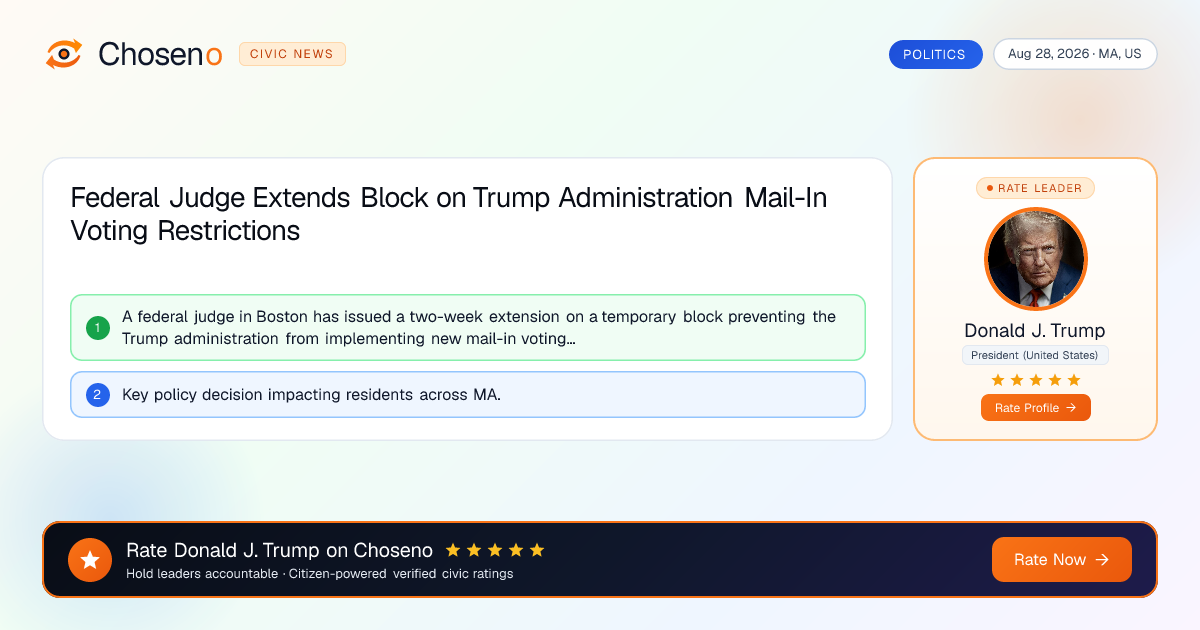
Federal Judge Extends Block on Trump Administration Mail-In Voting Restrictions
A federal judge in Boston has issued a two-week extension on a temporary block preventing the Trump administration from implementing new mail-in voting restrictions. This judicial intervention maintains current election procedures, impacting administrative costs and operational planning for state election officials ahead of the November midterms.
Choseno Civic News Desk August 28, 2026 2 min read MA, US
Dateline: Boston, Massachusetts
On Thursday night, Judge Indira Talwani issued a ruling extending a temporary block on the Trump administration's efforts to implement new restrictions on mail-in voting. The order ensures that existing voting protocols remain in effect for at least another two weeks as legal challenges proceed.
Policy & Taxpayer Impact
The judicial stay prevents the immediate enforcement of federal changes to mail-in ballot processing. For taxpayers and state governments, this ruling provides a temporary reprieve from the administrative costs and logistical burdens associated with rapidly reconfiguring election infrastructure, such as updating ballot verification software and retraining poll workers, just months before the November midterms.
Political & Legal Stakes
The legal challenge, brought by a coalition of blue states and voting rights organizations, centers on the argument that the administration's proposed restrictions exceed federal authority and infringe upon established voting access. According to reporting by The Hill Politics, the court found that the plaintiffs demonstrated a likelihood of success on the merits of their claims, necessitating the continued suspension of the new rules.
The Debate
Proponents of the administration's policy argue that stricter mail-in voting regulations are necessary to enhance election security and ensure uniform standards across all jurisdictions. Conversely, critics and the plaintiffs in this case contend that the restrictions are designed to suppress voter turnout and create unnecessary barriers to the ballot box, particularly in states that have historically relied on expanded mail-in options.
Public Accountability Context
This ruling highlights the ongoing tension between federal executive oversight and state-level election administration. As the November midterms approach, the judiciary remains a central arbiter in determining the scope of federal power over local voting procedures. Citizens are encouraged to monitor further court filings as the two-week extension period concludes and the administration prepares its next legal response.
Rate the people mentioned in this article

Related Coverage in Politics
See all Politics newsPolitics
US Aug 28, 2026
Trump Signals Potential Sanctions on Chinese Banks Amid High-Stakes Xi Visit
President Trump has signaled that his administration may impose sanctions on Chinese financial institutions for their business dealings with Iran. This potential escalation occurs as U.S. and Chinese officials convene in Washington to discuss trade and diplomatic relations ahead of President Xi Jinping's visit.
Read full article
Politics
US Aug 28, 2026
Federal Judge Extends Block on Mail-in Voting Restrictions
A federal judge in Boston has issued a two-week extension on a temporary block preventing the Trump administration from implementing new mail-in voting restrictions. This judicial intervention maintains current election procedures, impacting the administrative costs and logistical preparations for states ahead of the November midterms.
Read full article
Politics
US Aug 28, 2026
Technology Leaders Urge Unified Defense Against AI-Driven Cyber Threats
Major technology firms are advocating for a coordinated industry response to mitigate the rising risks posed by artificial intelligence in cyberattacks. This initiative aims to leverage AI tools to bolster digital security infrastructure, potentially reducing long-term costs associated with data breaches and system vulnerabilities.
Read full article