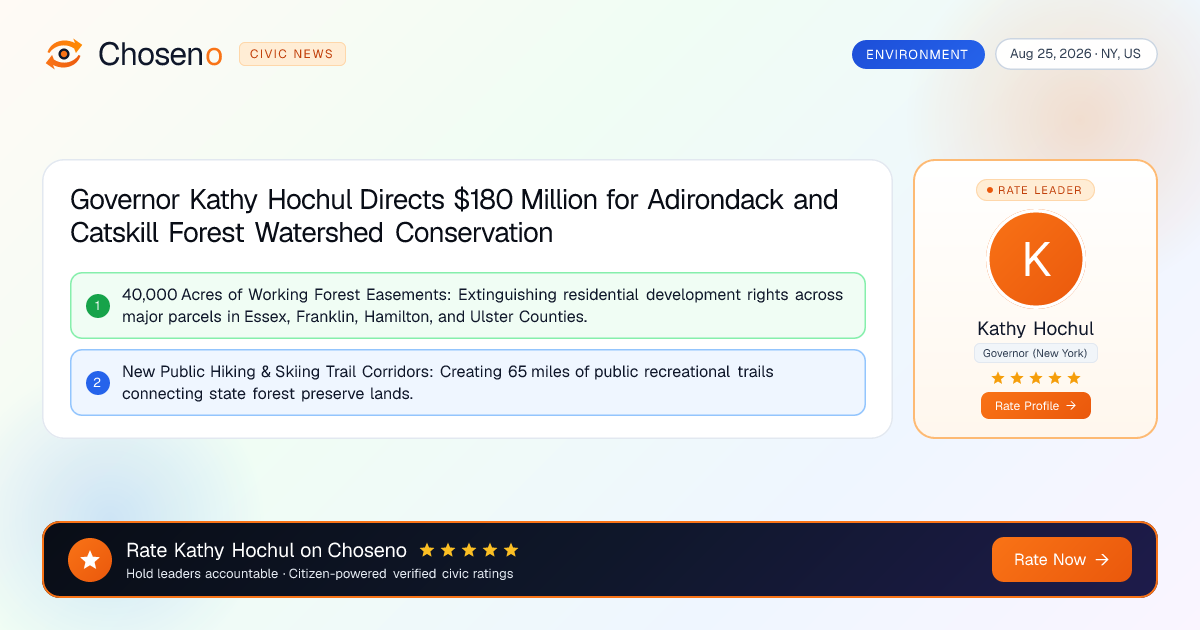
Governor Ron DeSantis Allocates $150 Million for St. Johns River Basin Filter Marshes and Water Quality
Florida Governor Ron DeSantis and DEP Secretary Shawn Hamilton award $150 million to construct 7,200 acres of flow-through treatment marshes and upgrade regional wastewater plants along the 310-mile St. Johns River.
Choseno Florida Desk August 25, 2026 2 min read FL, US
★ Choseno Civic Briefing
Key Leaders
JACKSONVILLE, Fla. — Governor Ron DeSantis and Florida Department of Environmental Protection (DEP) Secretary Shawn Hamilton announced on Monday the distribution of $150 million in state environmental restoration grants to construct 7,200 acres of regional flow-through wetland filtration marshes and upgrade municipal wastewater treatment facilities across the St. Johns River watershed.
The capital investments, managed in coordination with the St. Johns River Water Management District (SJRWMD), utilize native aquatic vegetation to capture agricultural and urban nutrient runoff before water enters Florida's longest river, mitigating harmful blue-green algal blooms and restoring submerged wild celery grass beds that sustain manatees and gamefish.
Restoring Florida's Most Iconic North-Flowing River System The 310-mile St. Johns River flows north through twelve Florida counties into the Atlantic Ocean at Jacksonville, supporting multi-billion-dollar commercial fisheries, recreational boating, and ecotourism. However, nutrient enrichment from legacy septic tanks and agricultural runoff has historically driven recurring summer algae blooms.
"The St. Johns River is an iconic Florida treasure, and our administration is dedicated to restoring its pristine water clarity from its headwaters in the Indian River marsh to its mouth in Jacksonville," Governor DeSantis said along the riverfront in Jacksonville. "This $150 million investment builds expansive engineered treatment wetlands that naturally filter out nitrogen and phosphorus, upgrades local wastewater treatment facilities, and ensures clean water for our manatees, fishermen, and future generations."
Watershed Allocations and Treatment Marsh Construction Key project awards include:
- Lower St. Johns River Wetland Treatment Complex (Duval/Clay): $55 million for a 3,500-acre marsh filtration system near Doctors Lake.
- Upper St. Johns River Basin Agricultural Retention Cells (Brevard/Indian River): $45 million to construct retention reservoirs capturing citrus and cattle runoff.
- Municipal Wastewater Advanced Denitrification Upgrades: $35 million in matching grants for municipal sewer utilities in Volusia, Seminole, and Putnam counties.
- Submerged Aquatic Vegetation Nursery Propagation: $15 million to propagate and plant 500,000 square feet of native tape grass beds.
Environmental advocacy federations, riverkeeper organizations, and marine tourism leaders commended the state investment, highlighting that watershed filter marshes provide natural, permanent water purification.
Rate the people mentioned in this article
Related Coverage in Environment
See all Environment newsEnvironment
US Aug 25, 2026
Governor Gavin Newsom Directs $310 Million for Central Valley Flood-Managed Aquifer Recharge
California Governor Gavin Newsom signs Assembly Bill 1920, appropriating $310 million to construct canal diversions, temporary settling basins, and agricultural on-farm flooding infrastructure to recharge 1.5 million acre-feet of groundwater.
Read full article

Environment
US Aug 25, 2026
EPA Directs $290 Million for Rural Municipal PFAS Water Filtration Systems Across 18 States
Environmental Protection Agency Administrator Michael Regan allocates $290 million from the Bipartisan Infrastructure Law to install granular activated carbon and ion-exchange filtration systems at 350 rural municipal drinking water plants.
Read full article
Environment
US Aug 25, 2026
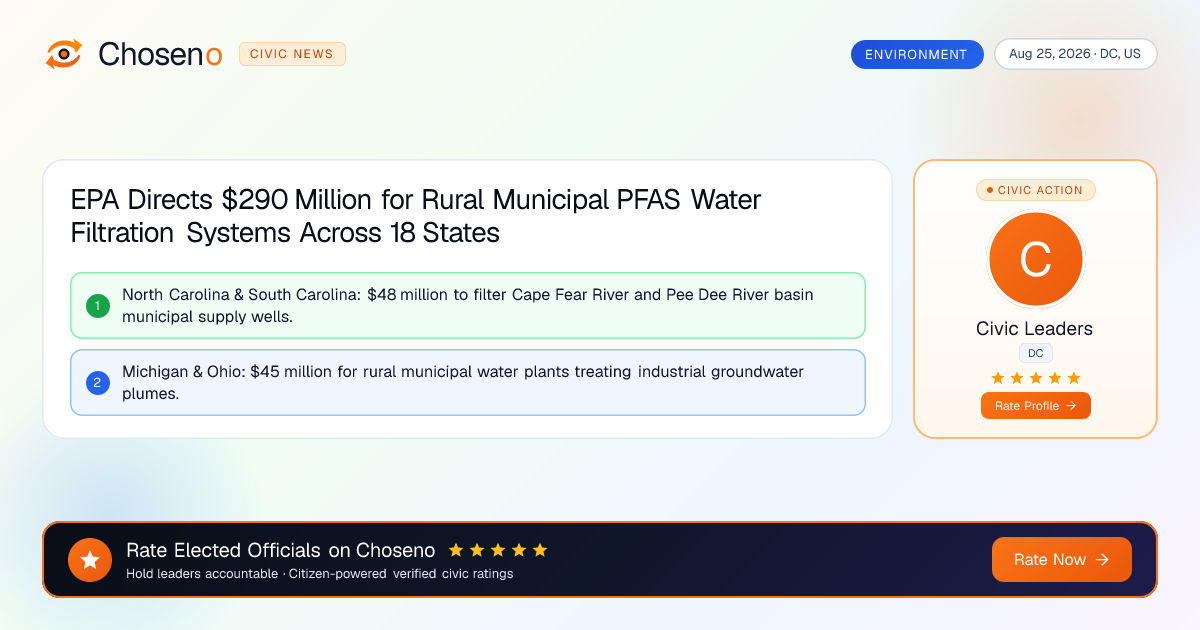
Governor Kathy Hochul Directs $180 Million for Adirondack and Catskill Forest Watershed Conservation
New York Governor Kathy Hochul announces $180 million in Environmental Protection Fund grants to acquire permanent conservation easements protecting 40,000 acres of working forest watersheds in the Adirondack and Catskill Parks.
Read full article