Four Regional Appointments Confirmed by Governor Sanders for Arkansas Boards and Commissions
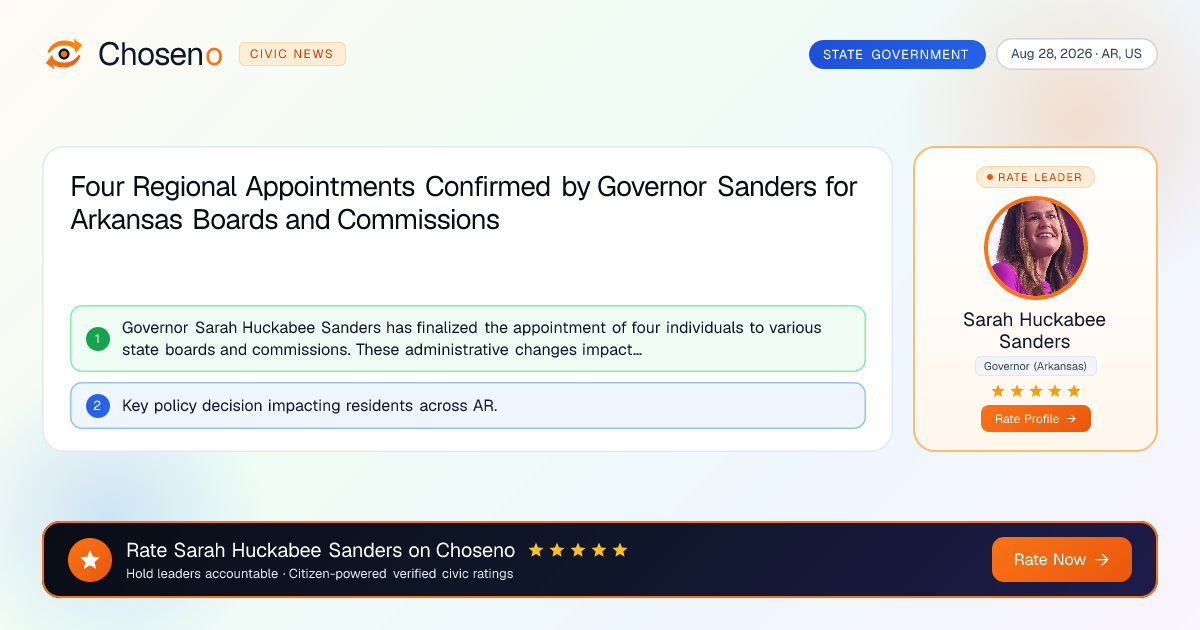
Governor Sarah Huckabee Sanders has finalized the appointment of four individuals to various state boards and commissions. These administrative changes impact the oversight of regional governance and public policy implementation.
Choseno Civic News Desk August 28, 2026 2 min read AR, US
Dateline Lead
LITTLE ROCK, AR — Governor Sarah Huckabee Sanders has officially announced the appointments of Browning, Sugg, House, and Hinchey to serve on various state boards and commissions. The announcement, reported by Arkansas Radio, confirms the administration's latest effort to fill vacancies within regional oversight bodies.
Policy & Taxpayer Impact
The appointments involve individuals selected from the region to oversee specific state functions. While the direct fiscal impact of these individual appointments is often limited to administrative stipends or travel reimbursements, the policy decisions made by these boards influence the allocation of state resources and the enforcement of regional regulations that affect taxpayer-funded services.
Political & Legal Stakes
These appointments are a standard exercise of executive authority granted to the Governor under Arkansas law. By selecting individuals from the region, the administration aims to ensure that local perspectives are represented in state-level decision-making. The legal validity of these appointments rests on the Governor's constitutional power to appoint members to boards and commissions, subject to any applicable legislative confirmation processes.
The Debate
Proponents of the Governor's appointments argue that these selections are essential for maintaining the functionality of state government and ensuring that regional interests are adequately addressed at the capital. Conversely, critics often scrutinize the appointment process for potential political patronage, questioning whether the selections are based on merit or political alignment. The debate centers on the balance between executive prerogative and the need for independent, expert oversight on state boards.
Public Accountability Context
Citizens seeking to understand the influence of these new appointees can review the specific mandates of the boards to which Browning, Sugg, House, and Hinchey have been assigned. As these individuals begin their terms, their voting records and policy stances will become matters of public record, providing a mechanism for constituents to evaluate the impact of the Governor's selections on regional governance.
Rate the people mentioned in this article

Related Coverage in State Government
See all State Government newsState Government
US Aug 28, 2026
Kentucky Secures Record-Breaking Settlement Agreement with Meta
Kentucky has reached a historic legal settlement with Meta, marking a significant resolution in ongoing litigation involving the technology giant. The agreement represents a major development in state-level oversight of digital platform operations.
Read full article
State Government
US Aug 28, 2026
Oklahoma Constitutional Convention Mandate Sparks Legal Dispute Over Authority
Fourteen states currently mandate periodic referendums on holding constitutional conventions to address governance structures. A specific disagreement has emerged in Oklahoma regarding which officials possess the legal authority to trigger these required votes.
Read full article