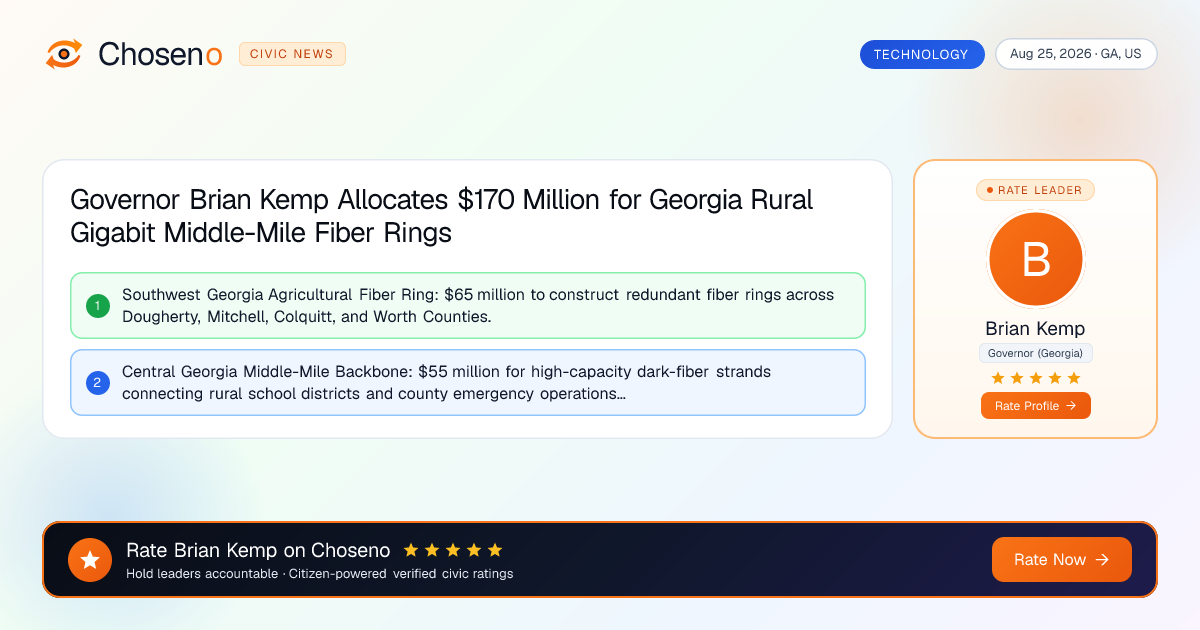
Governor Brian Kemp Allocates $170 Million for Georgia Rural Gigabit Middle-Mile Fiber Rings
Georgia Governor Brian Kemp and the Georgia Technology Authority announce $170 million in Capital Projects Fund grants to construct 3,800 miles of high-capacity middle-mile fiber rings connecting 50,000 unserved rural homes in South Georgia.
Choseno Atlanta Bureau August 25, 2026 2 min read GA, US
★ Choseno Civic Briefing
Key Leaders
ALBANY, Ga. — Governor Brian Kemp and Georgia Technology Authority (GTA) Executive Director Shawnzia Thomas announced on Monday the distribution of $170 million in state capital grants from the Capital Projects Fund to engineer and construct 3,800 miles of high-capacity middle-mile fiber-optic rings and last-mile residential drops across thirty rural counties in South and Middle Georgia.
The investment, matched by $115 million in private telecommunications provider capital, delivers symmetrical gigabit-speed fiber broadband to 50,000 previously unserved rural households, peanut and cotton farms, and rural community health clinics across the Black Belt and agricultural heartland.
Connecting Georgia Agriculture and Rural Healthcare to the Digital Economy High-speed fiber connectivity has become essential for GPS-guided precision tractors, remote practical soil moisture sensors, online public education, and specialized tele-stroke consults at rural hospitals.
"In Georgia, we believe that your zip code should not determine your opportunity to succeed," Governor Kemp said during an announcement at Albany State University. "For too long, rural Georgia communities were held back by slow, unreliable internet connections that made it difficult for small businesses to grow and students to do their homework. This $170 million investment builds thousands of miles of modern fiber-optic cable, connecting 50,000 rural homes and farms to high-speed internet, expanding economic development, and keeping Georgia the best place to live, work, and raise a family."
County-Level Fiber Ring Deployments The $170 million program finances:
- Southwest Georgia Agricultural Fiber Ring: $65 million to construct redundant fiber rings across Dougherty, Mitchell, Colquitt, and Worth Counties.
- Central Georgia Middle-Mile Backbone: $55 million for high-capacity dark-fiber strands connecting rural school districts and county emergency operations centers.
- Southeast Georgia Coastal Plain Last-Mile Drops: $50 million for underground fiber connections in Ware, Pierce, and Appling Counties.
County commissioners, rural hospital executives, and Georgia Farm Bureau directors praised the state investment, highlighting that robust middle-mile fiber backbones enable private internet providers to deliver affordable residential service in rural areas.
Rate the people mentioned in this article
Related Coverage in Technology
See all Technology newsTechnology
US Aug 25, 2026
Governor JB Pritzker Directs $110 Million for Chicago Quantum Foundries and Cryogenic Testing
Illinois Governor JB Pritzker announces $110 million in state capital grants through the Rebuild Illinois program to construct cryogenic testing facilities and specialized quantum qubit fabrication cleanrooms on Chicago's South Side.
Read full article

Technology
US Aug 25, 2026
Governor Greg Abbott Directs $260 Million for Texas Advanced Air Mobility and Commercial Vertiports
Texas Governor Greg Abbott and TxDOT announce $260 million to construct twenty-four electric vertical takeoff and landing (eVTOL) vertiports and deploy automated uncrewed traffic management (UTM) corridors across the Texas Triangle.
Read full article

Technology
US Aug 25, 2026
Mayor Matt Mahan Directs $40 Million for San Jose AI Smart Traffic Signals and Pedestrian Vision
San Jose Mayor Matt Mahan and the San Jose City Council authorize $40 million to install artificial-intelligence-enabled traffic signal controllers and automated pedestrian thermal sensors across 150 high-injury crash intersections.
Read full article