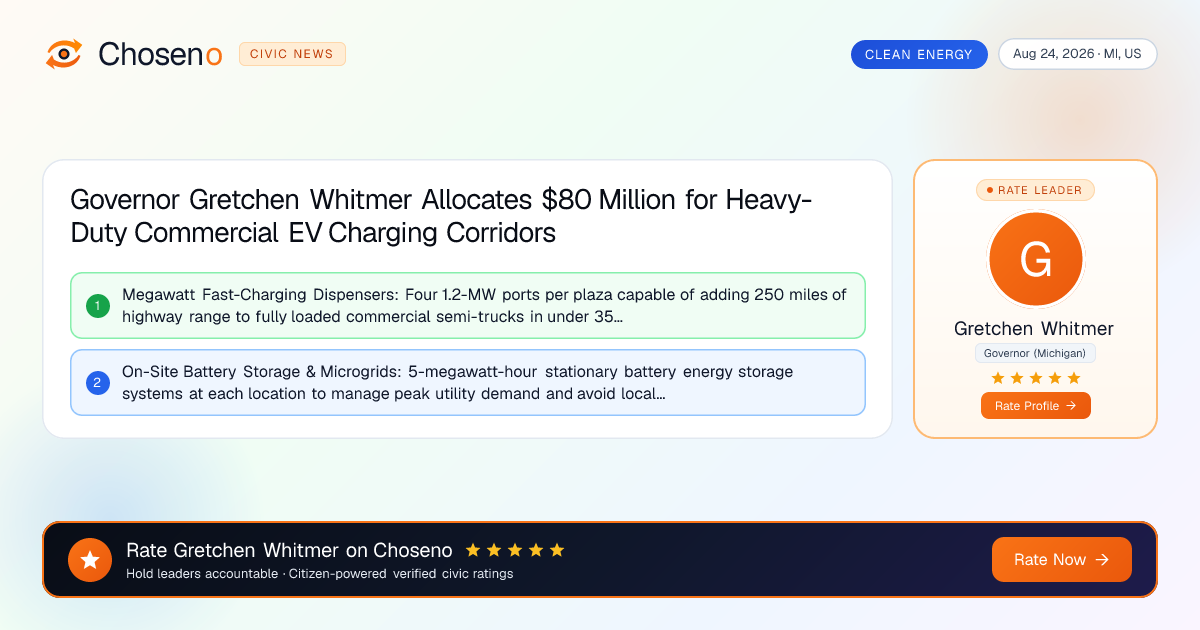
Governor Gretchen Whitmer Allocates $80 Million for Heavy-Duty Commercial EV Charging Corridors
Michigan Governor Gretchen Whitmer announces $80 million in Michigan Mobility Future grants to construct six heavy-duty electric commercial truck charging plazas along Interstate 94 and Interstate 75.
Choseno Detroit Bureau August 24, 2026 2 min read MI, US
★ Choseno Civic Briefing
Key Leaders
DETROIT — Governor Gretchen Whitmer announced on Monday the distribution of $80 million in state capital grants through the Michigan Mobility Future Program to engineer and construct six high-power commercial freight electric vehicle charging plazas along Interstate 94 and Interstate 75.
The high-capacity charging hubs, equipped with next-generation Megawatt Charging System (MCS) dispensers delivering up to 1.2 megawatts of power per port, are designed specifically to support heavy-duty Class 8 commercial electric semi-trucks transporting automotive components between Detroit, Lansing, Flint, and cross-border logistics hubs at the Ambassador Bridge and Gordie Howe International Bridge.
Electrifying the Core North American Automotive Supply Chain Interstate 94 carries more commercial freight value than any other highway corridor in North America, connecting thousands of automotive tier-one stamping plants, engine assembly facilities, and vehicle manufacturing complexes across the Great Lakes.
"Michigan put the world on wheels, and we are leading the transition to the next generation of clean, electric transportation," Governor Whitmer said at the Michigan Central Station mobility innovation hub in Detroit. "Commercial freight trucks account for a massive share of highway diesel emissions. This $80 million investment builds the heavy-duty fast-charging infrastructure our trucking companies and automotive suppliers need to transition their commercial fleets to electric, protecting clean air in our neighborhoods while strengthening our automotive leadership."
Charging Plaza Features and Fleet Electrification The six commercial truck charging centers will feature:
- Megawatt Fast-Charging Dispensers: Four 1.2-MW ports per plaza capable of adding 250 miles of highway range to fully loaded commercial semi-trucks in under 35 minutes.
- On-Site Battery Storage & Microgrids: 5-megawatt-hour stationary battery energy storage systems at each location to manage peak utility demand and avoid local grid strain.
- Pull-Through Truck Stalls: Hardened concrete lanes accommodating 53-foot commercial semi-trailers without requiring uncoupling.
Automotive manufacturing executives, commercial freight carriers, and building trades union representatives commended the investment, noting that high-capacity charging corridors make commercial fleet electrification economically viable.
Rate the people mentioned in this article
Related Coverage in Clean Energy
See all Clean Energy newsClean Energy
US Aug 25, 2026
Governor Gavin Newsom Signs Port Infrastructure Act to Build West Coast Offshore Wind Megahub
California Governor Gavin Newsom and Senate President Pro Tem Mike McGuire enact Senate Bill 1285, appropriating $275 million to construct a heavy-lift deepwater offshore wind assembly terminal at Humboldt Bay.
Read full article

Clean Energy
CA Aug 25, 2026
Natural Resources Minister Jonathan Wilkinson Allocates $275 Million for Sustainable Aviation Fuel Plants
Natural Resources Minister Jonathan Wilkinson awards $275 million from the Clean Fuels Fund to construct three commercial-scale Sustainable Aviation Fuel (SAF) biorefineries utilizing agricultural canola oil and forestry residues in Alberta and Ontario.
Read full article

Clean Energy
CA Aug 24, 2026
Premier David Eby Allocates $150 Million to Electrify BC Coastal Ferry Terminals and Island Vessels
British Columbia Premier David Eby and Transportation Minister Rob Fleming announce $150 million to install 10-megawatt rapid charging systems at five major BC Ferries terminals, enabling zero-emission hybrid-electric ferry sailings.
Read full article