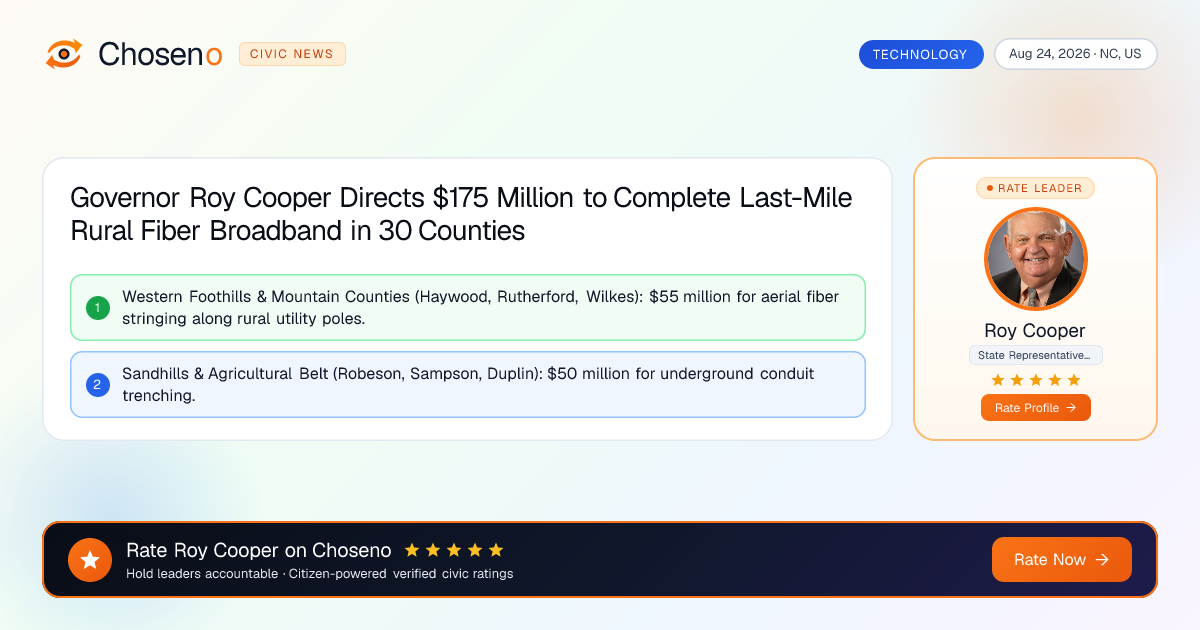
Governor Roy Cooper Directs $175 Million to Complete Last-Mile Rural Fiber Broadband in 30 Counties
North Carolina Governor Roy Cooper and the NC Department of Information Technology award $175 million in GREAT and CAB grants to connect 68,000 unserved rural households and agricultural operations to gigabit fiber optic broadband.
Choseno Raleigh Bureau August 24, 2026 2 min read NC, US
★ Choseno Civic Briefing
Key Leaders
RALEIGH, N.C. — Governor Roy Cooper and the North Carolina Department of Information Technology (NCDIT) announced on Monday the distribution of $175 million in state and federal digital infrastructure grants through the Growing Rural Economies with Access to Technology (GREAT) and Completing Access to Broadband (CAB) programs to deploy last-mile fiber optic high-speed internet to 68,000 unserved rural homes, farms, and small businesses across thirty counties.
The project, matched by $140 million in private co-investment from regional telecom cooperatives and fiber providers, ensures that rural residents in the Appalachian foothills, the Piedmont agricultural belt, and the Coastal Plain gain access to symmetrical gigabit broadband connections.
Closing the Digital Divide for Rural Students and Small Businesses Historically, low-density rural counties faced prohibitive capital expenditure costs for fiber trenching, leaving tens of thousands of rural North Carolinians reliant on slow satellite or spotty mobile connections.
"High-speed internet is no longer a luxury—it is as essential as electricity and clean running water for modern life, education, and healthcare," Governor Roy Cooper said in Wilson. "Every child in North Carolina deserves the ability to complete homework at home without sitting in a fast-food parking lot, and every rural entrepreneur deserves access to global markets. This $175 million investment closes the digital divide for 68,000 rural families, expanding telehealth access and creating economic prosperity across our state."
County Deployments and Fiber Infrastructure Key grant allocations include:
- Western Foothills & Mountain Counties (Haywood, Rutherford, Wilkes): $55 million for aerial fiber stringing along rural utility poles.
- Sandhills & Agricultural Belt (Robeson, Sampson, Duplin): $50 million for underground conduit trenching.
- Coastal Plain & Outer Banks (Beaufort, Pamlico, Hyde): $40 million for flood-hardened fiber connections.
- Digital Literacy & Telehealth Subsidies: $30 million dedicated for local community colleges to provide digital skills training and discounted devices for low-income seniors.
Rural county commissioners, school superintendents, and agricultural commodity groups applauded the awards, emphasizing that high-speed fiber transforms precision agriculture and rural education.
Rate the people mentioned in this article

Related Coverage in Technology
See all Technology newsTechnology
US Aug 24, 2026
CISA Enacts Binding Cybersecurity Directive Mandating Post-Quantum Encryption Across Federal Networks
Cybersecurity and Infrastructure Security Agency Director Jen Easterly issues Binding Operational Directive 26-02, requiring federal civilian executive agencies to transition public key infrastructure to post-quantum cryptographic algorithms.
Read full article
Technology
US Aug 24, 2026
Governor Greg Abbott Enacts Mandatory Cybersecurity Standards for Texas Municipal Water Utilities
Texas Governor Greg Abbott signs Senate Bill 940, establishing the Texas Water Infrastructure Cyber Defense Command and directing $90 million to install automated operational technology (OT) firewalls across 450 public water utilities.
Read full article

Technology
US Aug 24, 2026
FAA Finalizes Part 108 Rules Unlocking Commercial Beyond-Visual-Line-of-Sight Drone Delivery
Federal Aviation Administration Administrator Mike Whitaker issues the long-awaited Part 108 regulatory framework, authorizing commercial beyond-visual-line-of-sight (BVLOS) uncrewed cargo delivery and autonomous flight corridors.
Read full article