Governor Walz Makes Final Appearance at Minnesota State Fair
Governor Tim Walz attended the Minnesota State Fair for the final time during his current gubernatorial term. The appearance marks a concluding chapter in his administration's engagement with the annual state event.
Choseno Civic News Desk August 28, 2026 1 min read MN, US
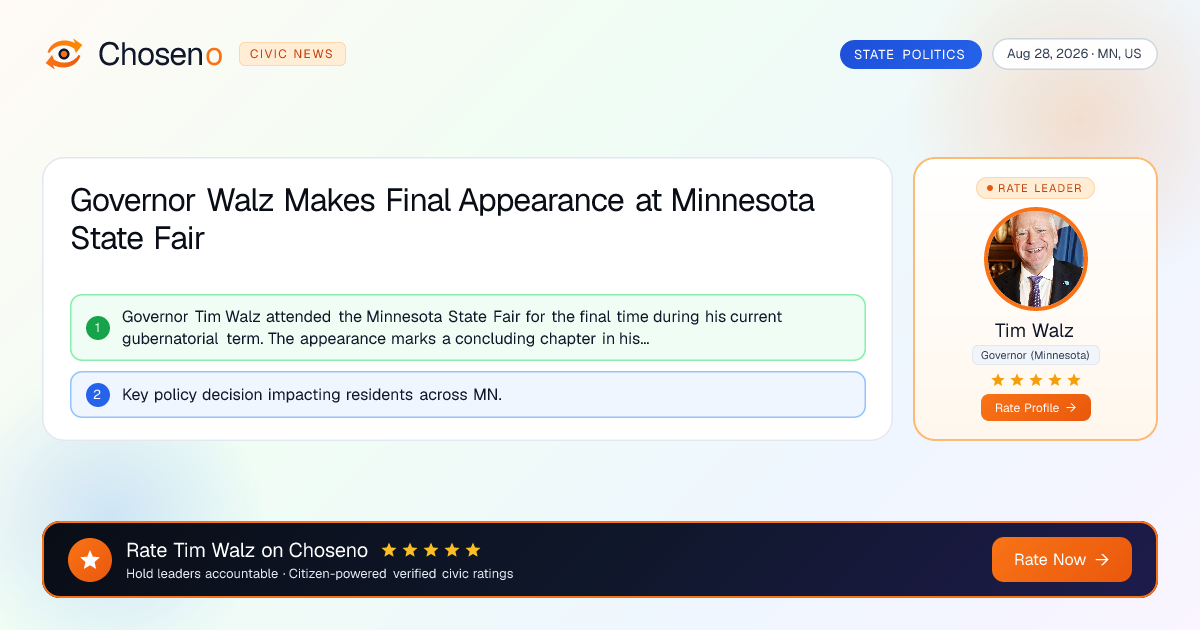
Governor Tim Walz participated in the Minnesota State Fair this week, marking his final attendance at the event in his current capacity as governor. The annual gathering, which serves as a significant venue for state officials to engage with constituents, saw the governor making his concluding rounds as the head of the state executive branch.
According to reporting by Willmar Radio, the appearance serves as a symbolic milestone for the administration as the governor nears the end of his term. The State Fair has historically functioned as a primary platform for Minnesota politicians to interact with the public, discuss policy initiatives, and participate in traditional fair activities. While the governor's presence at the fair is a routine aspect of the office, this specific visit carries additional weight due to the timing of his departure from the role.
No specific policy announcements or fiscal changes were tied to this appearance, as the visit focused on the ceremonial and community-engagement aspects of the gubernatorial office. The governor's participation concludes a multi-year cycle of engagement with the fairgrounds, which host hundreds of thousands of residents annually. As the administration prepares for the transition of power, such public appearances serve to bookend the governor's tenure in the eyes of the public.
Rate the people mentioned in this article

Related Coverage in State Politics
See all State Politics newsState Politics
US Aug 28, 2026
Data Center Expansion Becomes Central Policy Dispute in Oregon Gubernatorial Race
The rapid growth of data center infrastructure has become a primary point of contention between gubernatorial candidates Tina Kotek and Christine Drazan. The debate centers on balancing the economic benefits of tech investment against the strain on local power grids and water resources.
Read full article
State Politics
US Aug 28, 2026
Cook Political Report Shifts Florida Gubernatorial Race Outlook
The Cook Political Report has updated its electoral assessment for the Florida gubernatorial race, signaling a shift in favor of Democratic candidates. This adjustment reflects evolving polling data and campaign momentum that could influence future state-level policy priorities.
Read full article
State Politics
US Aug 28, 2026
Flock Camera Deployment Becomes Central Point of Contention in Texas Gubernatorial Campaign
The integration of Flock automated license plate recognition technology has transitioned into a significant policy debate within the Texas governor's race. The discourse centers on the balance between enhanced law enforcement surveillance capabilities and the preservation of individual privacy rights.
Read full article