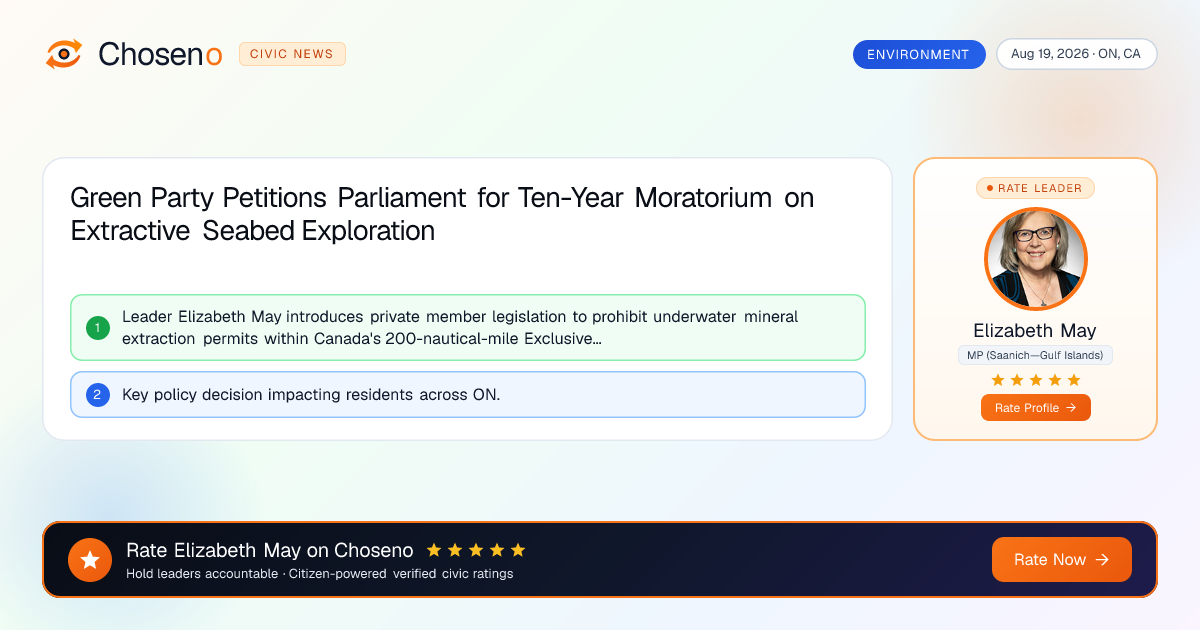
Green Party Petitions Parliament for Ten-Year Moratorium on Extractive Seabed Exploration
Leader Elizabeth May introduces private member legislation to prohibit underwater mineral extraction permits within Canada's 200-nautical-mile Exclusive Economic Zone.
Choseno Parliamentary Bureau August 19, 2026 1 min read ON, CA
★ Choseno Civic Briefing
OTTAWA, ON — Green Party Leader Elizabeth May filed private member's legislation on Parliament Hill Wednesday seeking a binding ten-year national moratorium on deep seabed mineral exploration and commercial mining activities within Canada's Exclusive Economic Zone.
Statutory Framework and Marine Conservation
The proposed Seabed Conservation and Marine Precaution Act would prohibit federal departments, including Fisheries and Oceans Canada and Natural Resources Canada, from issuing permits for polymetallic nodule extraction, hydrothermal vent prospecting, or subsea dredging along Pacific and Arctic continental shelves.
May cited extensive oceanographic research warning that deep-sea mining risks causing irreversible damage to benthic ecosystems, disrupting marine carbon sequestration cycles, and endangering vulnerable cold-water coral reefs.
International Treaty Context and Parliamentary Support
The legislative petition coincides with ongoing International Seabed Authority negotiations in Jamaica. May urged the federal government to join an international coalition of 27 nations, including the United Kingdom, France, and Germany, advocating for a precautionary pause on global seabed extraction.
Members from the NDP and Liberal environmental caucuses signaled openness to supporting committee study of the bill when Parliament reconvenes in mid-September.
Next Steps on Parliament Hill
The legislation will be scheduled for second-reading debate during designated private members' business hours in the House of Commons this autumn.
Sources
Rate the people mentioned in this article

Related Coverage in Environment
See all Environment newsEnvironment
US Aug 19, 2026
Florida Water Officials Finalize $210M Construction Contracts for Everglades Stormwater Treatment Basin
The South Florida Water Management District awards engineering bids for a 6,500-acre stormwater treatment wetland south of Lake Okeechobee.
Read full article
Environment
US Aug 19, 2026
Pennsylvania Regulators Levy $12.4M Civil Penalty on Natural Gas Operators for Watershed Violations
The Pennsylvania Department of Environmental Protection penalizes three midstream energy firms for unpermitted wetland discharges across Susquehanna County.
Read full article
Environment
US Aug 19, 2026
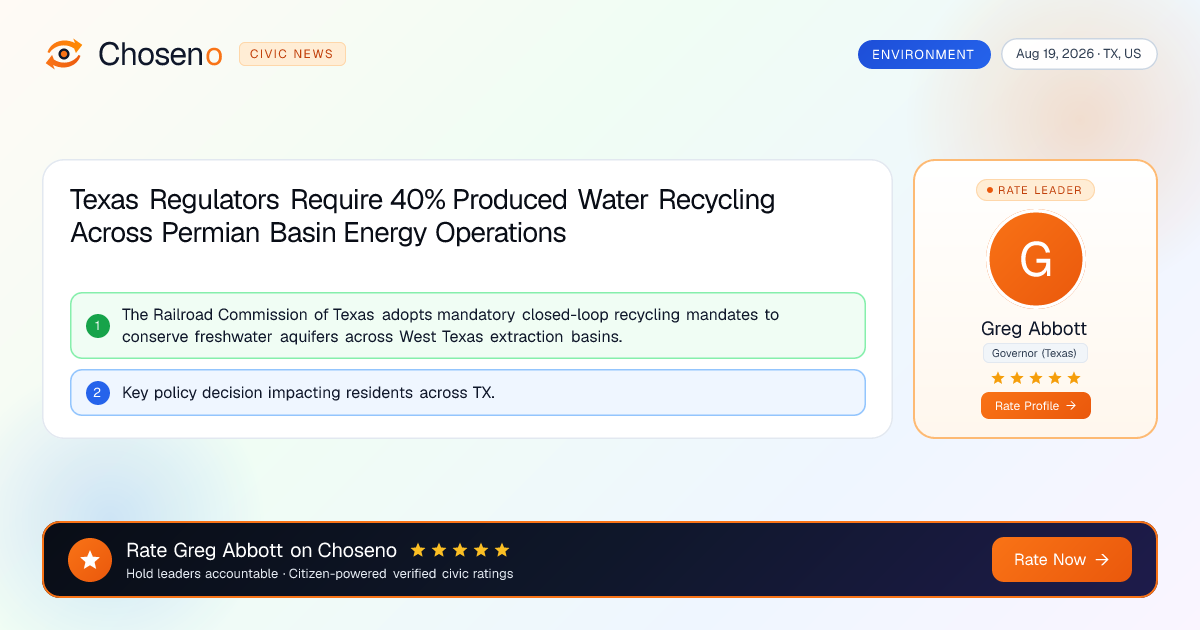
Texas Regulators Require 40% Produced Water Recycling Across Permian Basin Energy Operations
The Railroad Commission of Texas adopts mandatory closed-loop recycling mandates to conserve freshwater aquifers across West Texas extraction basins.
Read full article