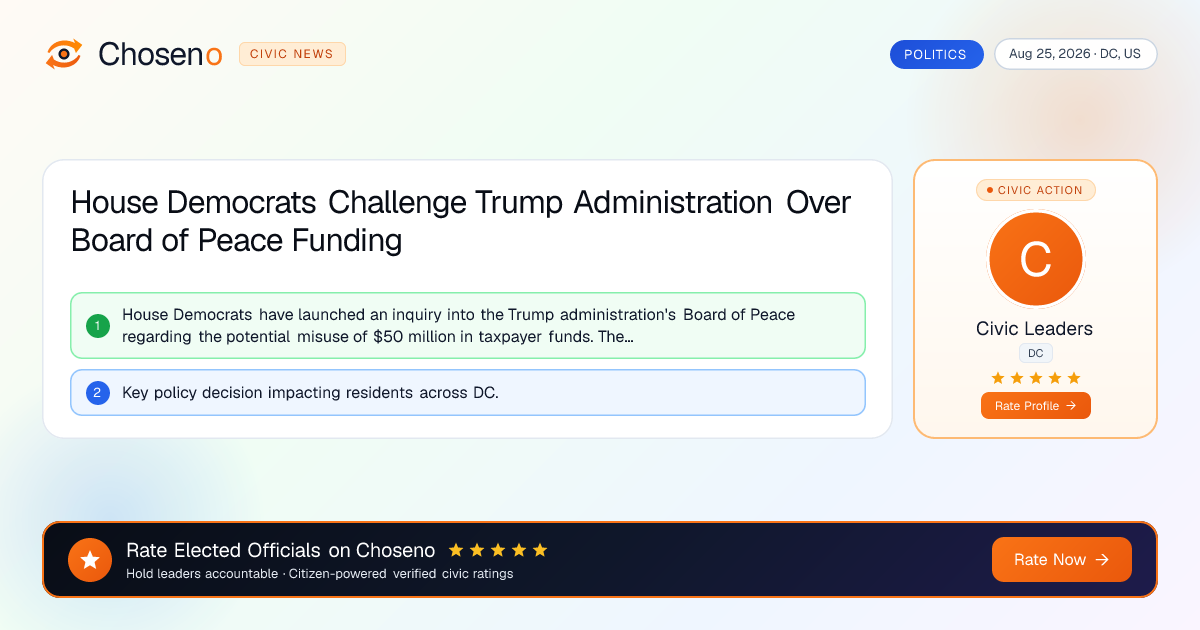
House Democrats Challenge Trump Administration Over Board of Peace Funding
House Democrats have launched an inquiry into the Trump administration's Board of Peace regarding the potential misuse of $50 million in taxpayer funds. The investigation focuses on allegations that the board may be operating as a slush fund with plans to profit from Gaza Strip reconstruction efforts.
Choseno Civic News Desk August 25, 2026 2 min read DC, US
★ Choseno Civic Briefing
Key Leaders
Dateline: Washington, D.C.
House Democrats have initiated a formal inquiry into the Trump administration’s Board of Peace, citing concerns over the management of federal resources. The investigation follows reports that the administration was compelled to suspend a $50 million transfer to the board amid mounting questions regarding its financial operations.
Policy & Taxpayer Impact
At the center of the controversy is the allocation of $50 million in American tax dollars. According to reporting by The Hill Politics, lawmakers are seeking to determine if these funds are being utilized as a slush fund. The inquiry specifically examines the board's involvement in potential reconstruction projects in the Gaza Strip and whether these initiatives are designed to generate profit for members of the administration's inner circle.
Political & Legal Stakes
This oversight effort places significant pressure on the administration to justify its international development strategies. By targeting the Board of Peace, Democratic lawmakers are attempting to establish a link between executive policy decisions and private financial gain. The suspension of the $50 million transfer indicates that the administration is currently facing internal or external hurdles in executing its planned funding disbursements.
The Debate: Proponent vs. Critic
Critics of the administration argue that the Board of Peace lacks the necessary transparency and ethical safeguards to manage large-scale international reconstruction funds. They contend that the potential for conflicts of interest is high, particularly regarding the Gaza Strip. Conversely, proponents of the administration’s approach typically argue that such boards are essential for executing rapid, high-level diplomatic and humanitarian objectives that traditional bureaucratic channels may be too slow to address.
Public Accountability Context
As the investigation continues, the focus remains on Senator Marco Rubio and other key officials who may have oversight responsibilities. The public demand for accountability centers on whether federal funds are being directed toward legitimate humanitarian goals or if they are being diverted for the benefit of private interests. Further congressional hearings are expected as lawmakers continue to press for documentation regarding the board's financial activities.
Related Coverage in Politics
See all Politics newsPolitics
US Aug 25, 2026
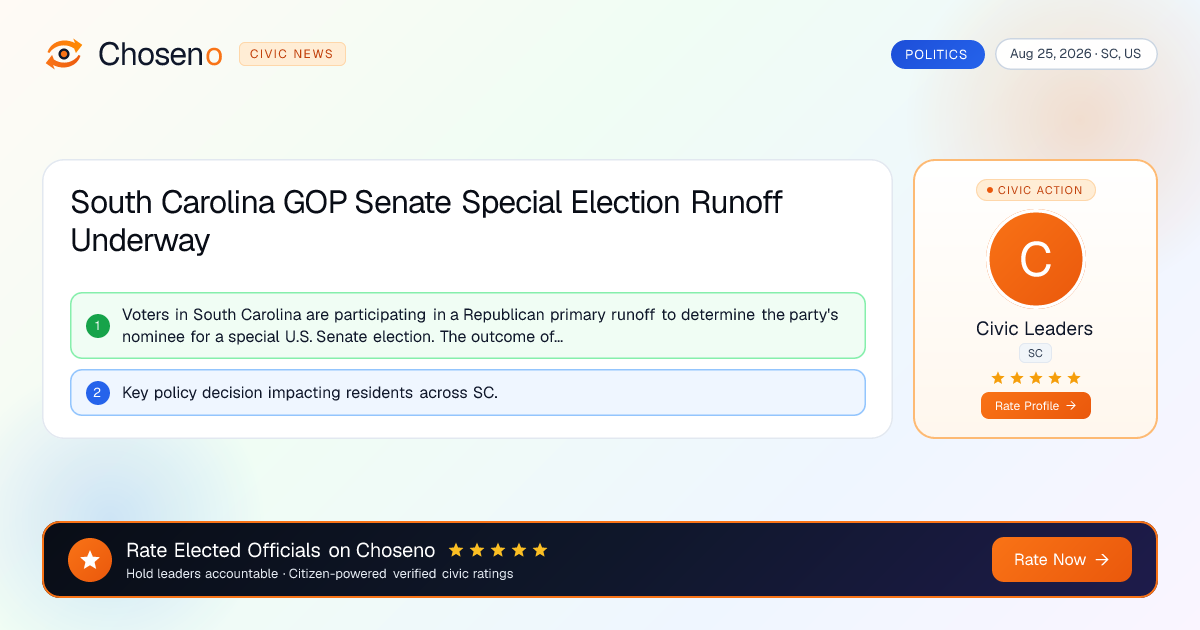
South Carolina GOP Senate Special Election Runoff Underway
Voters in South Carolina are participating in a Republican primary runoff to determine the party's nominee for a special U.S. Senate election. The outcome of this contest will influence the composition of the federal legislature and carries implications for state-level political representation.
Read full article
Politics
US Aug 25, 2026
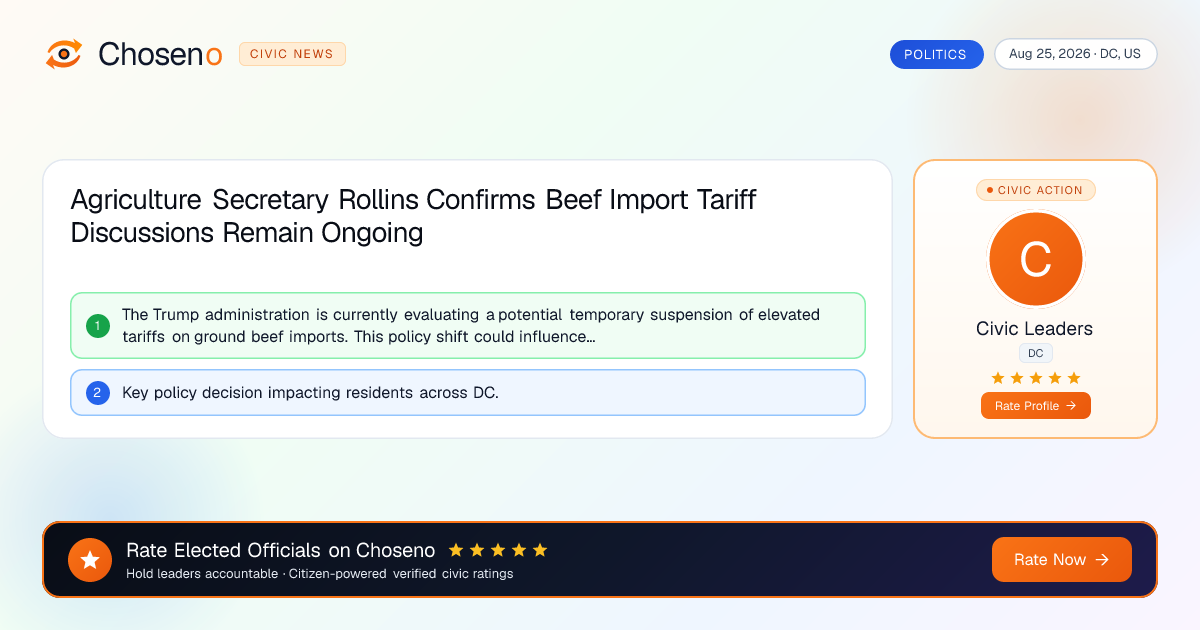
Agriculture Secretary Rollins Confirms Beef Import Tariff Discussions Remain Ongoing
The Trump administration is currently evaluating a potential temporary suspension of elevated tariffs on ground beef imports. This policy shift could influence domestic food pricing and trade relations, though specific details remain under internal review.
Read full article
Politics
US Aug 25, 2026
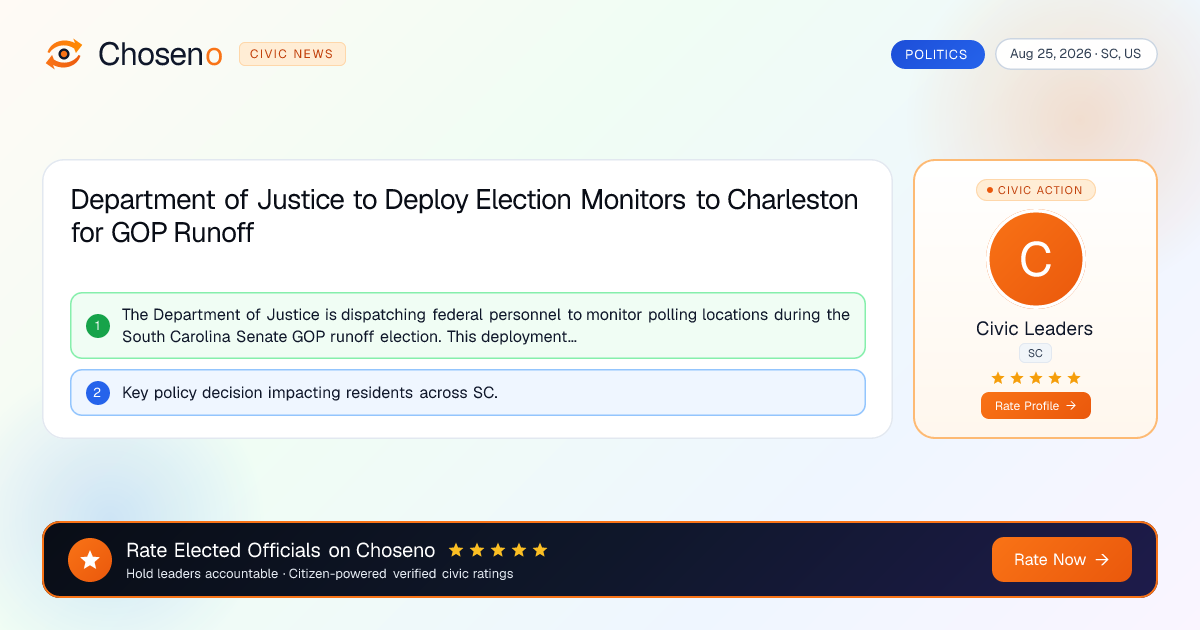
Department of Justice to Deploy Election Monitors to Charleston for GOP Runoff
The Department of Justice is dispatching federal personnel to monitor polling locations during the South Carolina Senate GOP runoff election. This deployment utilizes federal resources to oversee compliance with federal voting rights laws during the state-level contest.
Read full article