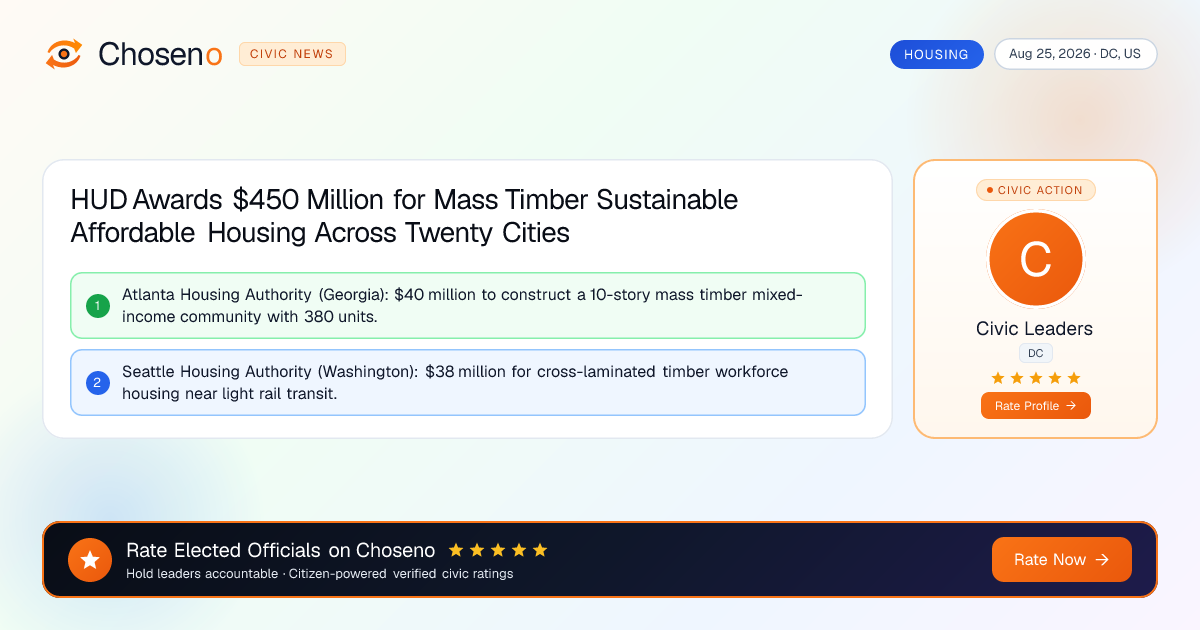
HUD Awards $450 Million for Mass Timber Sustainable Affordable Housing Across Twenty Cities
Acting HUD Secretary Adrianne Todman announces $450 million in Green and Resilient Retrofit Program grants to construct multi-family affordable housing utilizing carbon-sequestering mass timber and cross-laminated timber across twenty cities.
Choseno Urban Housing Bureau August 25, 2026 2 min read DC, US
★ Choseno Civic Briefing
Key Leaders
WASHINGTON — Acting Secretary of Housing and Urban Development (HUD) Adrianne Todman announced on Monday the distribution of $450 million in capital development grants from the Green and Resilient Retrofit Program (GRRP) to finance the engineering and construction of more than 6,000 energy-efficient, multi-family affordable housing units utilizing advanced Mass Timber and Cross-Laminated Timber (CLT) framing across twenty metropolitan housing authorities.
The initiative, delivered in partnership with the U.S. Forest Service, supports the construction of 6- to 12-story residential apartment buildings that replace carbon-intensive steel and concrete with sustainably harvested, fire-rated domestic mass timber panels.
Scaling Affordable Housing While Decarbonizing the Built Environment Traditional concrete and steel building construction accounts for nearly 15 percent of global greenhouse gas emissions. Mass timber structures sequester atmospheric carbon within timber panels, provide superior acoustic insulation, and reduce on-site construction timelines by up to 35 percent through factory-manufactured modular prefabrication.
"America is facing an affordable housing shortage and a climate challenge, and mass timber allows us to address both simultaneously," Acting HUD Secretary Adrianne Todman said during an announcement in Atlanta. "These $450 million investments will construct thousands of beautiful, healthy, and climate-resilient affordable homes for working families, while creating sustainable manufacturing jobs in our domestic forestry and timber communities."
Selected Municipal Housing Authorities Funded Major grant allocations include:
- Atlanta Housing Authority (Georgia): $40 million to construct a 10-story mass timber mixed-income community with 380 units.
- Seattle Housing Authority (Washington): $38 million for cross-laminated timber workforce housing near light rail transit.
- Minneapolis Public Housing Authority (Minnesota): $35 million for energy-efficient timber passive-house apartments.
- Philadelphia Housing Authority (Pennsylvania): $32 million for modular timber walk-up townhomes in North Philadelphia.
- Sixteen additional housing authorities in California, Colorado, Illinois, New York, and Oregon receiving between $15 million and $28 million.
Architects, structural engineers, and affordable housing developers commended HUD's targeted funding, highlighting that prefabricated timber panels significantly compress construction schedules and lower operational utility costs for low-income tenants.
Related Coverage in Housing
See all Housing newsHousing
US Aug 25, 2026
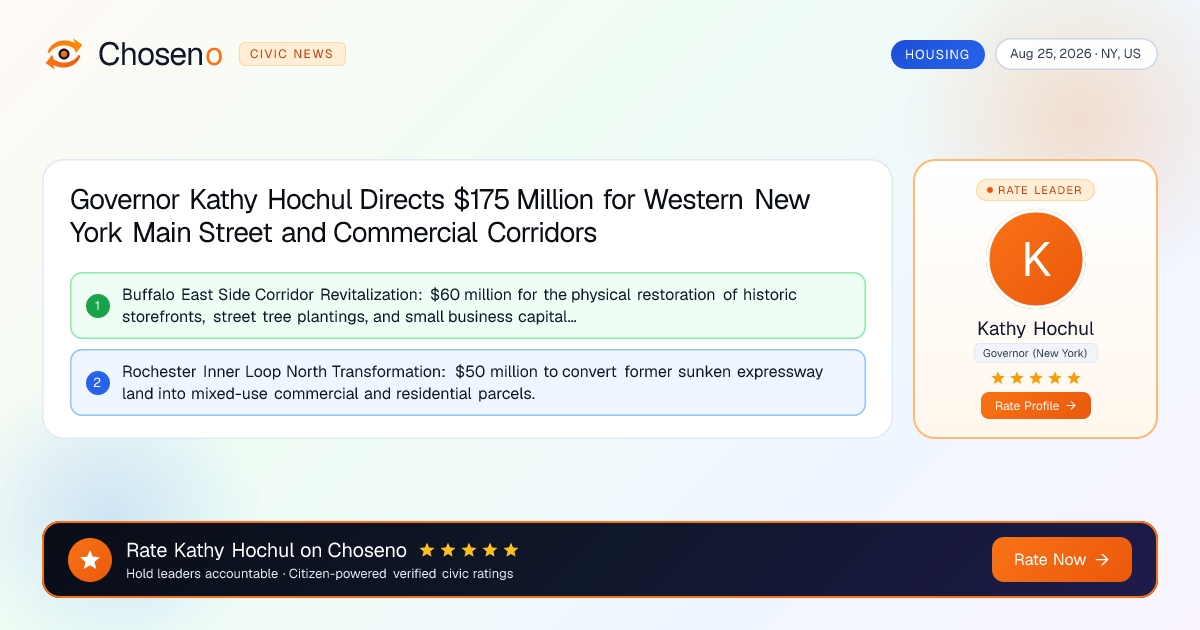
Governor Kathy Hochul Directs $175 Million for Western New York Main Street and Commercial Corridors
New York Governor Kathy Hochul announces $175 million in Western New York Downtown Revitalization grants to restore historic commercial storefronts, construct mixed-income housing, and build public pedestrian plazas in Buffalo and Rochester.
Read full article
Housing
CA Aug 25, 2026
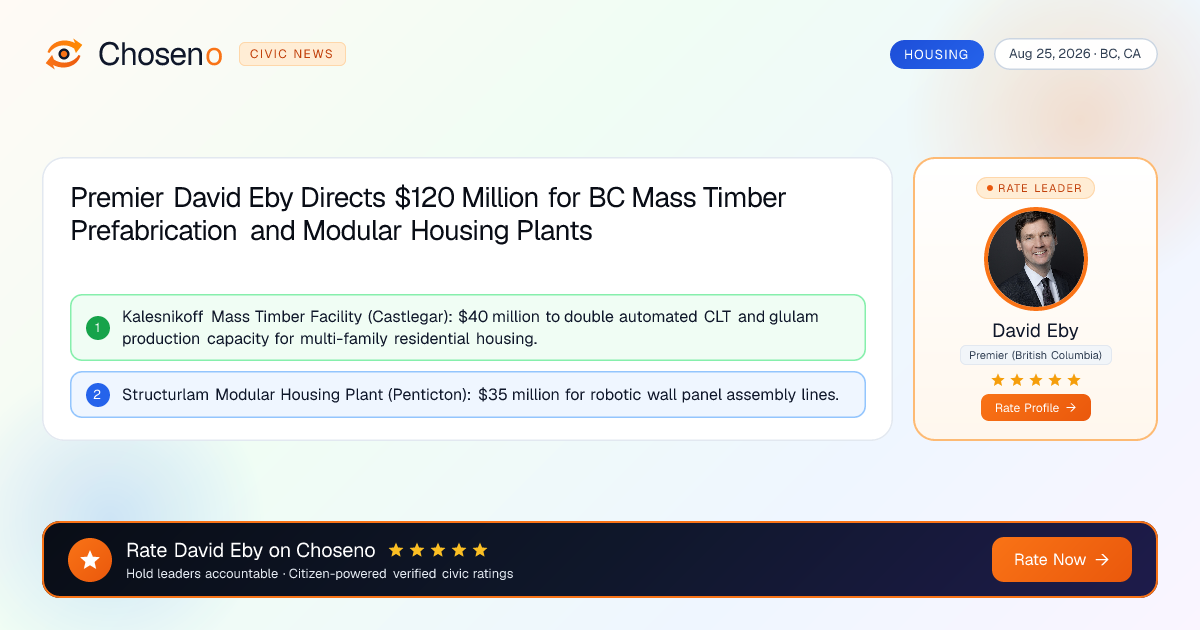
Premier David Eby Directs $120 Million for BC Mass Timber Prefabrication and Modular Housing Plants
British Columbia Premier David Eby and Jobs Minister Brenda Bailey allocate $120 million from the BC Manufacturing Jobs Fund to expand four commercial mass timber prefabrication and cross-laminated timber manufacturing factories in BC.
Read full article
Housing
US Aug 25, 2026
Mayor Matt Mahan Directs $50 Million for Fast-Build Modular Interim Housing Across San Jose
San Jose Mayor Matt Mahan and the San Jose City Council pass an emergency ordinance authorizing $50 million from Measure E to construct 800 prefabricated modular interim housing suites on city and state land.
Read full article