Industry Minister François-Philippe Champagne Directs $320 Million for Canadian AI Safety Institute and Supercomputing Compute
Innovation Minister François-Philippe Champagne announces $320 million from the AI Compute Access Fund to finance sovereign high-performance AI supercomputers and establish the Canadian Artificial Intelligence Safety Institute in Montreal and Toronto.
Choseno National Tech Bureau August 25, 2026 2 min read ON, CA

★ Choseno Civic Briefing
Key Leaders
MONTREAL — Minister of Innovation, Science and Industry François-Philippe Champagne announced on Monday the distribution of $320 million in federal investments through the Pan-Canadian Artificial Intelligence Strategy to deploy sovereign, high-performance GPU supercomputing clusters and formally launch the Canadian Artificial Intelligence Safety Institute (CAISI) with research hubs in Montreal and Toronto.
The investment, delivered in partnership with Mila (Quebec AI Institute), the Vector Institute, and Amii, provides Canadian AI researchers, startups, and academic institutions with subsidized access to cutting-edge sovereign supercomputing power, while CAISI conducts independent evaluations of frontier generative models for cybersecurity, algorithmic bias, and biosecurity risks.
Ensuring Sovereign Compute and Responsible AI Governance Access to advanced high-performance AI compute has become the decisive bottleneck for commercial startups and scientific researchers, who previously faced prohibitive commercial cloud costs and foreign compute dependencies.
"Canada was the birthplace of modern deep learning, and we are ensuring our nation remains at the absolute forefront of artificial intelligence innovation and responsible governance," Minister François-Philippe Champagne said at Mila in Montreal. "By investing $320 million into sovereign high-performance supercomputing clusters and launching the Canadian AI Safety Institute, we are providing our brilliant researchers and startups with the compute power they need to build world-changing technologies, while setting the global benchmark for safe, ethical, and trustworthy AI."
Sovereign Compute and Safety Research Allocations The $320 million package funds:
- Sovereign Canadian AI Compute Cloud: $220 million to procure and install 10,000 high-performance tensor-core GPUs at dedicated clean-hydroelectric data centers in Quebec and Ontario.
- Canadian AI Safety Institute Research Grants: $70 million for independent frontier AI model safety evaluations, red-teaming, and watermarking standardizations.
- Commercial AI Startup Compute Credits: $30 million providing non-dilutive compute grants for Canadian life sciences, clean tech, and advanced manufacturing startups.
AI research scientists, tech venture founders, and university presidents commended the federal funding, emphasizing that domestic sovereign compute keeps Canadian artificial intelligence intellectual property and talent in Canada.
Rate the people mentioned in this article

Related Coverage in Technology
See all Technology newsTechnology
US Aug 25, 2026
Governor Greg Abbott Directs $310 Million for Texas AI Semiconductor Packaging Cleanrooms
Texas Governor Greg Abbott and the Texas CHIPS Act Executive Committee allocate $310 million from the Texas Semiconductor Innovation Fund to construct advanced 2.5D/3D packaging cleanrooms and silicon photonics labs in Austin and Dallas.
Read full article

Technology
US Aug 25, 2026
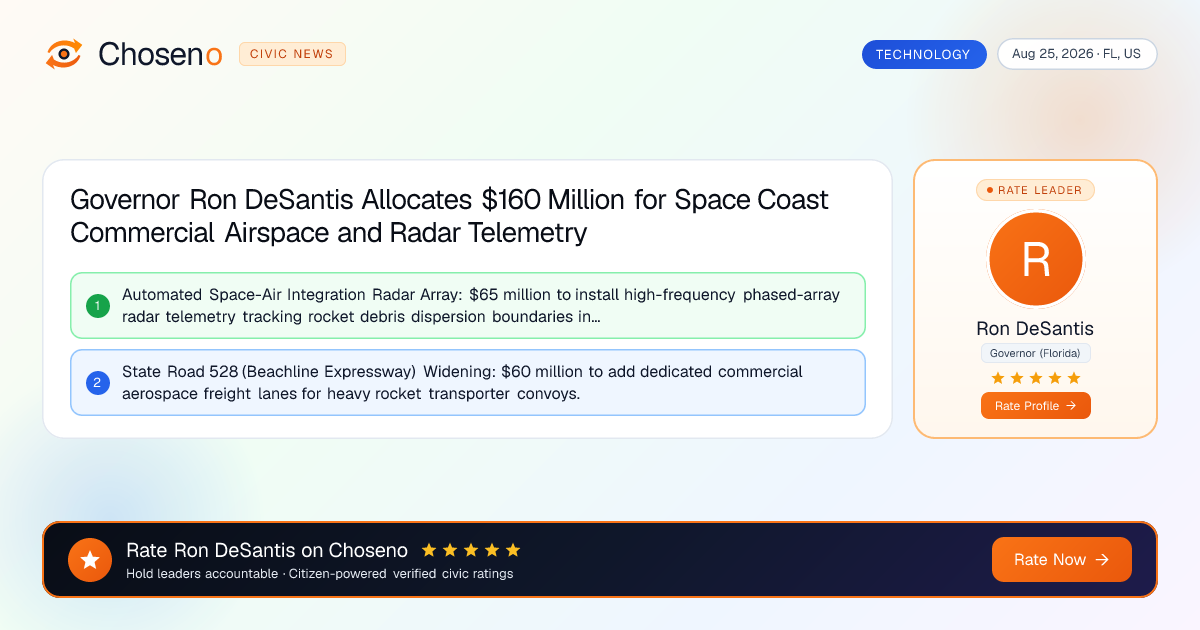
Governor Ron DeSantis Allocates $160 Million for Space Coast Commercial Airspace and Radar Telemetry
Florida Governor Ron DeSantis and FDOT announce $160 million to deploy automated Space-Air Integration radar networks and widen state aerospace transit highways connecting Orlando and Cape Canaveral.
Read full article
Technology
US Aug 25, 2026
Governor Josh Shapiro Directs $90 Million for Northern Tier Rural Gigabit Broadband Expansion
Pennsylvania Governor Josh Shapiro and the Pennsylvania Broadband Development Authority announce $90 million in capital grants to construct 2,200 miles of fiber-optic broadband across Bradford, Tioga, Potter, and Susquehanna Counties.
Read full article