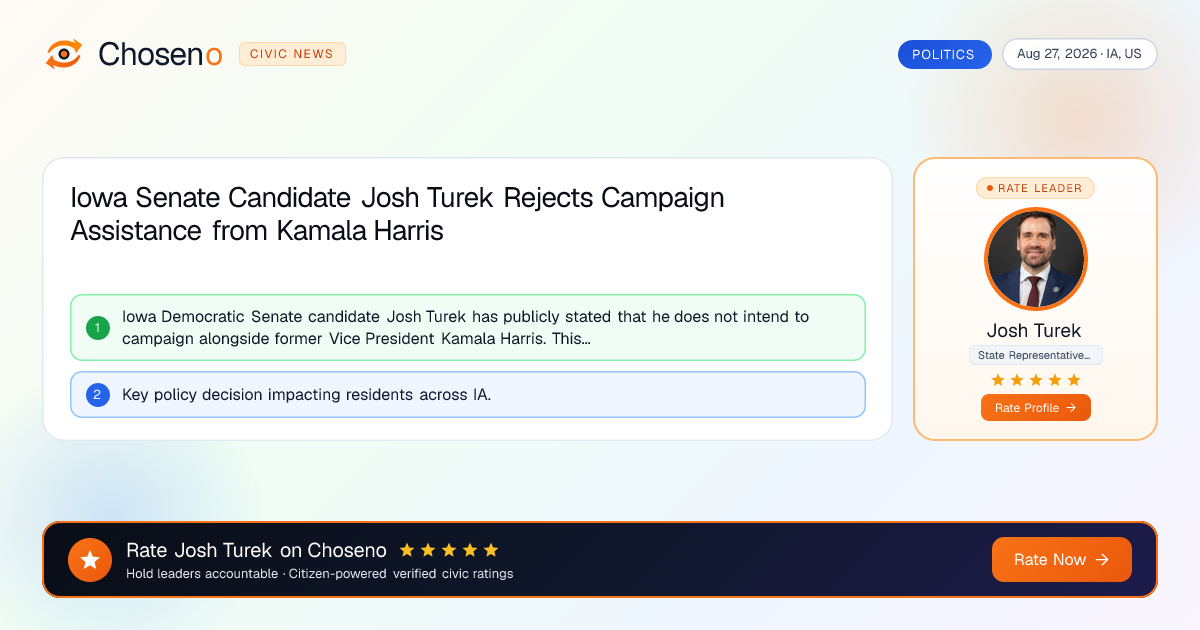
Iowa Senate Candidate Josh Turek Rejects Campaign Assistance from Kamala Harris
Iowa Democratic Senate candidate Josh Turek has publicly stated that he does not intend to campaign alongside former Vice President Kamala Harris. This decision highlights strategic distancing within the Democratic party as candidates navigate the current political landscape in Iowa.
Choseno Civic News Desk August 27, 2026 2 min read IA, US
★ Choseno Civic Briefing
Key Leaders
Dateline: Cedar Rapids, Iowa
On Wednesday, August 27, 2026, Iowa Democratic Senate candidate Josh Turek addressed inquiries regarding his campaign strategy. During an event held in Cedar Rapids, Turek explicitly dismissed the prospect of former Vice President Kamala Harris participating in his campaign efforts.
Policy & Taxpayer Impact
While the decision to decline high-profile surrogate support is a strategic campaign choice, it carries implications for the allocation of political resources and the focus of the upcoming Senate race. Taxpayers are indirectly affected by the nature of campaign messaging, as candidates define their platforms and associations in a way that shapes the discourse surrounding federal representation for the state of Iowa.
Political & Legal Stakes
For Turek, a state representative and two-time Paralympic basketball gold medalist, the move represents a calculated effort to manage his political brand. By distancing himself from a prominent national figure like Harris, Turek is navigating the specific political climate of Iowa, where candidates often seek to establish independence from national party leadership to appeal to a broader base of voters.
The Debate
Proponents of Turek's strategy argue that local candidates must prioritize state-specific issues and maintain a distinct identity to remain competitive in a challenging electoral environment. Conversely, critics or those aligned with national party interests might argue that rejecting support from established party figures could weaken the unified front necessary to mobilize the party's base and secure victory in a high-stakes Senate contest.
Public Accountability Context
As the election cycle progresses, voters are encouraged to monitor how candidates like Turek balance national party affiliations with local campaign priorities. This development serves as a reminder of the ongoing tension between national political branding and the specific needs of state-level constituencies, providing citizens with insight into how their potential representatives intend to operate if elected to the U.S. Senate.
Rate the people mentioned in this article
Related Coverage in Politics
See all Politics newsPolitics
US Aug 27, 2026
Lawmaker Alleges Kennedy Center Board Faces Demolition Threat Over Trump Name Dispute
A dispute regarding the Kennedy Center's branding and structural maintenance has escalated, with reports indicating potential demolition threats linked to the facility's name. The situation raises concerns regarding the financial stability of the institution and the future of the federal landmark.
Read full article
Politics
US Aug 27, 2026
Lawmaker Raises Alarm Over Kennedy Center Demolition Threats Linked to Trump Name Dispute
A legislative dispute has emerged regarding the structural future of the Kennedy Center following warnings that the facility may face demolition if specific renovation and naming requirements are not met. The situation highlights significant financial instability at the institution, raising concerns about the potential loss of public infrastructure and taxpayer-funded assets.
Read full article
Politics
US Aug 27, 2026
Texas State House Candidate Jorge Borrego Issues Apology for Past Online Conduct
Texas state House candidate Jorge Borrego has formally apologized for a series of past social media posts characterized as crude and immature. The incident has prompted public scrutiny regarding the candidate's history and its potential influence on his current legislative campaign.
Read full article