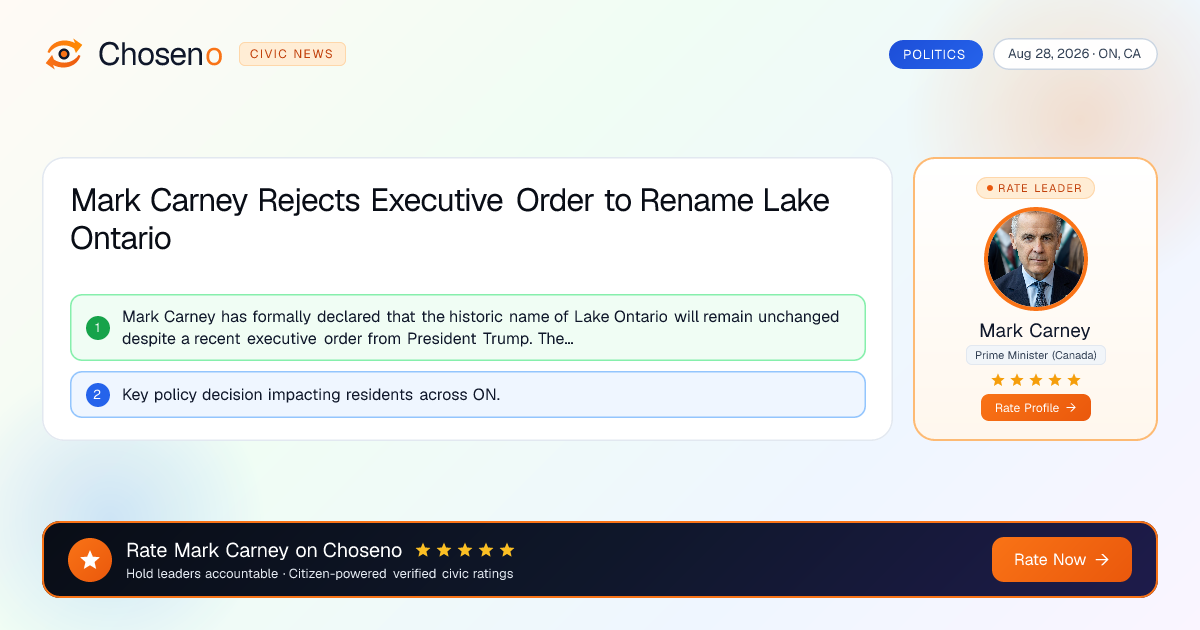
Mark Carney Rejects Executive Order to Rename Lake Ontario
Mark Carney has formally declared that the historic name of Lake Ontario will remain unchanged despite a recent executive order from President Trump. The decision maintains the status quo for the region, avoiding the administrative and logistical costs associated with a federal renaming initiative.
Choseno Civic News Desk August 28, 2026 1 min read ON, CA
Dateline: Ottawa, August 28, 2026
Mark Carney has issued a definitive statement regarding the nomenclature of Lake Ontario, confirming that the body of water will retain its historic title. This announcement serves as a direct response to a recent executive order issued by President Trump, which sought to rename the lake to "Lake America."
Policy & Taxpayer Impact
The proposed renaming initiative by the U.S. executive branch would have necessitated significant administrative adjustments, including the updating of federal maps, signage, and navigational documentation. By rejecting the change, the Canadian government avoids the potential fiscal burden of reconciling cross-border geographic data and the logistical complexities of dual-naming conventions for a shared international resource.
Political & Legal Stakes
The conflict highlights a tension between U.S. executive authority and established international geographic naming conventions. While the U.S. administration attempted to assert a unilateral change, the Canadian government’s refusal underscores the legal challenges inherent in renaming shared transboundary waters without bilateral consensus.
The Debate
Proponents of the renaming, aligned with the U.S. executive order, view the change as a symbolic assertion of national identity. Conversely, critics and Canadian officials emphasize the importance of historical continuity. Mark Carney solidified the government's stance, stating that the lake's name will remain as is, "then, now, and always."
Public Accountability Context
This dispute has drawn widespread media attention, with outlets such as The New York Times, The Atlantic, and Bloomberg reporting on the broader implications of the administration's naming policies. As the situation develops, citizens are encouraged to monitor how this disagreement impacts future diplomatic cooperation and the management of shared environmental assets.
Rate the people mentioned in this article


Related Coverage in Politics
See all Politics newsPolitics
US Aug 28, 2026
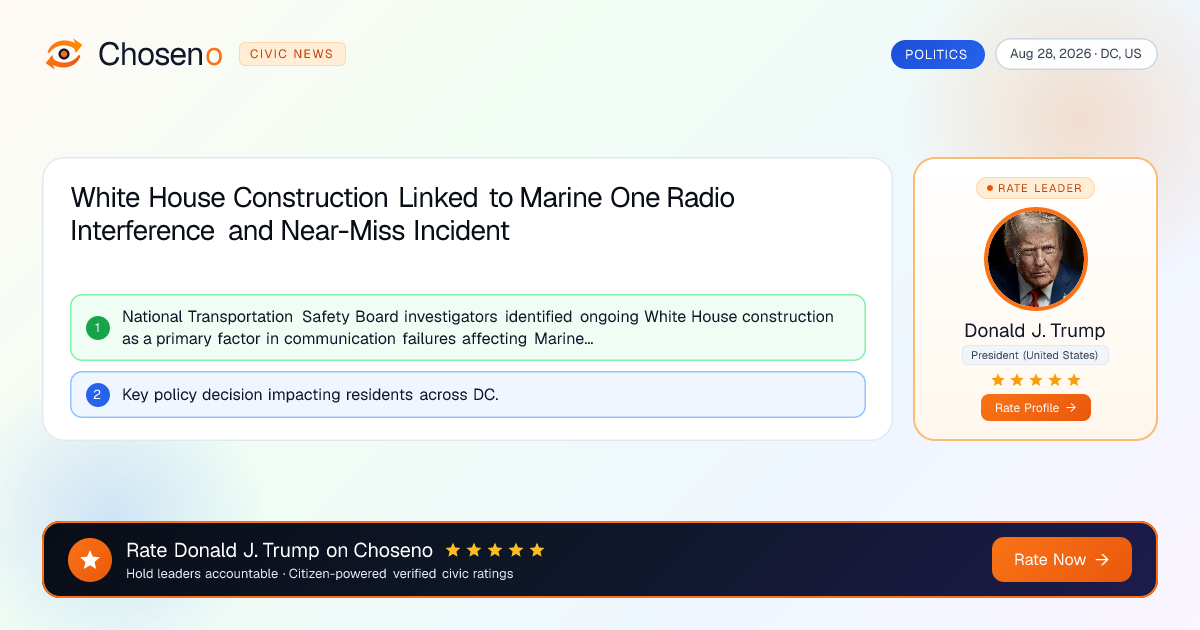
White House Construction Linked to Marine One Radio Interference and Near-Miss Incident
National Transportation Safety Board investigators identified ongoing White House construction as a primary factor in communication failures affecting Marine One. These radio disruptions contributed to a close-proximity incident involving the presidential helicopter and a commercial jet.
Read full article
Politics
US Aug 28, 2026
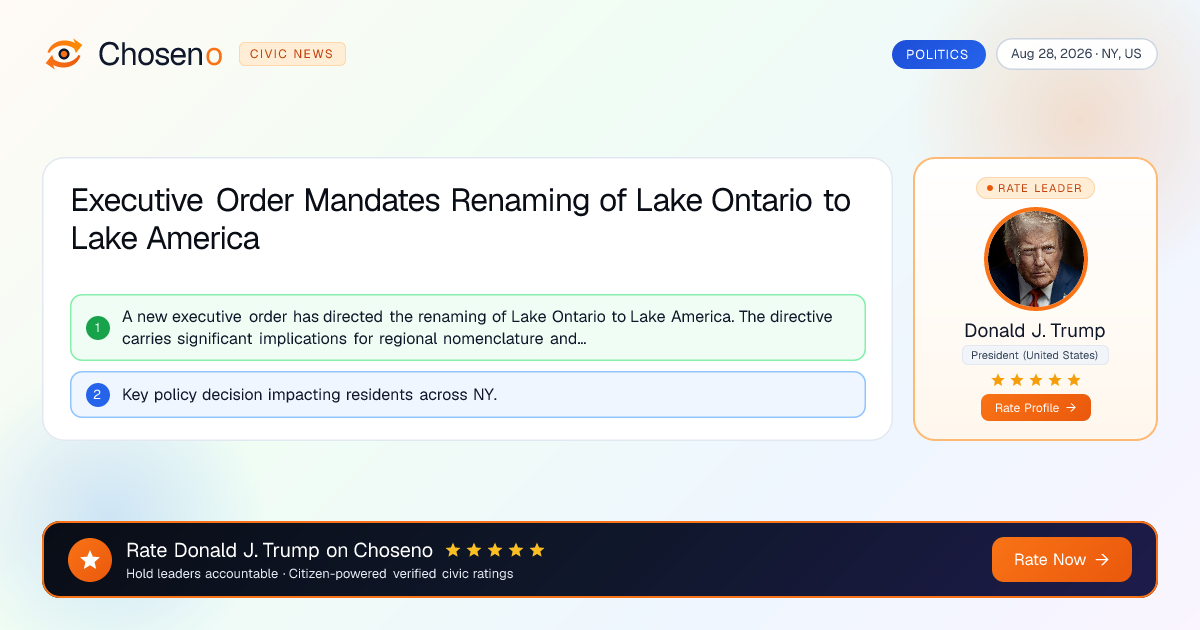
Executive Order Mandates Renaming of Lake Ontario to Lake America
A new executive order has directed the renaming of Lake Ontario to Lake America. The directive carries significant implications for regional nomenclature and cross-border geographic identification.
Read full article
Politics
US Aug 28, 2026
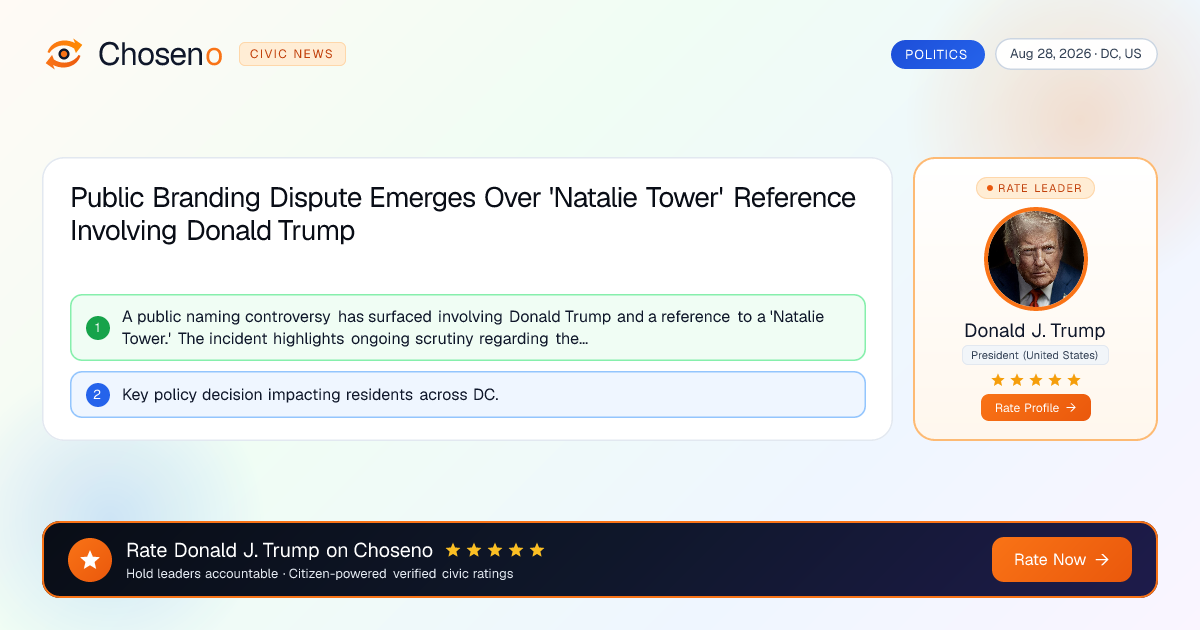
Public Branding Dispute Emerges Over 'Natalie Tower' Reference Involving Donald Trump
A public naming controversy has surfaced involving Donald Trump and a reference to a 'Natalie Tower.' The incident highlights ongoing scrutiny regarding the former president's real estate branding and public image.
Read full article