Massachusetts Gubernatorial Race Gains Endorsement from Barry Richard
Barry Richard has publicly announced his support for Brian Shortsleeve in the upcoming Massachusetts gubernatorial election. The endorsement highlights the ongoing political alignment process as candidates seek voter backing.
Choseno Civic News Desk August 28, 2026 1 min read MA, US
As the Massachusetts gubernatorial race progresses, Barry Richard has publicly declared his intention to vote for Brian Shortsleeve. This endorsement, reported by 1420 WBSM, marks a notable development in the campaign as candidates work to solidify their support bases ahead of the election.
The announcement serves as a signal of the shifting political landscape within the state. While the gubernatorial contest involves various policy considerations and competing visions for the Commonwealth, this specific endorsement focuses on the choice of candidate for the executive office. According to reporting by 1420 WBSM, the decision by Richard to back Shortsleeve reflects a strategic alignment within the electoral process.
In the context of state-level elections, endorsements from prominent figures are often utilized by campaigns to influence voter perception and demonstrate momentum. For citizens evaluating their options, such declarations provide insight into the coalitions forming around specific candidates. As the election date approaches, voters are expected to weigh these endorsements alongside the candidates' stated policy platforms and their proposed approaches to managing state government affairs.
Related Coverage in State Politics
See all State Politics newsState Politics
US Aug 28, 2026
Senator Pennacchio Demands Disclosure on Noncitizen Voting Records in New Jersey
Senator Joe Pennacchio has formally requested that the Governor provide data regarding instances of noncitizen voting within the state. The inquiry seeks to clarify the integrity of voter registration and election participation records.
Read full article
State Politics
US Aug 28, 2026
Wyoming Governor Demands Federal Probe Into DOJ Election Monitoring Presence
Governor Mark Gordon has formally requested an investigation into the activities of Department of Justice monitors during the state's recent primary election. The request centers on the scope and necessity of federal oversight within Wyoming's electoral process.
Read full article
State Politics
US Aug 28, 2026
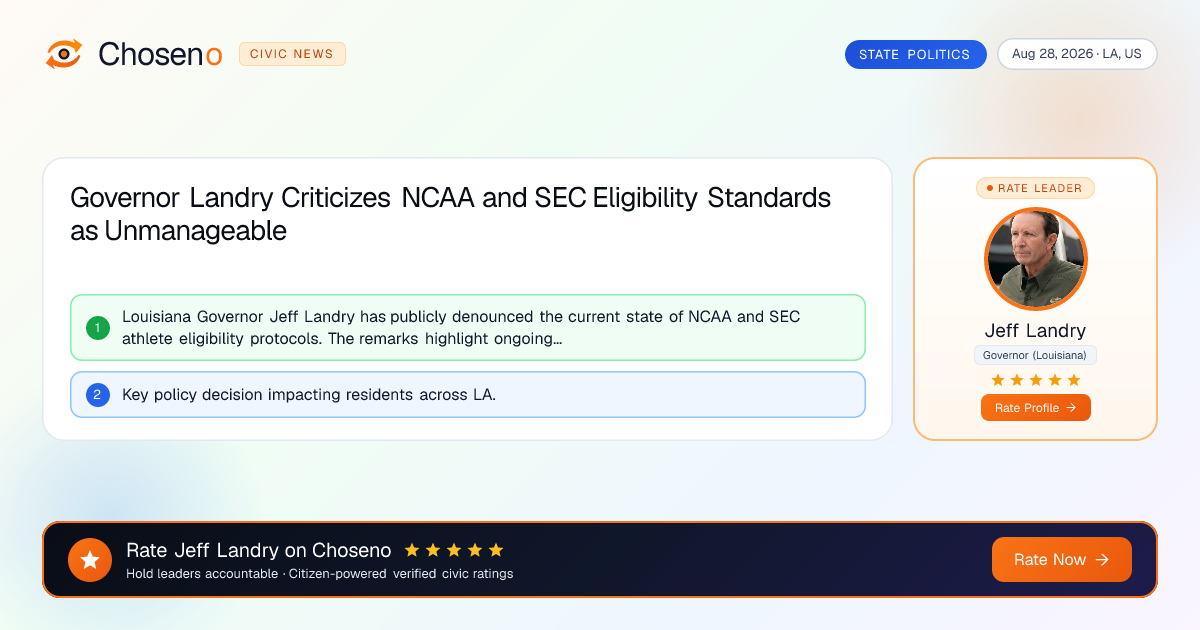
Governor Landry Criticizes NCAA and SEC Eligibility Standards as Unmanageable
Louisiana Governor Jeff Landry has publicly denounced the current state of NCAA and SEC athlete eligibility protocols. The remarks highlight ongoing administrative friction regarding collegiate sports governance.
Read full article