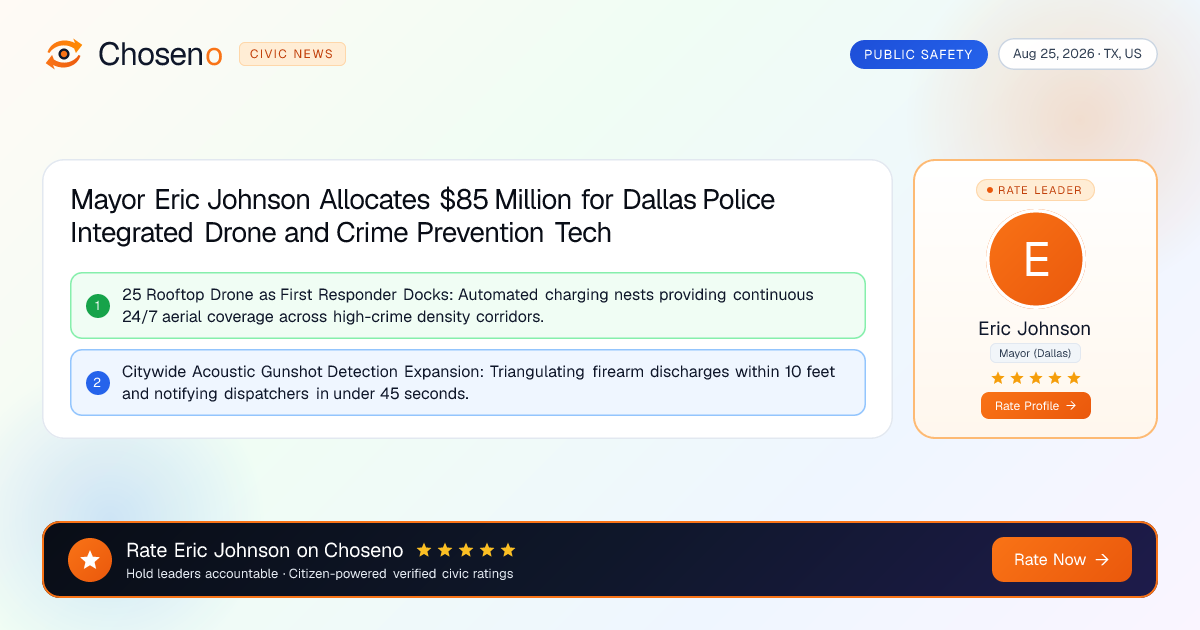
Mayor Eric Johnson Allocates $85 Million for Dallas Police Integrated Drone and Crime Prevention Tech
Dallas Mayor Eric Johnson and the Dallas City Council authorize $85 million to deploy automated Drone as First Responder (DFR) dock stations, expand real-time acoustic gunshot detection, and hire 150 civilian crime analysts.
Choseno Dallas City Hall Bureau August 25, 2026 2 min read TX, US
★ Choseno Civic Briefing
Key Leaders
DALLAS — Mayor Eric Johnson and the Dallas City Council approved an $85 million municipal public safety technology investment on Monday, authorizing the Dallas Police Department (DPD) to deploy an automated rooftop Drone as First Responder (DFR) network, expand real-time acoustic gunshot detection, and upgrade the city's centralized Real Time Crime Center (RTCC).
The technology rollout places automated, weatherized drone dock stations across all seven Dallas police patrol divisions, enabling autonomous thermal-camera drones to launch within 15 seconds of a 911 emergency call and arrive on scene minutes before ground patrol units to stream real-time aerial video to responding officers.
Sustaining Dallas's Historic Violent Crime Reductions Dallas has achieved five consecutive years of violent crime reductions, outperforming major metropolitan peers through targeted, data-driven hot-spot policing and community violence interruption.
"Dallas is proving that a major American city can prioritize constitutional, data-driven policing and achieve historic decreases in violent crime," Mayor Eric Johnson said at Dallas Police Headquarters. "By investing $85 million in cutting-edge Drone as First Responder technology and real-time intelligence, we are giving our police officers the tactical information they need to de-escalate volatile situations, apprehend dangerous suspects quickly, and keep every Dallas neighborhood safe."
Key Technology Deployments The $85 million package funds:
- 25 Rooftop Drone as First Responder Docks: Automated charging nests providing continuous 24/7 aerial coverage across high-crime density corridors.
- Citywide Acoustic Gunshot Detection Expansion: Triangulating firearm discharges within 10 feet and notifying dispatchers in under 45 seconds.
- RTCC Video Wall and Civilian Crime Analysts: Hiring 150 specialized intelligence analysts and integrating 2,500 public and private business security cameras into a single unified monitoring platform.
Police associations, business leaders, and community advisory boards commended the municipal investment, pointing out that aerial drone telemetry provides objective situational awareness that protects both officers and community residents during emergency calls.
Rate the people mentioned in this article
Related Coverage in Public Safety
See all Public Safety newsPublic Safety
US Aug 25, 2026
Governor Kathy Hochul Signs Comprehensive Commercial Indoor Air Quality and Ventilation Standards Act
New York Governor Kathy Hochul enacts legislation amending the state building code to establish mandatory MERV-13 air filtration, real-time carbon dioxide monitoring, and energy-recovery ventilation standards for commercial buildings and schools.
Read full article

Public Safety
US Aug 25, 2026
Governor Ron DeSantis Allocates $80 Million for Florida Maritime Interdiction Vessels and Radar
Florida Governor Ron DeSantis and FWC announce $80 million in state public safety capital to procure twenty-four high-speed ocean interdiction patrol boats and deploy offshore coastal radar surveillance along the Florida Keys.
Read full article

Public Safety
US Aug 25, 2026
Governor Josh Shapiro Awards $75 Million to Support Pennsylvania Fire and EMS Departments
Pennsylvania Governor Josh Shapiro directs $75 million in state public safety grants to provide direct operating funding, tuition assistance, and medical equipment for 2,200 volunteer and career fire companies and EMS agencies.
Read full article