Mayor Matt Mahan Directs $45 Million for San Jose Automated Clean Streets and Creekway Trash Traps
San Jose Mayor Matt Mahan and San Jose City Council authorize $45 million in municipal beautification funding to deploy electric sidewalk sweepers and install automated hydrodynamic trash booms along the Guadalupe River and Coyote Creek.
Choseno Silicon Valley Bureau August 25, 2026 2 min read CA, US

★ Choseno Civic Briefing
Key Leaders
SAN JOSE, Calif. — Mayor Matt Mahan and the San Jose City Council approved a $45 million municipal environmental beautification capital allocation on Monday to deploy a fleet of twenty compact electric sidewalk sweepers, install five automated hydrodynamic trash interception booms along Coyote Creek and the Guadalupe River, and expand daily litter abatement crews across all ten council districts.
The municipal clean streets initiative, managed through the San Jose Environmental Services Department and Department of Transportation, directly addresses street litter, illegal dumping, and stormwater trash pollution before plastic waste can enter urban creekways and drain into South San Francisco Bay.
Restoring Clean Public Sidewalks and Protecting Bay Ecosystems Urban runoff studies showed that street litter washed into municipal storm drains during winter rainstorms is the primary source of plastic pollution in the San Francisco Bay, degrading endangered steelhead trout and Chinook salmon spawning habitats.
"San Jose residents deserve clean, safe, and beautiful neighborhood streets and parks they can be proud of," Mayor Matt Mahan said along the Guadalupe River Trail in downtown San Jose. "You cannot have a thriving, world-class city if our sidewalks are covered in trash and our natural waterways are choked with plastic. This $45 million investment puts automated cleaning equipment on our neighborhood sidewalks every single day and installs heavy-duty trash traps in our creeks, stopping pollution at the source and keeping our city clean."
Key Equipment and Waterway Traps The $45 million package includes:
- 20 Compact Electric Sidewalk Sweepers: All-electric zero-emission sweepers engineered to clean narrow sidewalks, protected bike lanes, and transit plazas.
- 5 Hydrodynamic Creek Trash Booms: Installing heavy-duty floating booms equipped with conveyor belts that automatically collect and remove floating debris from Coyote Creek and Guadalupe River.
- BeautifySJ Neighborhood Quick-Response Teams: Hiring 80 full-time municipal workers to respond to illegal dumping service requests within 24 hours.
Neighborhood association leaders, environmental conservation federations, and downtown business owners praised the municipal funding, emphasizing that visible daily street cleaning immediately improves public safety and community pride.
Rate the people mentioned in this article
Related Coverage in Environment
See all Environment newsEnvironment
US Aug 25, 2026
Governor Gavin Newsom Directs $310 Million for Central Valley Flood-Managed Aquifer Recharge
California Governor Gavin Newsom signs Assembly Bill 1920, appropriating $310 million to construct canal diversions, temporary settling basins, and agricultural on-farm flooding infrastructure to recharge 1.5 million acre-feet of groundwater.
Read full article

Environment
US Aug 25, 2026
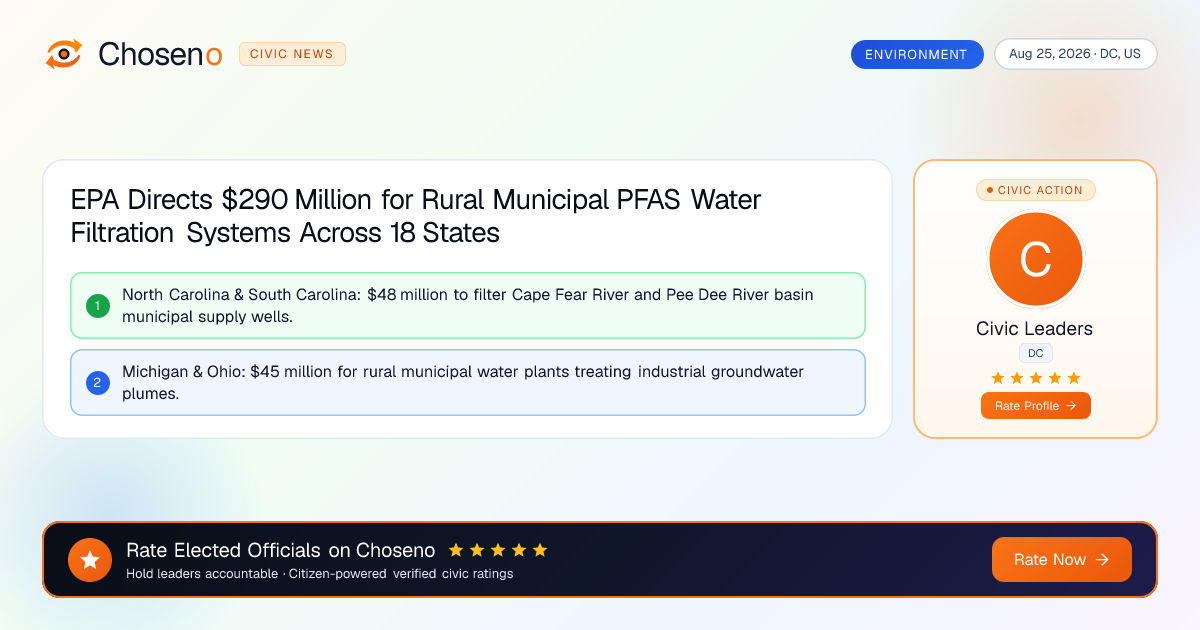
EPA Directs $290 Million for Rural Municipal PFAS Water Filtration Systems Across 18 States
Environmental Protection Agency Administrator Michael Regan allocates $290 million from the Bipartisan Infrastructure Law to install granular activated carbon and ion-exchange filtration systems at 350 rural municipal drinking water plants.
Read full article
Environment
US Aug 25, 2026
Governor Kathy Hochul Directs $180 Million for Adirondack and Catskill Forest Watershed Conservation
New York Governor Kathy Hochul announces $180 million in Environmental Protection Fund grants to acquire permanent conservation easements protecting 40,000 acres of working forest watersheds in the Adirondack and Catskill Parks.
Read full article