Minneapolis Mayor Jacob Frey Proposes Reallocating Municipal Funds Away from Violence Interrupter Programs
Citing lack of measurable crime-reduction metrics and fiscal compliance concerns, Mayor Jacob Frey’s proposed city budget reduces funding for civilian violence interrupters while expanding the city’s uniformed safety ambassador corps, sparking council debate.
Choseno Civic News Desk September 4, 2026Updated September 6, 2026 3 min read Minnesota, US
Minneapolis Mayor Jacob Frey has ignited an intense municipal governance debate after unveiling executive budget proposals that substantially reduce city funding for community-based violence interrupters. Presenting his fiscal priorities for the upcoming municipal cycle, Frey argued that while civilian street-level intervention models carry noble intentions, the programs have fallen short of demonstrating the rigorous, measurable public safety outcomes required to justify ongoing multi-million-dollar municipal expenditures.
Violence interruption contracts were dramatically expanded across Minneapolis in the aftermath of 2020, designed as non-police alternatives to mitigate neighborhood tension, mediate gang disputes, and de-escalate retaliatory gun violence in high-incident corridors. However, Mayor Frey stated that years of implementation have yielded inconsistent analytical data regarding their direct impact on violent crime reduction. Furthermore, the administration highlighted persistent administrative compliance and financial oversight challenges, pointing to recent legal disputes and city audits involving allegations of improper expenditure tracking and contract non-compliance among several external community service providers.
Rather than maintaining current funding allocations for third-party outreach groups, Frey’s budget proposal advocates doubling down on the city’s uniformed Community Safety Ambassador program. Operated under more centralized municipal supervision within the Office of Community Safety, the ambassadors maintain a visible, unarmed presence along transit corridors and commercial districts, providing hospitality, business check-ins, and direct coordination with emergency service dispatchers. Frey asserted that the ambassador model has demonstrated clear, quantifiable improvements in commercial corridor vitality, pedestrian safety perceptions, and neighborhood satisfaction.
The proposed restructuring has drawn sharp condemnation from community organizers, frontline intervention workers, and progressive members of the Minneapolis City Council. Outreach leaders argued that evaluating violence interruption solely through short-term statistical benchmarks fundamentally misconstrues the nature of trauma-informed street mediation. Advocates emphasized that interrupters—many of whom are credible neighborhood figures with lived experience in the justice system—possess unique community trust capable of reaching high-risk individuals who deliberately avoid contact with law enforcement or uniformed municipal personnel.
Adding to the tension is the broader fiscal environment facing City Hall, where diminished commercial property tax valuations in downtown Minneapolis have squeezed municipal revenue projections and forced tighter departmental prioritization. Municipal budget directors have emphasized that every discretionary dollar must undergo rigorous performance evaluation as the city attempts to avoid steep property tax increases on residential homeowners while sustaining competitive public services.
City Council members skeptical of the cuts cautioned that disinvesting from community mediation could dismantle hard-won relationships in historically marginalized neighborhoods, leaving vulnerable corridors exposed to retaliatory cycles of violence during critical summer months. Several council leaders indicated they will introduce formal budget amendments to preserve or restore contract lines for vetted non-profit partners, setting up a contentious legislative negotiation before final budget adoption in December.
The funding confrontation underscores persistent philosophical divisions over public safety reform and fiscal governance in Minneapolis. As the city continues efforts to rebuild staffing within the Minneapolis Police Department while complying with court-enforced federal and state consent decrees, municipal leaders face the complex task of balancing taxpayer accountability, programmatic transparency, and community-led safety interventions. The City Council’s forthcoming public budget hearings will test whether the administration’s shift toward centralized safety ambassadors prevails or whether grassroots violence interrupters retain their municipal funding footprint across Minneapolis.
Rate the people mentioned in this article

Related Coverage in Municipal
See all Municipal newsMunicipal
US Sep 27, 2026
‘Love Dogs But…’: Florida Gov Candidate Byron Donalds’ Shelter Video Sparks Skepticism on the Trail
‘Love Dogs But…’: Florida Gov Candidate Byron Donalds’ Shelter Video Sparks Skepticism on the Trail The Nerd Stash
Read full article

Municipal
US Sep 27, 2026
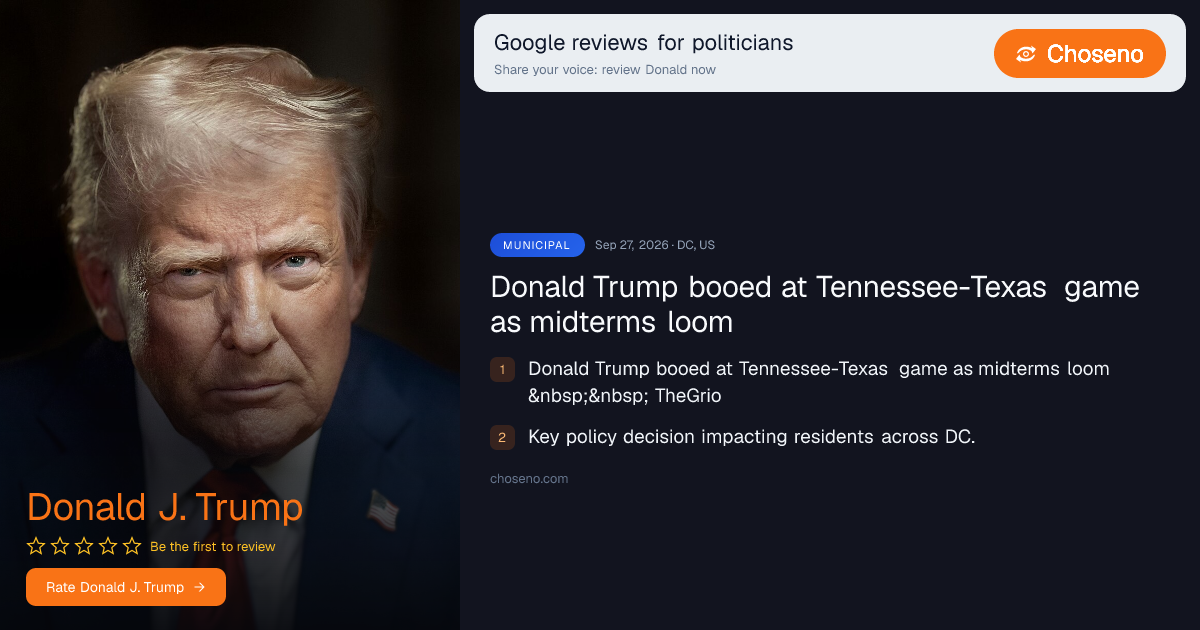
Donald Trump booed at Tennessee-Texas game as midterms loom
Donald Trump booed at Tennessee-Texas game as midterms loom TheGrio
Read full article
Municipal
US Sep 27, 2026
President Donald Trump Attends Presidents Cup in Democratic Stronghold
President Donald Trump Attends Presidents Cup in Democratic Stronghold 조선일보
Read full article