BREAKING
Governor Tim Walz Issues Executive Order Halting Mineral Mining Reviews Around Boundary Waters
Governor Tim Walz directs Minnesota DNR and MPCA to halt all environmental permitting for nonferrous sulfide mining within the Boundary Waters Canoe Area Wilderness watershed.
Choseno Environmental Governance Bureau August 24, 2026 1 min read MN, US
★ Choseno Civic Briefing
Key Leaders
ST. PAUL, MN — Minnesota Governor Tim Walz issued Executive Order 2026-08, directing the Department of Natural Resources (DNR) and the Minnesota Pollution Control Agency (MPCA) to cease all administrative processing of nonferrous metallic mineral mining permit applications within the 225,000-acre Rainy River watershed surrounding the Boundary Waters Canoe Area Wilderness (BWCAW).
Safeguarding Clean Freshwater Wilderness and Indigenous Waters
The executive directive halts active state environmental review on copper-nickel sulfide mining proposals adjacent to Birch Lake and the Kawishiwi River. Governor Walz affirmed that the Boundary Waters is an irreplaceable ecological treasure providing clean drinking water, world-class wilderness recreation, and treaty-protected wild rice waters for Anishinaabe tribal nations.
Governor Walz emphasized that sulfide mining runoff poses irreversible acidification risks to pristine boreal lakes that sustain Northern Minnesota's outdoor recreation economy.
Mining Industry Stance and Conservation Coalition Praise
Mining trade associations and Iron Range business federations voiced strong opposition, stating that domestic copper and nickel are required for green energy electrification and provide high-paying industrial jobs.
Friends of the Boundary Waters Wilderness and national conservation federations commended the executive action for establishing permanent watershed safeguards.
Administrative Implementation
State regulatory agencies have formally suspended environmental review dockets with immediate effect.
Related Coverage in Environment
See all Environment newsEnvironment
US Aug 24, 2026
Cincinnati City Council Approves $15 Million Capital Plan to Accelerate Lead Water Pipe Replacement
Cincinnati City Council unanimously approves $15 million in capital bonding to replace 3,500 private lead water service lines at zero cost to homeowners and licensed child care facilities.
Read full article
Environment
CA Aug 24, 2026
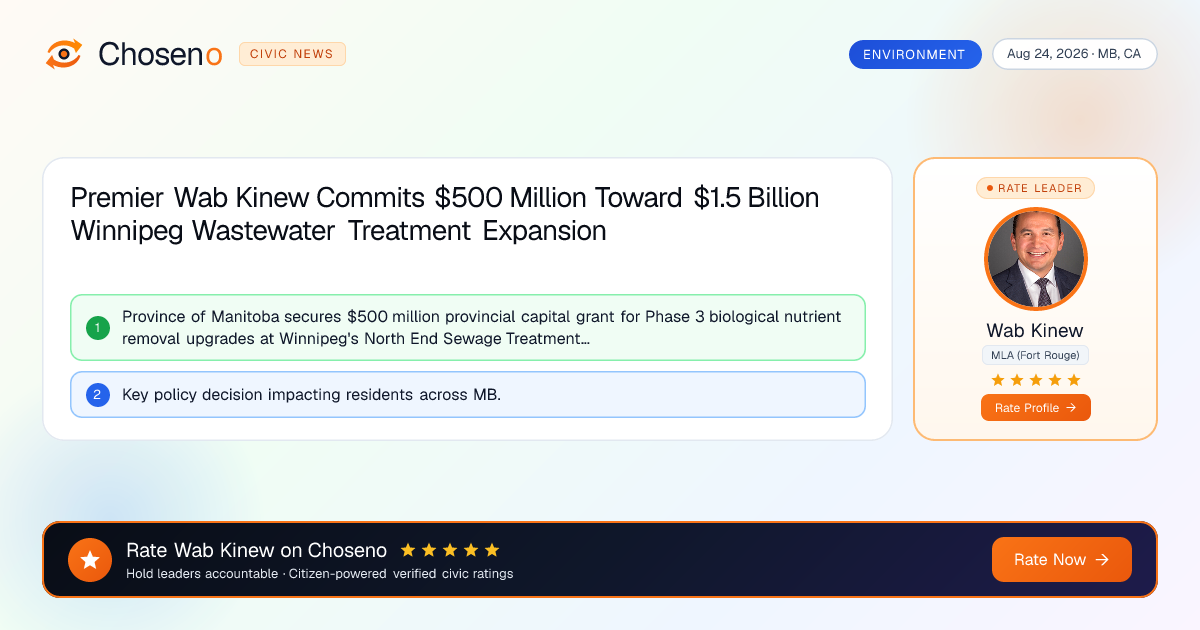
Premier Wab Kinew Commits $500 Million Toward $1.5 Billion Winnipeg Wastewater Treatment Expansion
Province of Manitoba secures $500 million provincial capital grant for Phase 3 biological nutrient removal upgrades at Winnipeg's North End Sewage Treatment Plant to protect Lake Winnipeg.
Read full article
Environment
US Aug 24, 2026
Governor Jared Polis Directs $30 Million in Clean Heat Grants for Commercial Buildings and Schools
Colorado Energy Office launches $30 million Clean Heat Enterprise Grant Program, providing up to $500,000 for public school districts and commercial buildings installing geothermal and heat pump systems.
Read full article