Nevada Republicans Test Early 2028 Campaign Playbook Targeting California Governor Gavin Newsom
Choseno Civic News Desk September 7, 2026 3 min read
What do you think of the people in this story? Rate them anonymously — tap a face below.
★ Choseno Civic Briefing
LAS VEGAS — Nevada Republicans have begun deploying an aggressive electoral strategy that utilizes the state’s high-stakes gubernatorial contest as a proving ground for attacks against California Governor Gavin Newsom ahead of the 2028 presidential election cycle. Republican operatives and incumbent Governor Joe Lombardo are actively anchoring their statewide messaging to California’s regulatory record, attempting to transform voter frustration over regional energy costs and economic migration into a durable political liability for prominent West Coast Democrats.
The emerging campaign offensive centers on fuel prices, transportation costs, and environmental regulations across the shared interstate border. Nevada imports the vast majority of its refined petroleum products directly from California refineries through regional pipeline systems, leaving consumers and commercial haulers in Las Vegas and Reno acutely vulnerable to supply disruptions and price volatility originating in the neighboring state. Governor Lombardo and allied political action groups have repeatedly charged that clean energy mandates, refinery storage requirements, and emissions regulations championed by Governor Newsom are directly inflating the daily cost of living for Nevada working families.
Republican strategists view this inter-state linkage as a potent wedge issue capable of influencing both the immediate gubernatorial contest and future presidential primary dynamics. Nevada holds an influential early position on the national Democratic presidential nominating calendar, providing a crucial testing environment for national messaging and policy evaluations. By elevating Governor Newsom into a primary campaign foil, Nevada Republicans are attempting to define the California executive’s administrative record for independent swing voters long before any formal federal campaign commences.
The strategic offensive extends directly to the Nevada gubernatorial race, where the Better Nevada political action committee, closely aligned with Governor Lombardo, has launched high-visibility billboard, broadcast, and digital campaigns connecting Democratic nominee and state Attorney General Aaron Ford to Governor Newsom. Campaign advertisements assert that the Democratic ticket seeks to import California-style governance, regulatory burdens, and progressive tax policies into Nevada communities. Republican campaign advisers note that linking in-state opponents to California political figures resonates strongly with suburban voters who relocated to Nevada specifically to escape high West Coast housing costs, utility bills, and commercial taxes.
In response, Nevada Democrats and campaign representatives for Attorney General Ford have dismissed the attacks as partisan political posturing designed to distract from the governor’s own administrative record and legislative vetoes. Democratic organizers argue that Nevada’s fuel prices are dictated by global crude oil markets and multinational corporate distribution decisions rather than California statehouse statutes. They maintain that Silver State voters are primarily focused on domestic Nevada priorities, including public education funding, affordable housing availability, workplace development, and healthcare access, rather than ideological battles with adjacent states.
Political analysts observe that the cross-border campaign underscores how state-level elections are increasingly shaped by nationalized political narratives and future presidential positioning. For Governor Newsom, the Nevada attacks offer an early preview of the economic criticisms likely to accompany any prospective federal campaign, particularly regarding Western regional energy policies, grid reliability, and cost-of-living concerns. For Governor Lombardo, anchoring the reelection message to regional economic anxieties provides a cohesive framework to consolidate Republican turnout and appeal to price-conscious nonpartisan voters across Nevada’s decisive suburban corridors.
Rate the people mentioned in this article


Related Coverage in General
See all General newsGeneral
US Sep 25, 2026
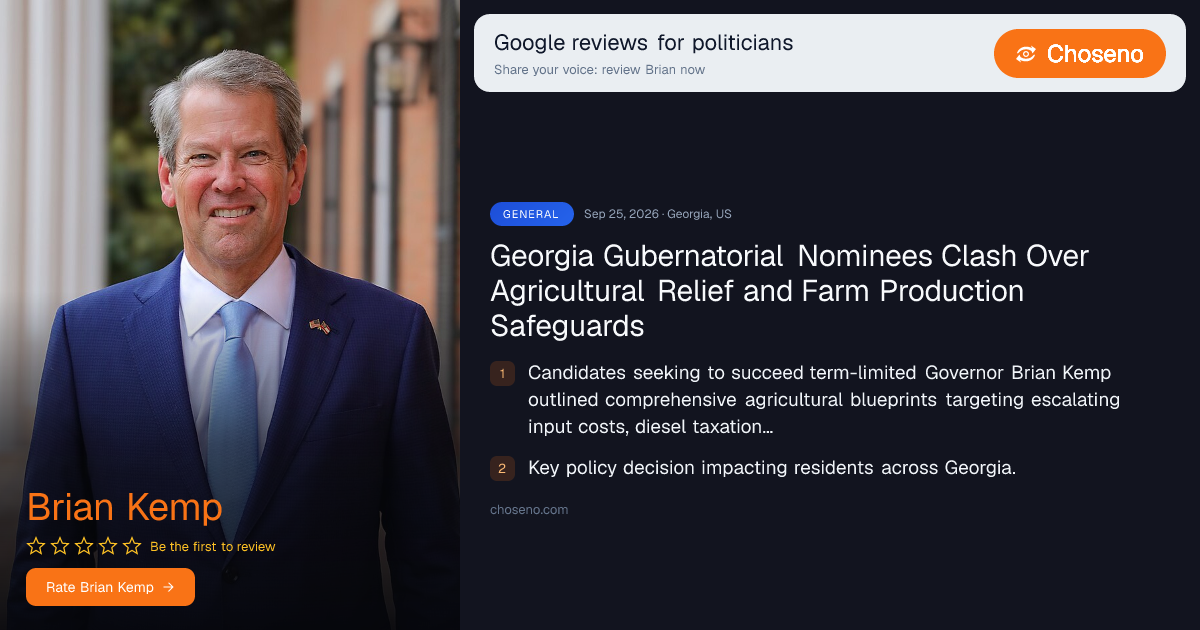
Georgia Gubernatorial Nominees Clash Over Agricultural Relief and Farm Production Safeguards
Candidates seeking to succeed term-limited Governor Brian Kemp outlined comprehensive agricultural blueprints targeting escalating input costs, diesel taxation relief, water allocations, and family farm preservation.
Read full article
General
US Sep 25, 2026
Oregon Gubernatorial Candidates Kotek and Drazan Present Contrasting Economic Platforms in Rematch Forum
Oregon Governor Tina Kotek and Republican challenger Christine Drazan outlined starkly different economic blueprints regarding commercial regulations, tax structures, and industrial competitiveness at a Portland business forum.
Read full article
General
US Sep 25, 2026
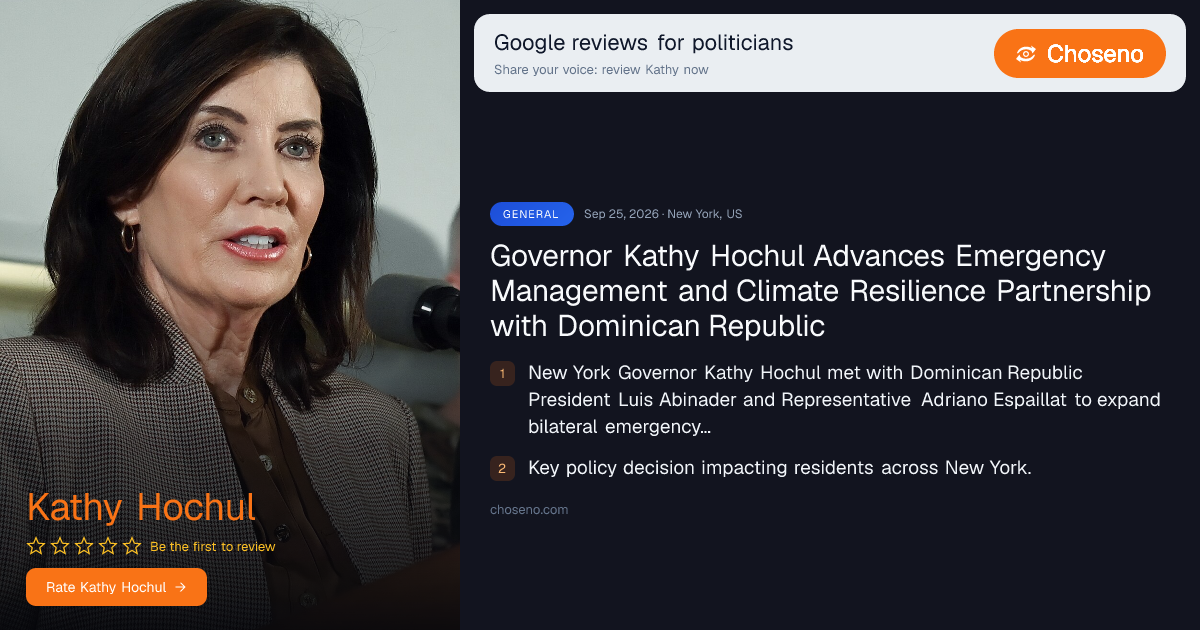
Governor Kathy Hochul Advances Emergency Management and Climate Resilience Partnership with Dominican Republic
New York Governor Kathy Hochul met with Dominican Republic President Luis Abinader and Representative Adriano Espaillat to expand bilateral emergency management cooperation, training exchanges, and environmental resilience.
Read full article