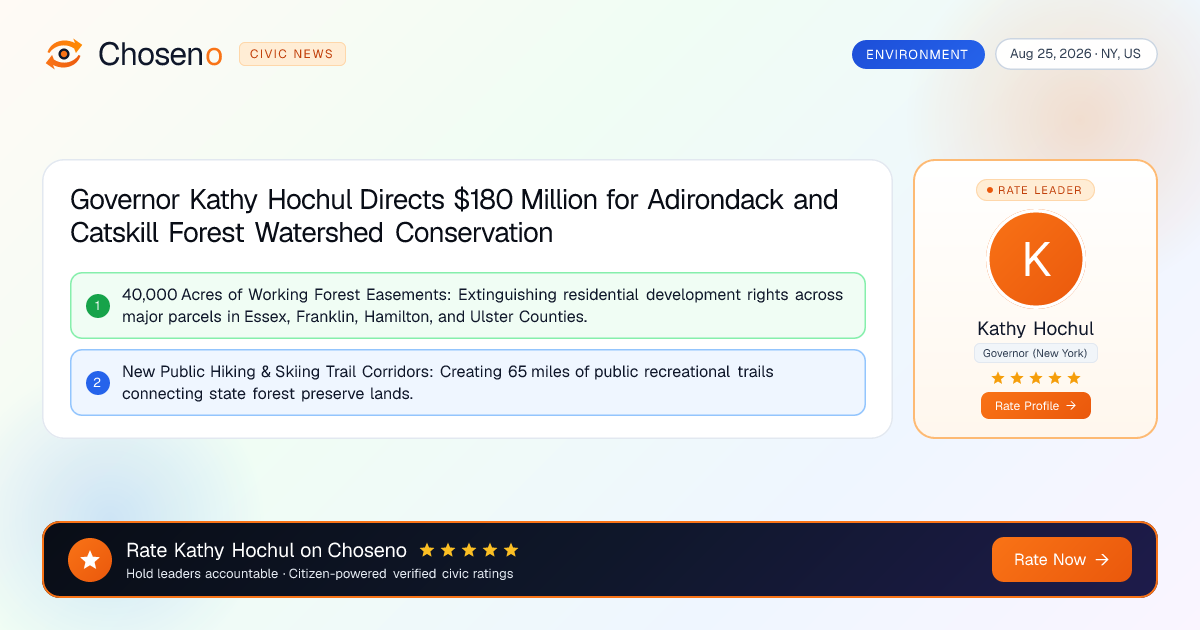
NOAA Awards $310 Million for Living Shorelines and Mangrove Storm Buffers Across Coastal States
Under Secretary of Commerce and NOAA Administrator Rick Spinrad awards $310 million in Climate-Ready Coasts grants to construct engineered living oyster reefs, restore mangrove forests, and stabilize barrier dunes across fifteen coastal states.
Choseno Marine & Climate Bureau August 25, 2026 2 min read DC, US
★ Choseno Civic Briefing
Key Leaders
WASHINGTON — Under Secretary of Commerce for Oceans and Atmosphere and NOAA Administrator Rick Spinrad announced on Monday the distribution of $310 million in federal coastal resilience investments from the Inflation Reduction Act to construct engineered living oyster reefs, restore 25,000 acres of coastal mangrove wetlands, and rebuild protective barrier island dunes across fifteen coastal states.
The nature-based coastal infrastructure investments, administered through NOAA's Climate-Ready Coasts initiative, absorb wave energy, attenuate hurricane storm surges, and mitigate chronic coastal erosion while creating essential nursery habitats for commercially vital marine fisheries.
Protecting Coastal Communities with Engineered Nature-Based Defenses Coastal engineering research demonstrated that healthy coastal wetlands and living oyster breakwaters reduce ocean wave height and storm surge energy by up to 60 percent, delivering superior long-term flood mitigation compared to traditional vertical concrete seawalls that reflect wave scour.
"America's coastal communities are on the frontlines of rising seas and intense storm surges, and nature-based infrastructure is our most durable and cost-effective defense," NOAA Administrator Rick Spinrad said in Washington. "These $310 million investments restore protective coastal marshes, engineer living oyster reefs, and expand mangrove forests, protecting billions in coastal real estate and critical infrastructure while sustaining our vibrant coastal maritime economies."
Major Coastal Restoration Packages Key state allocations include:
- Louisiana Gulf Coast Living Reefs: $60 million to construct 30 miles of offshore submerged bio-engineered oyster reef breakwaters in Barataria and Terrebonne Bays.
- Florida Mangrove & Seagrass Restoration: $55 million to restore 8,000 acres of coastal red mangrove forests across Tampa Bay and Biscayne Bay.
- North Carolina Outer Banks Dune Stabilization: $40 million for engineered beach nourishment and maritime forest plantings along Cape Hatteras.
- Texas Coastal Bend Wetland Buffers: $35 million for salt marsh reconstruction in Matagorda and Aransas Bays.
- Eleven additional Atlantic, Pacific, and Great Lakes coastal restoration projects receiving between $10 million and $25 million.
Coastal mayors, commercial fishing captains, and marine conservation biologists commended the federal grants, emphasizing that nature-based living shorelines provide continuous self-healing flood protection.
Related Coverage in Environment
See all Environment newsEnvironment
US Aug 25, 2026
Governor Gavin Newsom Directs $310 Million for Central Valley Flood-Managed Aquifer Recharge
California Governor Gavin Newsom signs Assembly Bill 1920, appropriating $310 million to construct canal diversions, temporary settling basins, and agricultural on-farm flooding infrastructure to recharge 1.5 million acre-feet of groundwater.
Read full article

Environment
US Aug 25, 2026
EPA Directs $290 Million for Rural Municipal PFAS Water Filtration Systems Across 18 States
Environmental Protection Agency Administrator Michael Regan allocates $290 million from the Bipartisan Infrastructure Law to install granular activated carbon and ion-exchange filtration systems at 350 rural municipal drinking water plants.
Read full article
Environment
US Aug 25, 2026
Governor Kathy Hochul Directs $180 Million for Adirondack and Catskill Forest Watershed Conservation
New York Governor Kathy Hochul announces $180 million in Environmental Protection Fund grants to acquire permanent conservation easements protecting 40,000 acres of working forest watersheds in the Adirondack and Catskill Parks.
Read full article