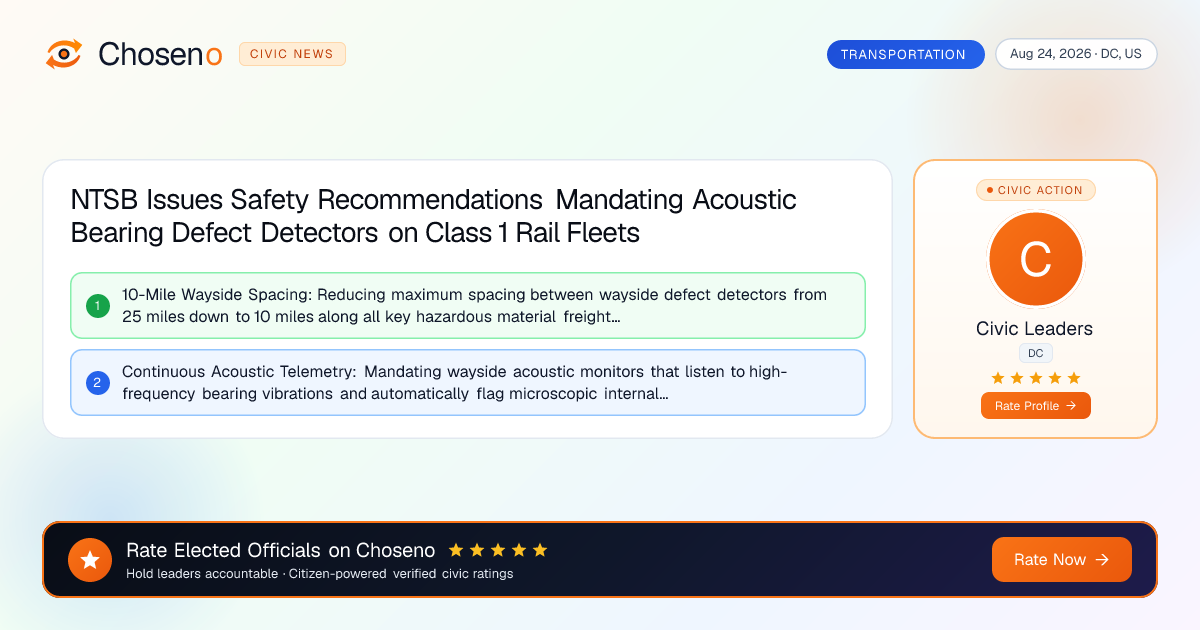
NTSB Issues Safety Recommendations Mandating Acoustic Bearing Defect Detectors on Class 1 Rail Fleets
National Transportation Safety Board Chair Jennifer Homendy releases final investigative findings, recommending federal regulators mandate continuous acoustic bearing health telemetry and compressed 10-mile detector spacing on freight railroads.
Choseno Transportation Safety Bureau August 24, 2026 2 min read DC, US
★ Choseno Civic Briefing
Key Leaders
WASHINGTON — National Transportation Safety Board (NTSB) Chair Jennifer Homendy released comprehensive investigative recommendations on Monday, urging the Federal Railroad Administration (FRA) and the Pipeline and Hazardous Materials Safety Administration (PHMSA) to enact mandatory federal safety standards for wayside defect detection across the nation's 140,000-mile commercial freight rail network.
The recommendations, adopted unanimously by the five-member safety board following exhaustive metallurgical and telemetry investigations of major hazardous material derailments, require Class 1 freight rail carriers to modernize legacy infrared hot-bearing detectors with advanced multi-spectrum acoustic bearing sensor arrays.
Stopping Roller Bearing Failures Before Catastrophic Seizure Metallurgical analyses revealed that conventional infrared heat sensors only alert train dispatchers when a roller bearing has already reached critical failure temperatures exceeding 200 degrees Fahrenheit, often leaving train crews with inadequate braking distance before wheels seize and sever from axles.
"The current rail safety standard of waiting for an axle bearing to catch fire before sounding an alarm is fundamentally obsolete and unacceptable," NTSB Chair Jennifer Homendy said in Washington. "Acoustic bearing detection technology identifies internal metal flaking and cage fatigue weeks before a bearing overheats. Implementing these common-sense safety recommendations will prevent catastrophic hazardous material derailments and protect rail workers and trackside communities."
Key NTSB Safety Directives The safety recommendations call for:
- 10-Mile Wayside Spacing: Reducing maximum spacing between wayside defect detectors from 25 miles down to 10 miles along all key hazardous material freight routes.
- Continuous Acoustic Telemetry: Mandating wayside acoustic monitors that listen to high-frequency bearing vibrations and automatically flag microscopic internal defects.
- Standardized Real-Time Alarms: Establishing uniform federal temperature and acoustic alert thresholds that require automated locomotive brake applications when critical faults are detected.
Rail labor unions and trackside municipal coalitions praised the board's decisive recommendations, calling on Congress and federal transport regulators to codify the standards into binding federal law without delay.
Related Coverage in Transportation
See all Transportation newsTransportation
US Aug 25, 2026
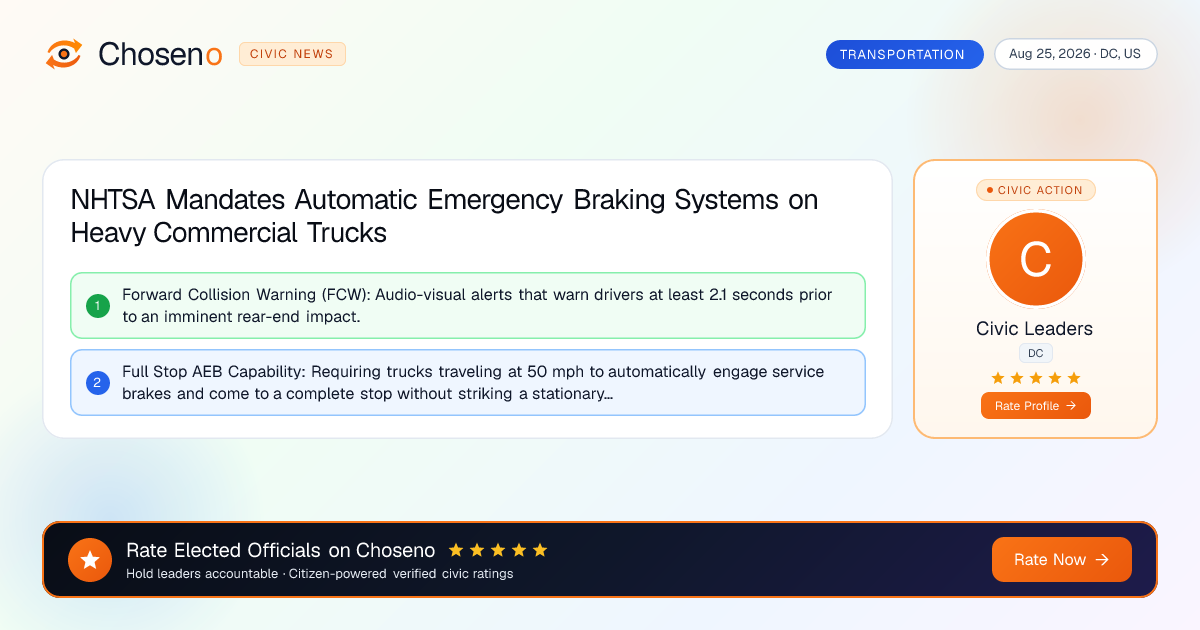
NHTSA Mandates Automatic Emergency Braking Systems on Heavy Commercial Trucks
Transportation Secretary Pete Buttigieg and NHTSA issue a final Federal Motor Vehicle Safety Standard mandating radar- and camera-based Automatic Emergency Braking (AEB) on all new heavy commercial trucks and buses.
Read full article
Transportation
US Aug 25, 2026
Governor Brian Kemp Allocates $220 Million for Georgia Highway Freight Interchanges and Weigh-in-Motion Tech
Georgia Governor Brian Kemp and GDOT announce $220 million to construct four grade-separated freight interchanges and install high-speed weigh-in-motion electronic screening along Interstate 16 and Interstate 85.
Read full article

Transportation
CA Aug 25, 2026
Mayor Amarjeet Sohi Directs $70 Million for Edmonton Valley Line West LRT Pedestrian Connections
Edmonton Mayor Amarjeet Sohi and Edmonton City Council authorize $70 million in municipal capital financing to build heated multi-use transit plazas, protected bike pathways, and pedestrian bridges connecting fourteen Valley Line West LRT stations.
Read full article