Pennsylvania Governor Signals Support for Statewide Prohibition of Flock Surveillance Technology
Governor Josh Shapiro has expressed openness to a legislative ban on the use of Flock automated license plate reader cameras across Pennsylvania. The potential policy shift follows ongoing public and legislative discourse regarding the privacy implications of widespread automated surveillance.
Choseno Civic News Desk August 28, 2026 1 min read PA, US
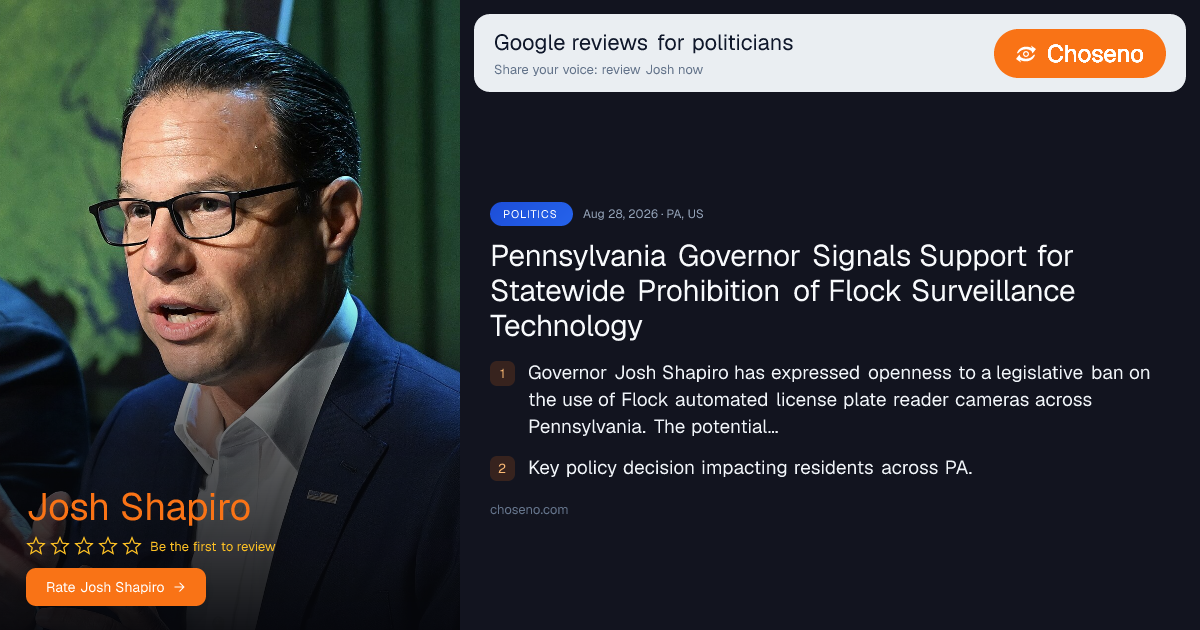
Pennsylvania Governor Josh Shapiro has indicated a willingness to support legislation that would prohibit the use of Flock automated license plate reader cameras within the state. The governor’s stance, reported by NBC10 Philadelphia, marks a notable development in the ongoing debate over the balance between public safety tools and individual privacy rights.
Flock Safety technology, which utilizes high-definition cameras to capture and analyze vehicle license plates and other identifying characteristics, has been adopted by numerous law enforcement agencies across the United States. Proponents of the technology argue that these systems provide critical data that assists police in solving crimes, locating stolen vehicles, and identifying suspects involved in violent incidents. By creating a network of searchable data, supporters contend that the cameras act as a force multiplier for departments with limited personnel.
Conversely, the widespread deployment of such surveillance infrastructure has drawn significant criticism from privacy advocates and civil liberties organizations. Critics argue that the continuous monitoring of public movements creates a digital dragnet that disproportionately impacts citizens who are not suspected of any wrongdoing. Concerns have been raised regarding the long-term storage of data, the potential for mission creep in how the information is utilized, and the lack of comprehensive oversight regarding who has access to the collected intelligence.
Governor Shapiro’s recent comments suggest that the executive branch is prepared to engage with the state legislature on the matter. Should a bill to restrict or ban the technology reach his desk, it would force a formal legislative showdown between those prioritizing the investigative utility of automated surveillance and those advocating for stricter limitations on government data collection. As of now, the discussion remains in the preliminary stages, with no specific legislative language or timeline for a potential vote having been finalized.
Rate the people mentioned in this article

Related Coverage in Politics
See all Politics newsPolitics
US Aug 28, 2026
Texas Governor Proposes Three-Year Undergraduate Degree Pathways
Governor Greg Abbott has formally requested the development of accelerated three-year bachelor's degree programs across Texas public universities. The initiative aims to reduce the financial burden on students by shortening the time required to complete undergraduate studies.
Read full article

Politics
US Aug 28, 2026
California Legislature Passes SB 1167, Advancing Bicycle Infrastructure Legislation to Governor's Desk
The California State Legislature has officially passed SB 1167, moving the bill to Governor Gavin Newsom for final consideration. The legislation aims to address state-level bicycle infrastructure standards and safety protocols.
Read full article

Politics
CA Aug 28, 2026
Alberta Premier Warns of Economic Damage from Retaliatory Tariffs
Premier Danielle Smith has expressed concern that potential retaliatory tariffs could negatively impact Alberta's economy. The warning highlights the province's vulnerability to shifting international trade policies.
Read full article