Portland City Council Authorizes $28M for Seismic Retrofits of Historic Willamette River Bridges
Portland and Multnomah County approved capital funding to reinforce bridge piers and install shock-absorbing dampers on the Hawthorne and Morrison bridges to withstand Cascadia earthquakes.
Choseno Pacific Northwest Bureau August 23, 2026 1 min read OR, US
★ Choseno Civic Briefing
Key Leaders
PORTLAND, OR — The Portland City Council and the Multnomah County Board of Commissioners authorized a joint $28-million seismic resiliency funding package on Sunday afternoon to upgrade foundational structural supports on historic Willamette River crossings.
Engineering Scope and Seismic Damper Architecture
The capital investment finances Phase 1 of the Willamette River Seismic Lifeline Program, focusing on the Hawthorne Bridge (constructed in 1910) and the Morrison Bridge (constructed in 1958). Civil engineering contractors will install high-capacity fluid viscous dampers, reinforce underwater concrete piers with steel jackets, and replace aging mechanical expansion joints.
The engineering retrofits are designed to ensure that critical river crossings remain structurally passable for emergency medical and first responder vehicles following a major Cascadia Subduction Zone seismic event.
"Our bridges are essential lifelines that connect East and West Portland," Multnomah County Chair Jessica Vega Pederson said. "Investing in seismic retrofits today ensures our city can respond effectively and maintain emergency connectivity after a major earthquake."
Transit and River Navigation Protection
The Hawthorne Bridge carries over 30,000 daily motor vehicles, 12 TriMet bus routes, and 8,000 daily cyclists and pedestrians. County engineers confirmed that the seismic reinforcement work will occur primarily from river barges, minimizing daytime traffic lane restrictions on bridge decks.
Maritime commercial river operators confirmed that navigation channels beneath the vertical lift spans will remain fully operational during construction.
Construction Timeline
Marine construction bids will be awarded in late autumn 2026, with on-water pier retrofits commencing in spring 2027.
Sources
Related Coverage in Infrastructure
See all Infrastructure newsInfrastructure
US Aug 23, 2026
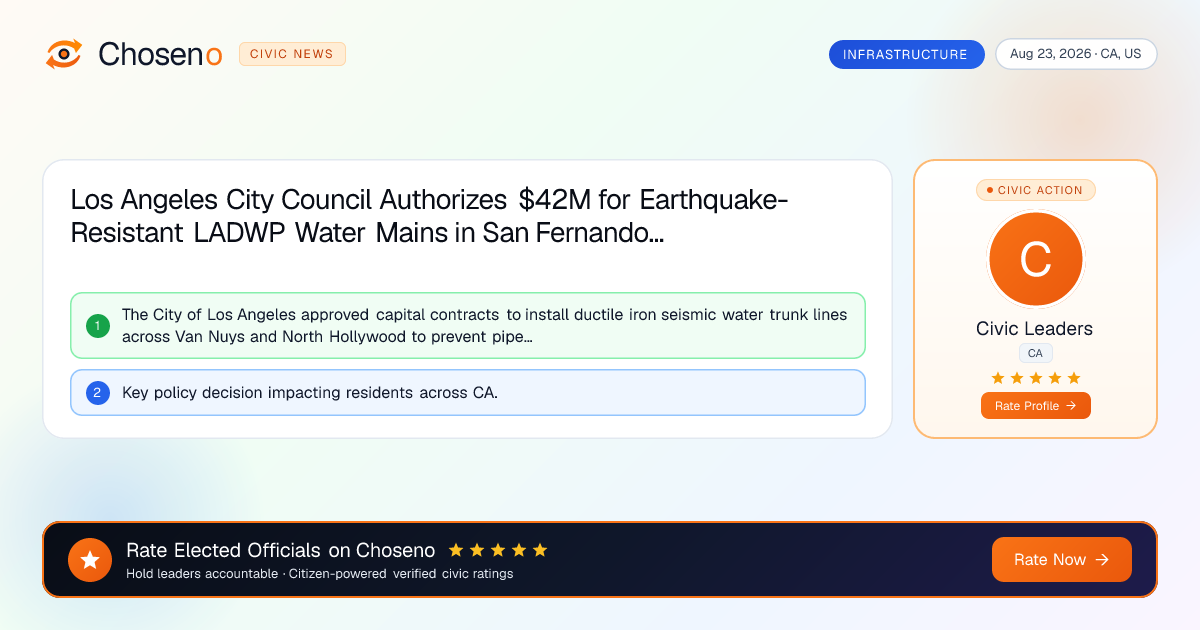
Los Angeles City Council Authorizes $42M for Earthquake-Resistant LADWP Water Mains in San Fernando Valley
The City of Los Angeles approved capital contracts to install ductile iron seismic water trunk lines across Van Nuys and North Hollywood to prevent pipe ruptures during earthquakes.
Read full article
Infrastructure
US Aug 23, 2026
Dallas City Council Approves $35M Flood Detention Basin to Safeguard West Dallas Neighborhoods
Dallas authorized civil engineering construction for a 280-acre stormwater detention basin along the Trinity River floodplain to prevent residential flood inundation.
Read full article

Infrastructure
US Aug 23, 2026
Department of Transportation Allocates $85M for Heavy-Duty Electric Truck Charging Depots Along I-80
The Federal Highway Administration awarded grants to construct six multi-megawatt commercial charging plazas capable of recharging electric freight trucks in under 45 minutes.
Read full article