BREAKING
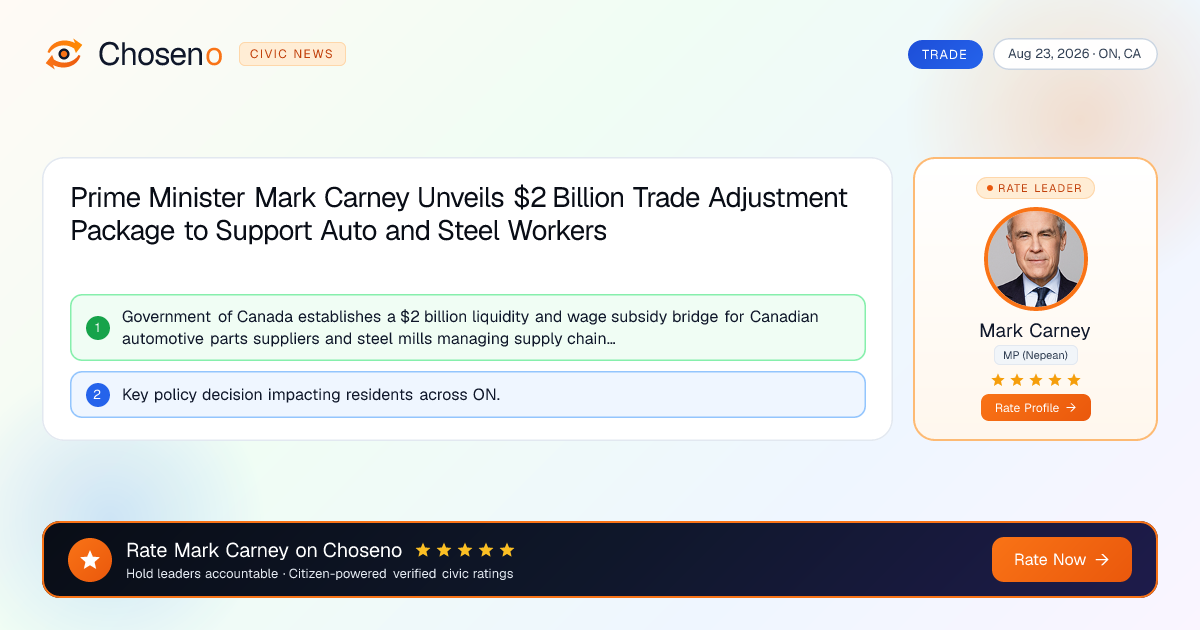
Prime Minister Mark Carney Unveils $2 Billion Trade Adjustment Package to Support Auto and Steel Workers
Government of Canada establishes a $2 billion liquidity and wage subsidy bridge for Canadian automotive parts suppliers and steel mills managing supply chain realignments amid U.S. tariffs.
Choseno National & Trade Affairs Bureau August 24, 2026 1 min read ON, CA
★ Choseno Civic Briefing
Key Leaders
OTTAWA, ON — Prime Minister Mark Carney and Finance Minister François-Philippe Champagne announced the creation of the $2 billion Canadian Industrial Trade Adjustment Program (CITAP), providing immediate working capital support and direct payroll wage subsidies for domestic manufacturing workers.
Protecting Industrial Manufacturing and Skilled Trades
The federal adjustment program guarantees up to $50 million in low-interest commercial credit lines per manufacturing enterprise and provides 75% work-sharing wage subsidies to prevent plant layoffs while Canadian manufacturers diversify export delivery contracts across European Union, Asian, and Latin American trade corridors. Prime Minister Carney affirmed that Canadian auto parts makers, aluminum smelters, and steelworkers will not bear the cost of unilateral foreign trade duties alone.
Prime Minister Carney emphasized that Canada’s economic foundation is resilient, backed by strategic critical minerals, clean electricity, and the world’s most skilled manufacturing workforce.
Industrial Coalitions and Labor Union Endorsements
Unifor and the United Steelworkers (USW) strongly endorsed the federal wage subsidy backstop, highlighting that protecting manufacturing jobs preserves industrial community stability in Windsor, Hamilton, and Sault Ste. Marie.
Canadian Manufacturers & Exporters (CME) praised the emergency liquidity window for preventing cash flow insolvency.
Program Application Timeline
Federal trade adjustment portal intake opens through the Business Development Bank of Canada (BDC) on September 1, 2026.
Rate the people mentioned in this article

Related Coverage in Trade
See all Trade newsTrade Breaking
CA Aug 22, 2026
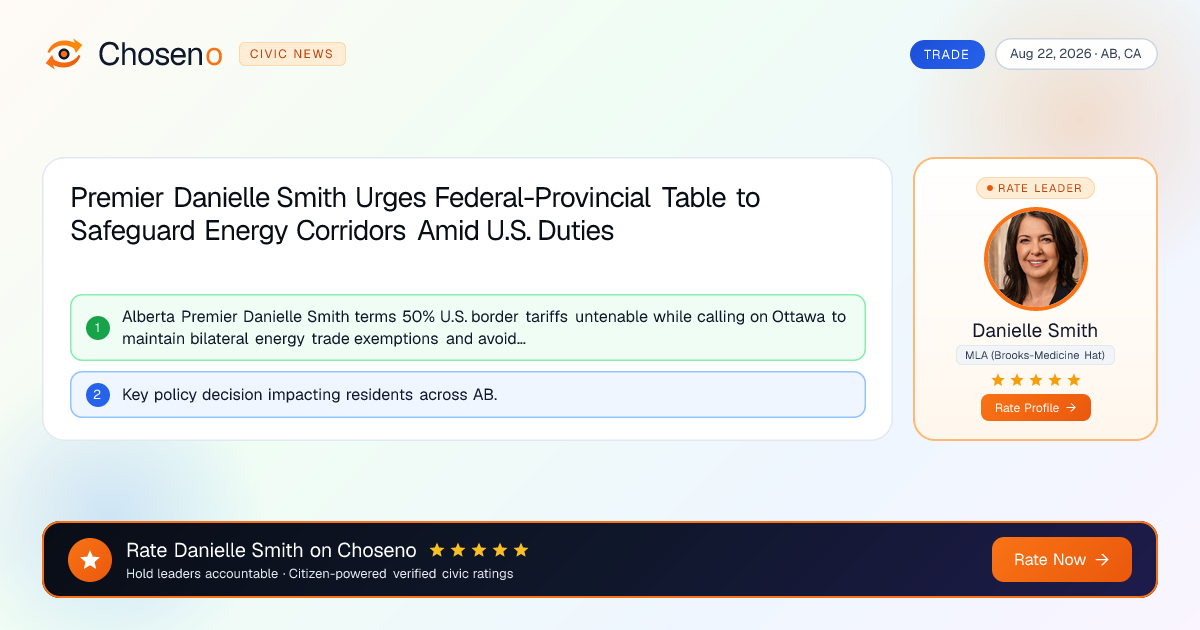
Premier Danielle Smith Urges Federal-Provincial Table to Safeguard Energy Corridors Amid U.S. Duties
Alberta Premier Danielle Smith terms 50% U.S. border tariffs untenable while calling on Ottawa to maintain bilateral energy trade exemptions and avoid escalating cross-border duties.
Read full article
Trade
CA Aug 22, 2026
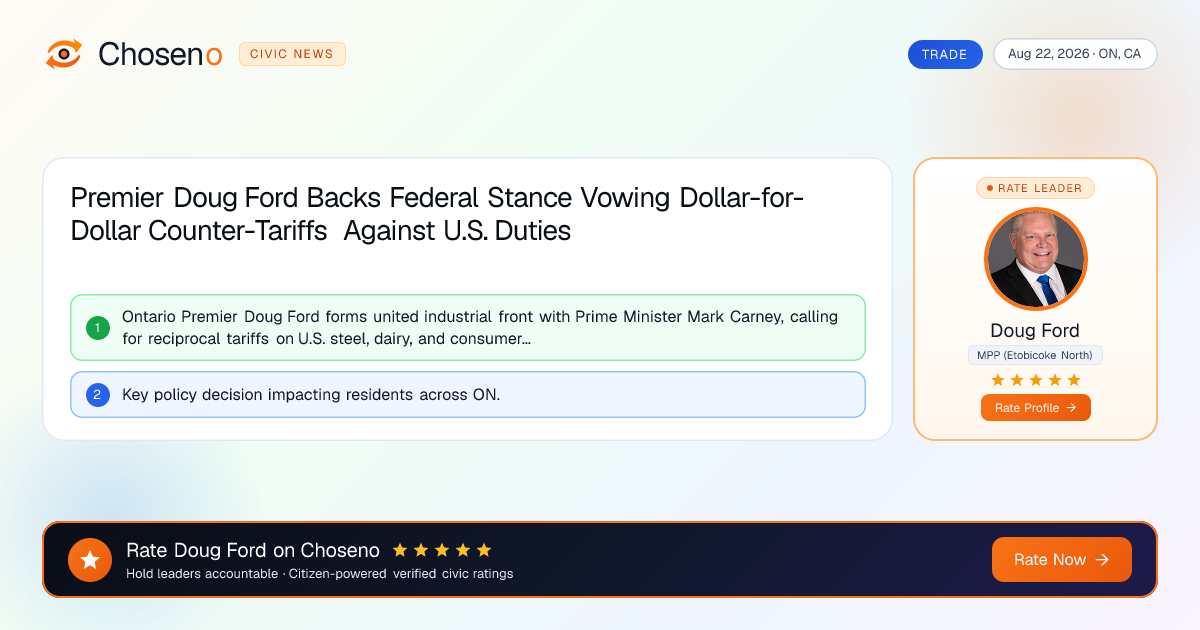
Premier Doug Ford Backs Federal Stance Vowing Dollar-for-Dollar Counter-Tariffs Against U.S. Duties
Ontario Premier Doug Ford forms united industrial front with Prime Minister Mark Carney, calling for reciprocal tariffs on U.S. steel, dairy, and consumer goods taking effect September 8.
Read full article
Trade
US Aug 22, 2026
South Korea Launches First Commercial Ice-Class Container Vessel on Arctic Northern Sea Route
Maritime authorities in Busan dispatch a specialized vessel to test the transit corridor to Europe, cutting 14 days off the traditional Suez Canal passage.
Read full article