Quebec Government Prepares Economic Safeguards as Cross-Border Tariff Measures Take Effect
Quebec provincial leadership convenes emergency cabinet sessions to shield aerospace and manufacturing sectors against escalating United States trade restrictions.
Choseno Civic News Desk September 24, 2026 3 min read CA
Quebec Premier Christine Fréchette issued a formal warning on Monday regarding potential secondary economic disruptions as sweeping Canadian counter-tariffs on American imports formally took effect across the country. Speaking during a news conference in Mirabel, the provincial executive cautioned that impending trade countermeasures could trigger further retaliatory restrictions from United States President Donald Trump, underscoring the urgent necessity of coordinated provincial interventions to protect domestic manufacturing employment, stabilize capital investments, and maintain supply chain continuity across key industrial sectors.
The trade escalation follows federal determinations to enact retaliatory import tariffs of up to fifty percent on targeted American imports, including raw steel, aluminum products, specialized electronics, and agricultural commodities. In response to potential supply chain shocks and market volatility, Fréchette paused provincial campaign activities to convene an extraordinary virtual cabinet meeting focused on mitigating operational risks for regional industrial exporters, particularly aerospace manufacturing complexes, forestry operators, and heavy manufacturing clusters across Greater Montreal, the Eastern Townships, and regional manufacturing corridors.
Provincial economic ministers outlined a multi-faceted defense framework designed to insulate Quebec commercial enterprises from international market volatility and sudden border disruptions. The provincial strategy includes prioritizing domestic manufacturers and regional suppliers across public procurement tenders, expediting emergency bridge financing for affected exporters through provincial credit agencies, and establishing emergency advisory desks through Investissement Québec to help businesses identify alternative global export destinations across Europe, Latin America, and the Asia-Pacific region.
The provincial measures coincide with a seven-point-five billion dollar federal transition fund announced by Canadian Prime Minister Mark Carney to support industrial sectors and supply chain workers exposed to cross-border trade friction. Fréchette confirmed that provincial officials engaged in direct consultations with federal cabinet ministers in Ottawa, securing technical adjustments to the national counter-tariff schedule to prevent severe cost spikes for intermediate components and specialized industrial inputs imported by Quebec aerospace and transportation manufacturers.
Regional labor federations and industry associations expressed support for the provincial government proactive posture, while urging legislative leaders across competing political parties to maintain a united front during international trade confrontations. Union leaders stressed that hundreds of thousands of high-wage industrial jobs throughout Quebec depend on predictable market access and tariff-free cross-border trade, emphasizing that provincial economic interventions must protect frontline shop-floor workers against temporary production curtailments, reduced shifts, or unexpected layoffs.
Opposition party leaders in Quebec City echoed the call for strategic economic defense, debating the allocation of provincial liquidity reserves and advocating for enhanced tax credits for companies investing in local supply chain integration. The interprovincial dynamics of the trade conflict also prompted discussions on eliminating remaining interprovincial trade barriers to allow Quebec agricultural and manufactured goods to circulate more freely across Canadian provinces.
As bilateral diplomatic communications between Washington and Ottawa continue amid market uncertainty, Quebec officials confirmed that intergovernmental monitoring teams will track border crossing tariffs, transport wait times, and supply chain metrics on a daily basis. Fréchette reiterated that while Quebec remains fundamentally committed to continental trade integration and historical partnerships, provincial authorities are prepared to deploy all available fiscal and regulatory mechanisms to safeguard provincial industrial sovereignty throughout the ongoing trade dispute.
Related Coverage in Economy & Trade
See all Economy & Trade newsEconomy & Trade
US Sep 24, 2026
Senator Jerry Moran Defends Bombardier Kansas Operations Following Executive Trade Warning
Kansas Senator Jerry Moran directly engaged the administration to safeguard Wichita aerospace jobs after federal warnings threatened market access for Canadian jet maker Bombardier.
Read full article

Economy & Trade
CA Sep 24, 2026
President Donald Trump Issues Domestic Assembly Mandate Targeting Canadian Jet Manufacturer Bombardier
President Donald Trump stated that Canadian aerospace manufacturer Bombardier must build aircraft within the United States to maintain market access, elevating cross-border industrial trade tensions.
Read full article
Economy & Trade
CA Sep 8, 2026
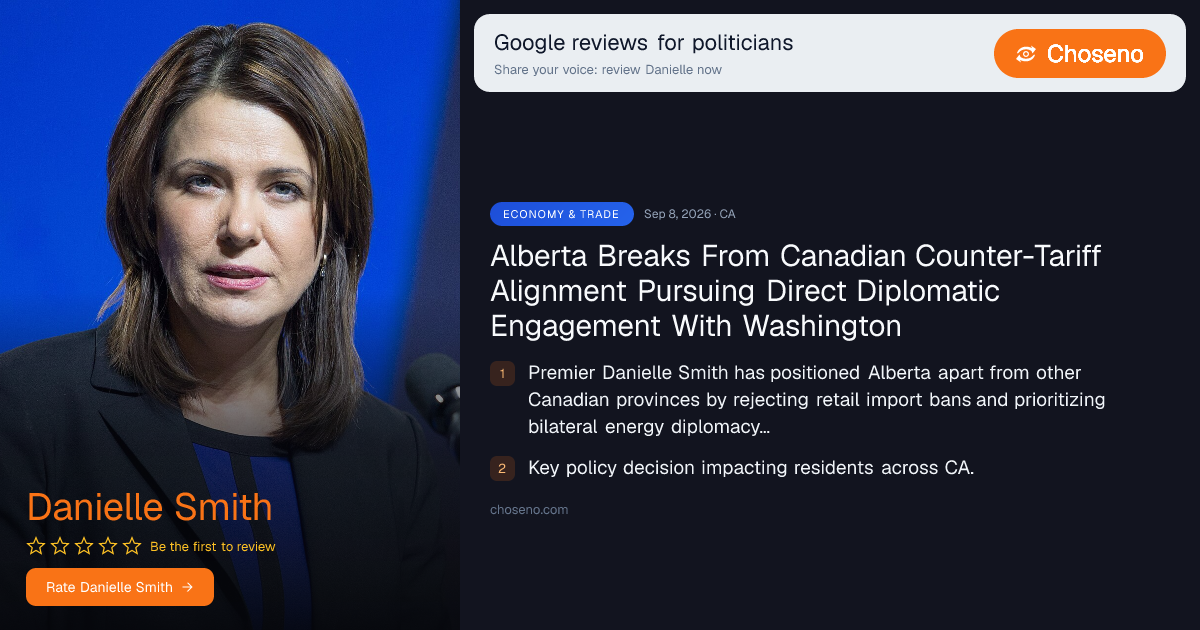
Alberta Breaks From Canadian Counter-Tariff Alignment Pursuing Direct Diplomatic Engagement With Washington
Premier Danielle Smith has positioned Alberta apart from other Canadian provinces by rejecting retail import bans and prioritizing bilateral energy diplomacy with the United States administration.
Read full article