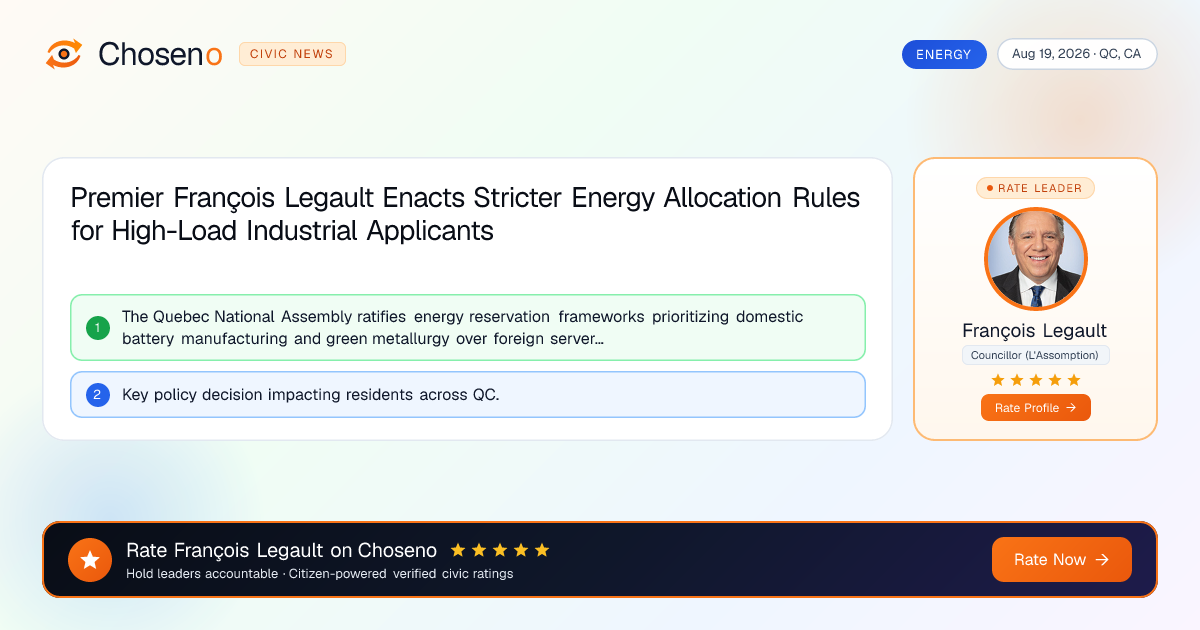
Premier François Legault Enacts Stricter Energy Allocation Rules for High-Load Industrial Applicants
The Quebec National Assembly ratifies energy reservation frameworks prioritizing domestic battery manufacturing and green metallurgy over foreign server clusters.
Choseno Quebec Bureau August 19, 2026 1 min read QC, CA
★ Choseno Civic Briefing
QUEBEC CITY, QC — Quebec Premier François Legault formalized strict new provincial energy allocation guidelines Wednesday, directing Hydro-Québec to prioritize domestic critical mineral processing and green metallurgy over foreign hyperscale data center projects.
Policy Framework and Megawatt Allocations
Under ministerial directives established pursuant to Bill 69, industrial electricity requests exceeding 5 megawatts will undergo mandatory economic-benefit scoring before grid connection permits are granted. Applications will be evaluated on high-wage job creation per megawatt, local supply chain integration, and greenhouse gas displacement value.
Premier Legault emphasized that with Hydro-Québec projecting domestic demand growth of over 100 terawatt-hours by 2035, the province's clean hydroelectric baseload must be strategically reserved to anchor the Bécancour electric vehicle battery corridor and decarbonize primary aluminum smelting in the Saguenay.
Industrial Reactions and Economic Debate
International technology firms and data center consortiums cautioned that restrictive grid allocation criteria could divert commercial cloud infrastructure capital to neighboring jurisdictions. However, domestic manufacturing leaders and labour federations strongly supported the directive, arguing that processing Quebec's lithium and nickel locally yields significantly higher long-term GDP returns.
Hydro-Québec confirmed it currently has over 3,000 megawatts of industrial connection requests pending review under the newly codified scoring matrix.
Next Steps in Implementation
The Ministry of Economy, Innovation and Energy will publish the first quarterly round of approved industrial energy allocations in November 2026.
Sources
Rate the people mentioned in this article
Related Coverage in Energy
See all Energy news
Energy
CA Aug 19, 2026
St. John's Legislative Hearing Set as Opposition Challenges Terms of $70B Churchill Falls Hydro Pact
Newfoundland and Labrador opposition leaders demand statutory audits on price escalator caps within the $70 billion joint Quebec-Labrador clean energy agreement.
Read full article
Energy
US Aug 19, 2026
California Energy Regulators Authorize $450M Battery Storage Installation Across Central Valley
The California Energy Commission approves 1,200 megawatts of four-hour battery storage to fortify state grid resilience against late-summer thermal spikes.
Read full article
Energy
CA Aug 19, 2026
Edmonton Tables Proposal for 2% Grid Contribution Fee on Hyperscale Data Centers
Premier Danielle Smith outlines statutory conditions for commercial computing campuses consuming over 75 megawatts to construct dedicated on-site generation.
Read full article