Senator Amy Klobuchar Launches Minnesota Gubernatorial Campaign Seeking Executive Reset Amid Federal Standoff
Choseno Civic News Desk September 7, 2026 3 min read
What do you think of the people in this story? Rate them anonymously — tap a face below.
★ Choseno Civic Briefing
MINNEAPOLIS — In a pivotal development reshaping Midwestern politics, United States Senator Amy Klobuchar has launched her campaign for Governor of Minnesota, articulating an ambitious executive agenda aimed at restructuring state agency operations, rebuilding public confidence in state government, and resetting the Commonwealth’s fraught relationship with the federal executive branch. The three-term federal lawmaker framed her gubernatorial candidacy as an urgent mission to stabilize Minnesota’s civic institutions amid relentless political confrontation with the administration of President Donald J. Trump.
The decision by Senator Klobuchar to leave the upper chamber of Congress to seek the governorship comes during a turbulent period for the North Star State. Washington officials have repeatedly singled out Minnesota in national political discourse, portraying Democratic state governance as inefficient and deploying federal enforcement apparatuses that have fueled intense localized friction throughout the Twin Cities metropolitan region. Klobuchar contended that Minnesota requires a seasoned executive who possesses both the legislative fortitude to defend state sovereignty against federal intrusion and the pragmatic diplomatic relationships in Washington necessary to protect critical federal highway, scientific research, and healthcare investments.
A central element of Klobuchar’s gubernatorial platform centers on a comprehensive managerial overhaul of state government operations. Following scrutiny surrounding grant oversight, department procurement, and bureaucratic administration during the tenure of incumbent Governor Tim Walz, Klobuchar committed her prospective administration to executing independent, top-to-bottom forensic audits across all cabinet-level state agencies. The senator emphasized that restoring public trust requires uncompromising financial transparency, stringent internal accounting controls, modern whistleblower protections, and measurable performance benchmarks for state-administered social welfare, educational, environmental, public safety, and healthcare programs.
The campaign rollout highlights Klobuchar’s long-standing political identity as a pragmatic centrist capable of bridging severe regional divides between the progressive Twin Cities metropolitan core and conservative agricultural counties across Greater Minnesota. In rural communities where federal trade policy and cross-border counter-tariffs have pressured dairy farms, soybean growers, and regional timber processors, Klobuchar is campaigning on rural healthcare stabilization, critical access hospital funding, expanded high-speed broadband deployment, and targeted tax relief for family-owned agricultural enterprises and Main Street merchants.
However, Klobuchar’s executive bid must navigate complex cross-currents within her own political party. While moderate suburban voters, civic leaders, municipal mayors, and business federations have broadly welcomed her managerial focus, progressive grassroots coalitions have questioned whether her consensus-seeking approach will adequately confront aggressive federal directives regarding immigration enforcement and social policy. Klobuchar addressed these internal debates by arguing that effective resistance to federal pressure requires an efficient, scandal-free state government that delivers tangible public services, protects vulnerable communities, balances biennial state budgets, and demonstrates administrative competence to independent swing voters across the state.
Political observers view the Minnesota gubernatorial contest as one of the marquee executive campaigns of the 2026 midterm cycle, testing whether a high-profile national lawmaker can successfully translate federal legislative prominence into state-level executive authority. By positioning her campaign as both a defense of Minnesota’s civic values and a rigorous managerial reset, Klobuchar is asking voters to entrust her with leading the state through a defining period of national polarization and economic transition.
Rate the people mentioned in this article


Related Coverage in General
See all General newsGeneral
US Sep 25, 2026
Georgia Gubernatorial Nominees Clash Over Agricultural Relief and Farm Production Safeguards
Candidates seeking to succeed term-limited Governor Brian Kemp outlined comprehensive agricultural blueprints targeting escalating input costs, diesel taxation relief, water allocations, and family farm preservation.
Read full article

General
US Sep 25, 2026
Oregon Gubernatorial Candidates Kotek and Drazan Present Contrasting Economic Platforms in Rematch Forum
Oregon Governor Tina Kotek and Republican challenger Christine Drazan outlined starkly different economic blueprints regarding commercial regulations, tax structures, and industrial competitiveness at a Portland business forum.
Read full article

General
US Sep 25, 2026
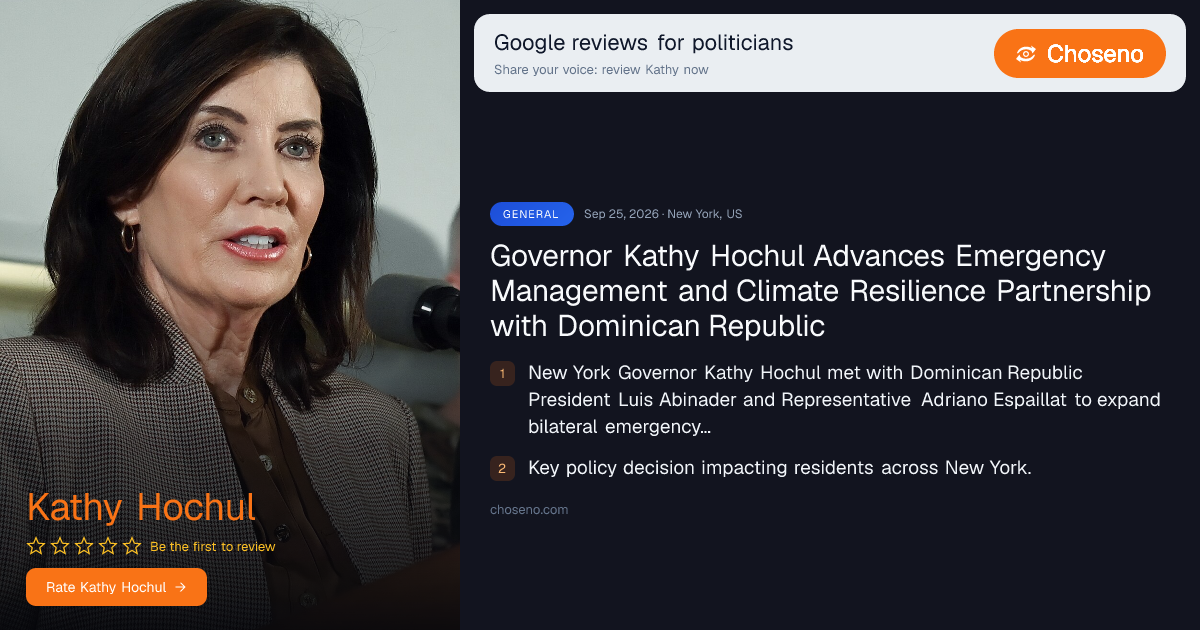
Governor Kathy Hochul Advances Emergency Management and Climate Resilience Partnership with Dominican Republic
New York Governor Kathy Hochul met with Dominican Republic President Luis Abinader and Representative Adriano Espaillat to expand bilateral emergency management cooperation, training exchanges, and environmental resilience.
Read full article