South Carolina Gubernatorial Nominees Alan Wilson and Jermaine Johnson Agree to Televised General Election Debate
Choseno Civic News Desk September 7, 2026 3 min read
What do you think of the people in this story? Rate them anonymously — tap a face below.
★ Choseno Civic Briefing
COLUMBIA, S.C. — In an agreement setting the stage for a critical statewide clash ahead of the November election, South Carolina gubernatorial nominees Republican Attorney General Alan Wilson and Democratic state Representative Jermaine Johnson have committed to participate in a televised general election debate. The high-profile broadcast, scheduled one month prior to the November 3 balloting, will provide Palmetto State voters with their primary opportunity to evaluate competing visions for the state’s executive leadership as they prepare to choose a successor to term-limited Republican Governor Henry McMaster.
The gubernatorial contest marks a significant generational transition in South Carolina politics, where Governor McMaster has held executive office for nearly a decade following the resignation of former Governor Nikki Haley in 2017. Wilson, who has served four terms as the state’s chief legal officer, secured the Republican nomination following a fiercely contested June primary runoff against Lieutenant Governor Pamela Evette. Johnson, a Richland County lawmaker, former collegiate basketball player, and community organizer, won the Democratic nomination outright during the primary election, positioning himself as a modernizer seeking to challenge more than two decades of Republican control of the governor’s mansion.
At the core of the upcoming debate are contrasting policy blueprints regarding state tax structures, public education investments, workforce training, and the state’s rapidly growing industrial energy demands. Wilson has anchored his campaign message to orthodox conservative governance, pledging to enact comprehensive judicial reform that eliminates legislative influence over judicial selection, accelerate individual income tax cuts, and maintain stringent statutory limits on reproductive healthcare. The attorney general emphasized that his extensive prosecutorial experience and defense of state statutes against federal overreach position him to maintain South Carolina’s business-friendly regulatory climate, attract corporate manufacturing, and preserve public safety.
In contrast, Representative Johnson is focusing his general election campaign on kitchen-table economic issues, rural hospital closures, and public school infrastructure. The Democratic nominee has proposed substantial state salary enhancements to address acute teacher shortages, expanded Medicaid coverage to preserve rural emergency medical centers across the Pee Dee and Lowcountry regions, and targeted state bond investments to upgrade deteriorating road, bridge, water, and broadband systems. Johnson contended that persistent single-party dominance has left working-class families and rural communities behind while prioritizing corporate tax exemptions, arguing that state government requires energetic executive oversight focused on transparency, judicial balance, and equitable economic development.
Political strategists note that the televised debate will be especially consequential in defining the candidates for independent suburban voters in fast-growing metropolitan areas surrounding Charleston, Greenville, and York County. While South Carolina remains a reliably conservative state in federal contests, substantial population growth driven by out-of-state relocations has diversified the electorate in coastal and suburban legislative districts.
Debate organizers and broadcast sponsors indicated that the formal program will feature questions regarding state infrastructure readiness, coastal storm resilience, electric grid reliability, and public education funding formulas. With early voting scheduled to commence shortly after the broadcast, campaign field directors from both parties are treating the debate as a decisive moment to mobilize volunteers, persuade nonpartisan voters, and define the stakes of the executive transition.
Rate the people mentioned in this article


Related Coverage in General
See all General newsGeneral
US Sep 25, 2026
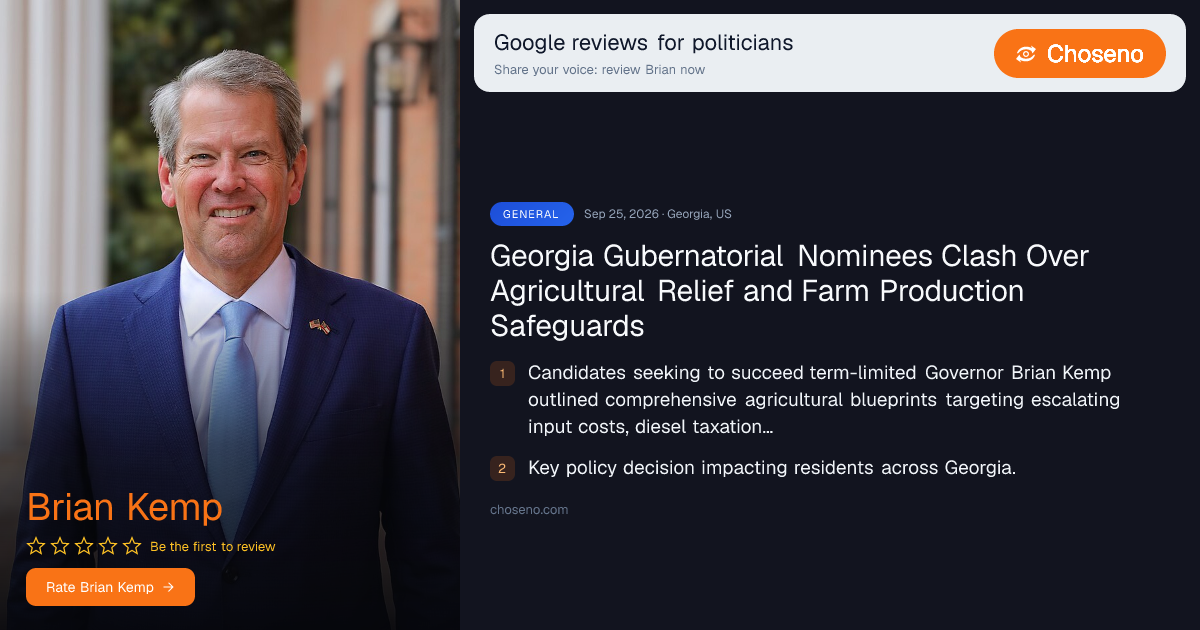
Georgia Gubernatorial Nominees Clash Over Agricultural Relief and Farm Production Safeguards
Candidates seeking to succeed term-limited Governor Brian Kemp outlined comprehensive agricultural blueprints targeting escalating input costs, diesel taxation relief, water allocations, and family farm preservation.
Read full article
General
US Sep 25, 2026
Oregon Gubernatorial Candidates Kotek and Drazan Present Contrasting Economic Platforms in Rematch Forum
Oregon Governor Tina Kotek and Republican challenger Christine Drazan outlined starkly different economic blueprints regarding commercial regulations, tax structures, and industrial competitiveness at a Portland business forum.
Read full article
General
US Sep 25, 2026
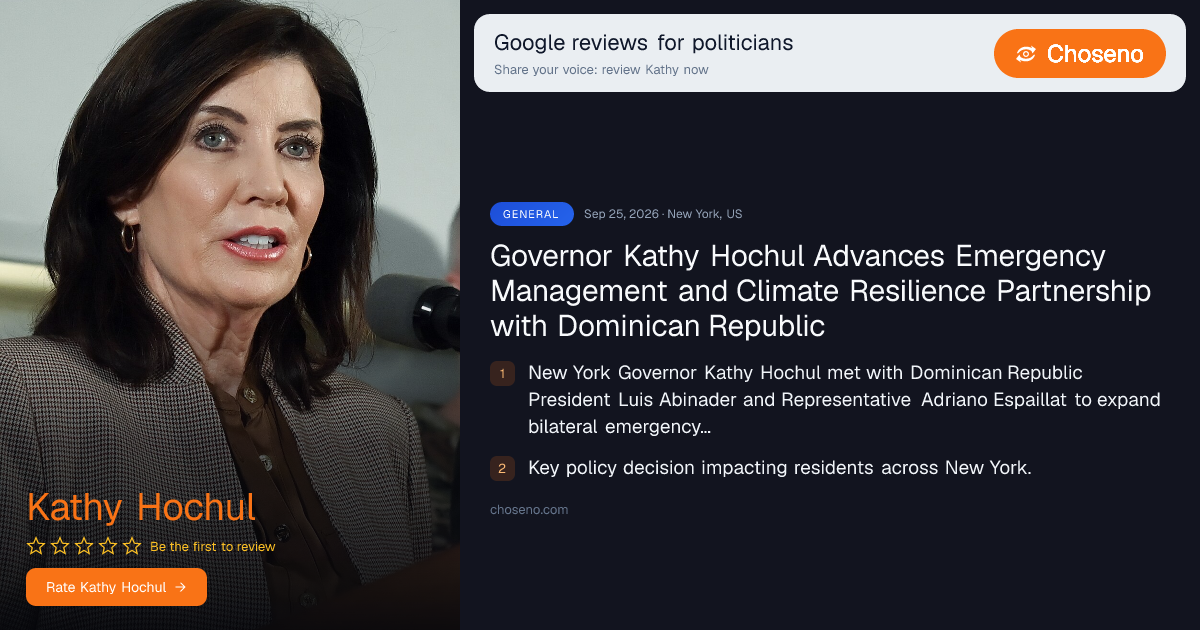
Governor Kathy Hochul Advances Emergency Management and Climate Resilience Partnership with Dominican Republic
New York Governor Kathy Hochul met with Dominican Republic President Luis Abinader and Representative Adriano Espaillat to expand bilateral emergency management cooperation, training exchanges, and environmental resilience.
Read full article