South Dakota Gubernatorial Candidates Form Rare Bipartisan Coalition Against Federal Beef Import Quotas
In a televised gubernatorial debate at the South Dakota State Fair, Republican Governor Larry Rhoden and Democratic challenger Dan Ahlers united in opposition to federal proposals permitting three hundred thousand metric tons of tariff-free foreign beef imports, warning the policy threatens domestic cattle ranchers.
Choseno Civic News Desk September 7, 2026 3 min read South Dakota, US
What do you think of the people in this story? Rate them anonymously — tap a face below.
During a televised gubernatorial debate at the South Dakota State Fair in Huron, Republican Governor Larry Rhoden and Democratic nominee Dan Ahlers forged an unexpected bipartisan consensus in opposing federal trade proposals that would authorize three hundred thousand metric tons of tariff-free foreign beef imports into the United States. While clashing sharply over state budget priorities, property tax assessments, and reproductive healthcare, both contenders voiced urgent alarm that opening domestic markets to foreign livestock undercuts South Dakota’s family-owned ranches and destabilizes the state’s agricultural economy.
The federal import initiative, proposed by former President Donald J. Trump as an administrative mechanism to curb escalating grocery store beef prices for national consumers, has provoked fierce pushback across Great Plains cattle communities. Addressing debate moderators and an audience comprised largely of agricultural producers, Governor Rhoden explained that while he maintains broad ideological alignment with national conservative policies, he could not endorse trade measures that disadvantage domestic cattle operations. Rhoden emphasized that South Dakota cattlemen already operate under narrow profit margins, burdened by escalating diesel fuel expenses, feed costs, and stringent domestic processing regulations that foreign competitors do not face.
Democratic challenger Dan Ahlers concurred with Rhoden’s assessment, characterizing the proposed flood of foreign beef imports as a reckless policy intervention that treats family farmers as collateral damage in national political maneuvers. Ahlers argued that artificially depressing wholesale livestock prices will accelerate the consolidation of independent ranches into corporate agribusiness conglomerates without delivering durable price relief to retail consumers. Both candidates echoed concerns raised by the South Dakota Cattlemen’s Association and the South Dakota Stockgrowers Association, demanding that federal trade representatives enforce mandatory country-of-origin labeling rules and preserve import tariffs to protect domestic agricultural integrity and herd biosecurity throughout the upper Midwest.
The candidates also engaged in sharp exchanges over land use and eminent domain authority regarding proposed interstate carbon capture pipelines. Rural landowners and agricultural cooperatives have organized extensively against state regulatory frameworks that permit private carbon sequestration developers to condemn private farmland for pipeline easements. Ahlers pledged to support constitutional property protections that ban the use of eminent domain for private commercial pipelines, while Rhoden defended existing state utility commission oversight processes as balanced mechanisms intended to support regional ethanol processing infrastructure and corn growers across the state.
On state fiscal governance, Ahlers sharply criticized the Rhoden administration over rising residential and agricultural property tax valuations, proposing that the state utilize its ongoing budget reserves to fund direct property tax credits and substantially increase state aid to rural K-12 public school districts. In response, Governor Rhoden defended his administration’s conservative fiscal management, pointing to South Dakota’s lack of a state personal income tax, low corporate regulatory burdens, and record state reserve funds as proof that state spending discipline protects the local economy from national inflationary pressures.
The debate highlighted the unique political geography of South Dakota, where deep agricultural dependencies frequently supersede national partisan orthodoxy. With the November general election approaching, the shared opposition to federal trade directives demonstrates that defending ranching livelihoods remains an indispensable prerequisite for securing statewide executive office in Pierre.
Rate the people mentioned in this article


Related Coverage in General
See all General newsGeneral
US Sep 25, 2026
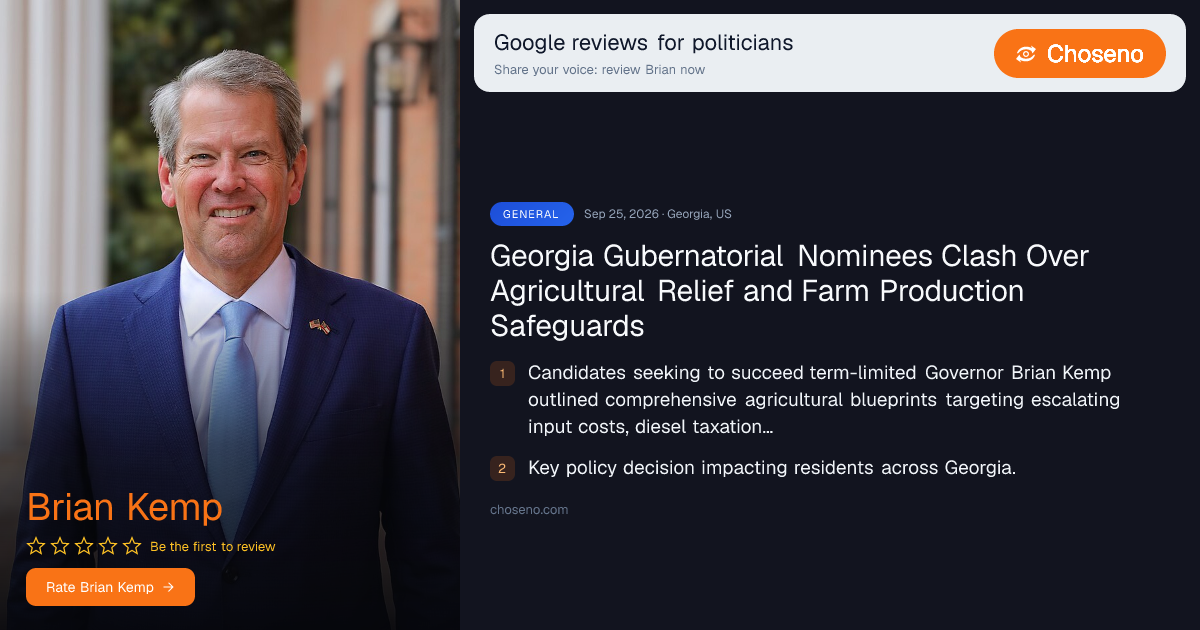
Georgia Gubernatorial Nominees Clash Over Agricultural Relief and Farm Production Safeguards
Candidates seeking to succeed term-limited Governor Brian Kemp outlined comprehensive agricultural blueprints targeting escalating input costs, diesel taxation relief, water allocations, and family farm preservation.
Read full article
General
US Sep 25, 2026
Oregon Gubernatorial Candidates Kotek and Drazan Present Contrasting Economic Platforms in Rematch Forum
Oregon Governor Tina Kotek and Republican challenger Christine Drazan outlined starkly different economic blueprints regarding commercial regulations, tax structures, and industrial competitiveness at a Portland business forum.
Read full article
General
US Sep 25, 2026
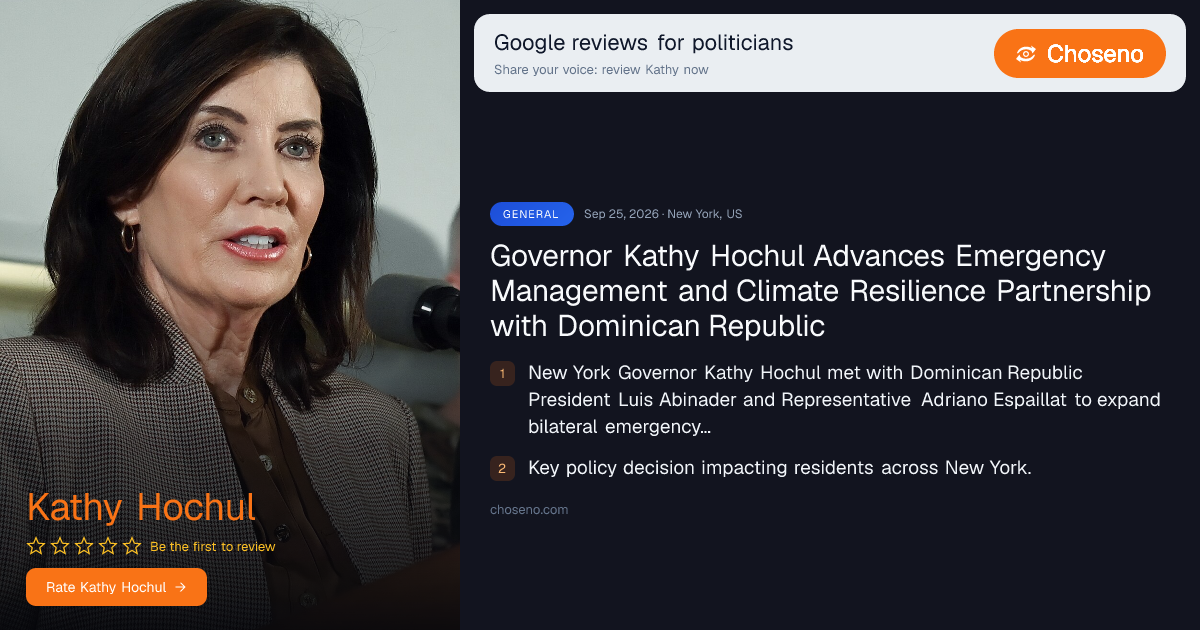
Governor Kathy Hochul Advances Emergency Management and Climate Resilience Partnership with Dominican Republic
New York Governor Kathy Hochul met with Dominican Republic President Luis Abinader and Representative Adriano Espaillat to expand bilateral emergency management cooperation, training exchanges, and environmental resilience.
Read full article