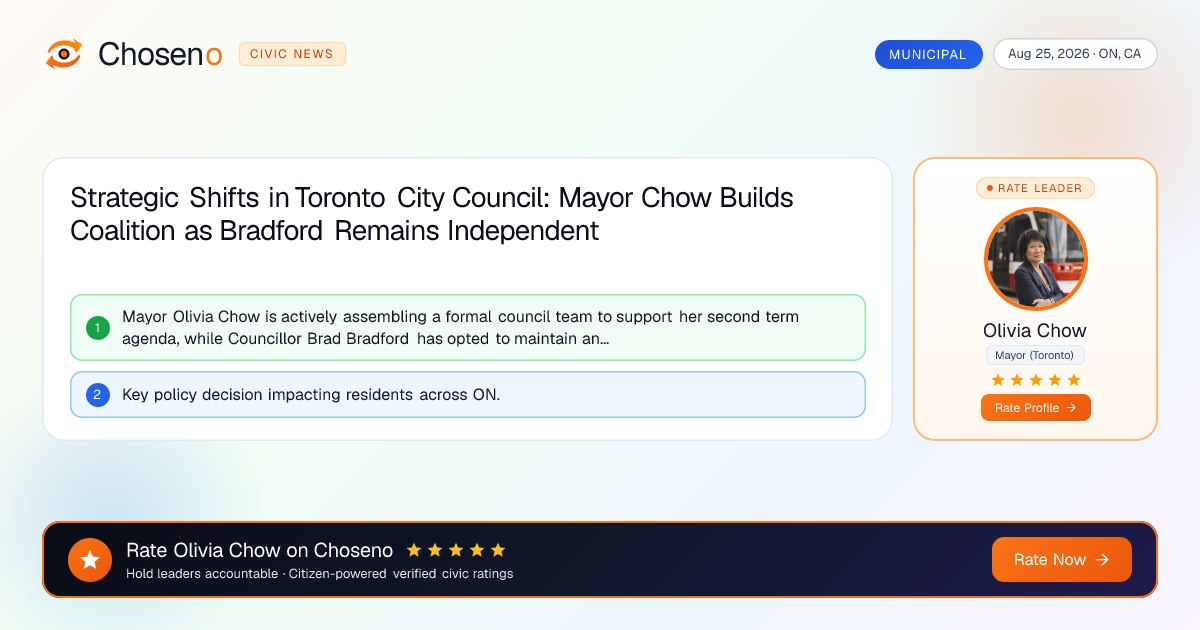
Strategic Shifts in Toronto City Council: Mayor Chow Builds Coalition as Bradford Remains Independent
Mayor Olivia Chow is actively assembling a formal council team to support her second term agenda, while Councillor Brad Bradford has opted to maintain an independent approach. These divergent political strategies signal a shift in how municipal policy will be negotiated and advanced at Toronto City Hall.
Choseno Civic News Desk August 25, 2026 2 min read ON, CA
★ Choseno Civic Briefing
Key Leaders
Dateline: Toronto, August 25, 2026
As Toronto enters a new political cycle, the structural approach to governance at City Hall is undergoing a visible transformation. Mayor Olivia Chow has begun the process of building a dedicated council team, a move that contrasts sharply with the strategy of Councillor Brad Bradford, who is "rolling solo."
Policy & Taxpayer Impact
The formation of a formal team by the Mayor’s office is designed to streamline the passage of municipal policy and budget priorities. For taxpayers, this shift suggests a more centralized approach to legislative outcomes, potentially reducing the time spent on floor negotiations but also concentrating influence within the Mayor's inner circle. Conversely, Bradford’s independent stance suggests a focus on individual advocacy, which may offer a different avenue for constituent representation but could face challenges in securing the necessary votes for policy implementation.
Political & Legal Stakes
This development highlights the evolving nature of municipal party-like structures within a non-partisan council framework. By building a team, Chow is attempting to solidify a reliable voting bloc to ensure her second-term agenda remains stable. Bradford’s decision to remain independent serves as a political statement, positioning himself as an alternative voice outside of the Mayor’s established coalition.
The Debate: Proponent vs. Critic
Proponents of the Mayor’s team-building strategy argue that a cohesive group is essential for effective governance and delivering on campaign promises in a complex municipal environment. Critics, however, suggest that such consolidation may stifle diverse debate and limit the influence of independent councillors. Those supporting Bradford’s solo approach emphasize the importance of individual accountability and the ability to vote based on specific ward needs rather than party-line loyalty.
Public Accountability Context
Citizens are encouraged to monitor how these internal council dynamics affect the speed and quality of service delivery. As the Mayor seeks to formalize her support base, the transparency of these alliances will be a key metric for voters assessing the effectiveness of the current administration. The divergence between a team-based approach and independent representation provides a clear choice for residents to evaluate as they look toward future municipal decision-making.
Rate the people mentioned in this article


Related Coverage in Municipal
See all Municipal newsMunicipal
US Aug 25, 2026
Salem City Council Initiates Application Process Following Death of Councilman John Saunders
The Salem City Council has officially opened the application process to fill a vacant seat created by the passing of Councilman John Saunders. This administrative transition ensures continued municipal representation for residents while the council manages the appointment process.
Read full article
Municipal
US Aug 25, 2026
Portland City Council Moves Forward with Old Westmoreland Road Development
The Portland City Council has officially advanced a new development project located on Old Westmoreland Road. This legislative action marks a significant step in the city's land-use planning, with potential long-term implications for local infrastructure and municipal growth.
Read full article
Municipal
US Aug 25, 2026
City Council Approves Updates to FEMA Flood Plain Management Ordinance
The City Council has officially updated its flood plain management ordinance to align with current FEMA standards. This regulatory adjustment aims to ensure continued compliance with federal guidelines, which may influence local insurance requirements and development standards.
Read full article