Hawaii Mobilizes Emergency Infrastructure Teams as Tropical Storm Lala Leaves 100,000 Without Power
State and county emergency officials deploy disaster response teams across Hawaii as Tropical Storm Lala causes widespread flash flooding, structural damage in Naalehu, and knocks out electrical service to over 100,000 residents.
Choseno Environmental Crisis Bureau August 18, 2026 1 min read HI, US

★ Choseno Civic Briefing
HONOLULU, HI — Emergency management authorities across the State of Hawaii mobilized civil defense units and heavy machinery crews on Tuesday following the passage of Tropical Storm Lala, which generated record-breaking rainfall, destroyed six regional bridges, and disrupted electrical power for more than 100,000 residential and commercial customers.
Extreme Precipitation and Big Island Infrastructure Impact
Rain gauges in high-elevation terrain on Hawaii Island recorded over 42 inches of rain within a 36-hour window, triggering catastrophic debris flows that severed major transportation arteries in the Kaʻū district. The southern communities of Naʻalehu, Pāhala, and Waiʻōhinu remained partially isolated as Highway 11 sustained structural washouts.
Hawaii County Civil Defense confirmed one storm-related casualty: a 90-year-old Naʻalehu resident whose residence was engulfed by floodwaters. Search and rescue personnel conducted over 40 high-water evacuations across inundated rural residential subdivisions, operating temporary emergency shelters in coordination with the American Red Cross.
Power Grid Rebuilding and Utility Warning
Hawaiian Electric dispatched emergency transmission repair crews across the Big Island, Maui, and Oahu. Utility executives cautioned that while metropolitan feeders would see progressive restoration within 48 hours, replacing downed high-voltage transmission towers and sheared wooden poles in remote mountainous canyons will require multi-week construction efforts.
Acting Governor Sylvia Luke and county leadership signed emergency disaster declarations unlocking state contingency funds and authorizing National Guard engineering support to assist municipal public works departments with debris clearing and water purification distribution.
Federal Emergency Declaration and Climate Resilience
Hawaii's congressional delegation petitioned the Federal Emergency Management Agency (FEMA) for an expedited presidential major disaster declaration. Lawmakers noted that the increasing frequency of intense tropical cyclonic activity underscores the urgent necessity of federal funding to underground island power infrastructure and elevate coastal transit corridors.
Sources
Related Coverage in Climate
See all Climate news
Climate
CA Aug 17, 2026
B.C. Emergency Management Ministry Issues Directives Curbing Wildfire Evacuation Disinformation
British Columbia Premier David Eby and Emergency Management Minister Kelly Greene issue strict directives to combat coordinated online disinformation and fraudulent contractors targeting evacuated interior communities.
Read full article

Climate
US Aug 17, 2026
Federal Authorities Pause Border Barrier Construction Along Environmentally Sensitive Big Bend Corridor
Federal authorities temporarily halt border barrier construction in West Texas near Big Bend National Park following environmental impact petitions and logistical challenges across rugged desert canyon terrain.
Read full article
Climate
US Aug 17, 2026
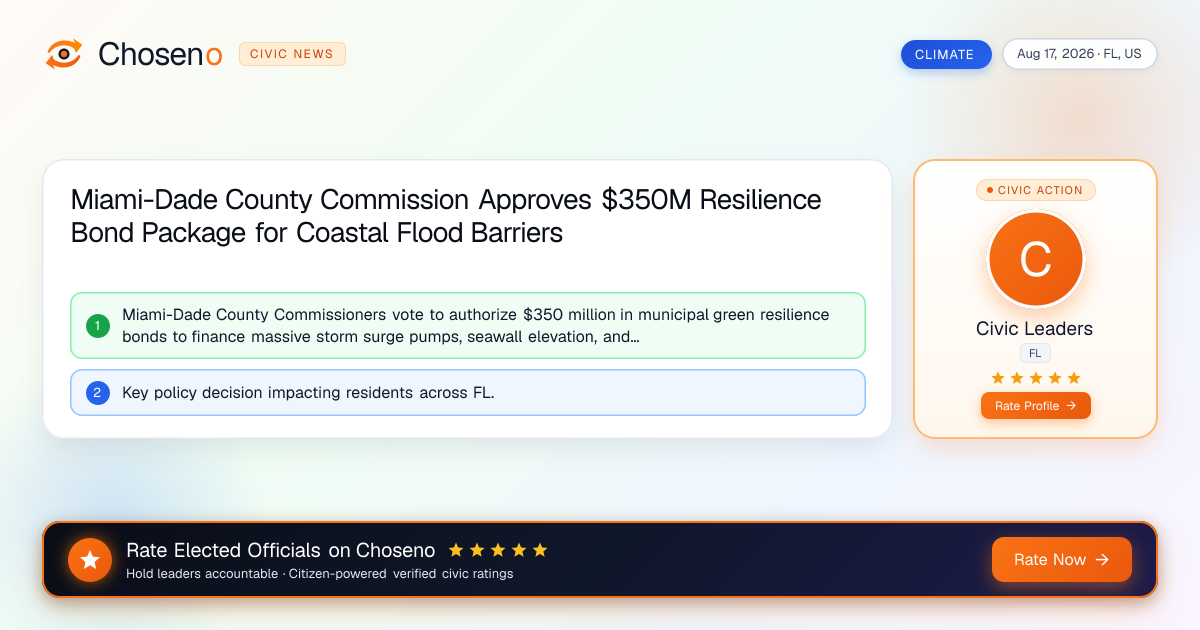
Miami-Dade County Commission Approves $350M Resilience Bond Package for Coastal Flood Barriers
Miami-Dade County Commissioners vote to authorize $350 million in municipal green resilience bonds to finance massive storm surge pumps, seawall elevation, and mangrove wetland restoration across vulnerable coastal neighborhoods.
Read full article