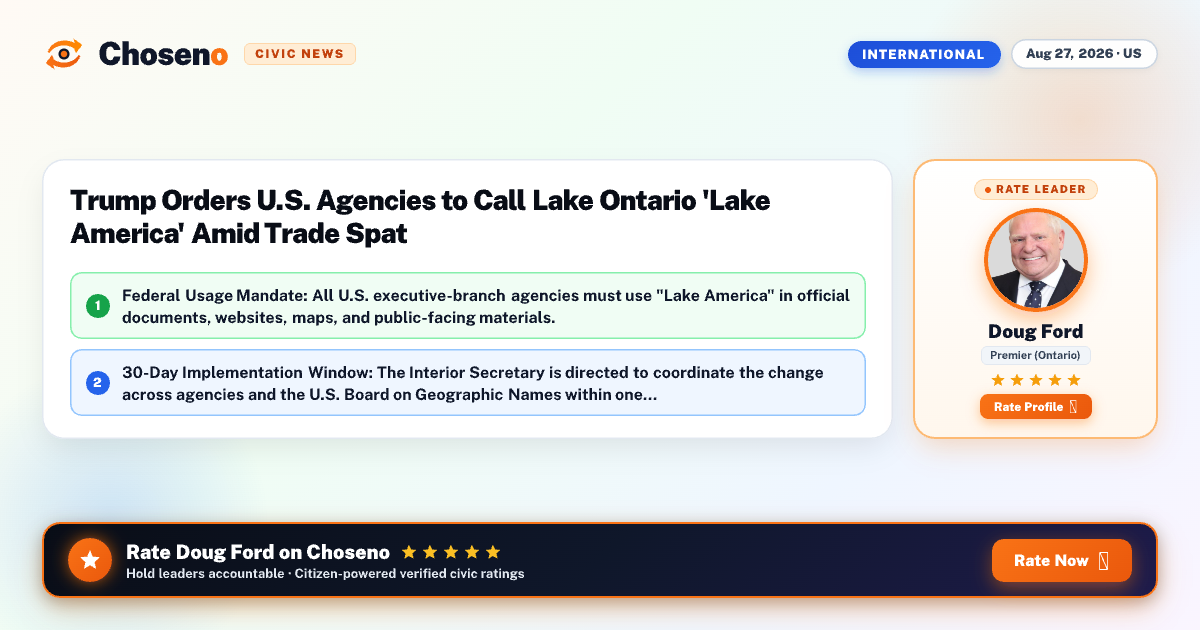
Trump Orders U.S. Agencies to Call Lake Ontario 'Lake America' Amid Trade Spat
President Trump signs executive order directing federal renaming of Lake Ontario to Lake America, a symbolic move with no legal effect in Canada.
Choseno Civic News Desk August 27, 2026 4 min read US
WASHINGTON — President Donald Trump signed an executive order on Thursday, August 27, 2026, directing the U.S. Department of the Interior and the U.S. Board on Geographic Names to update all federal databases, maps, contracts, and official communications to refer to Lake Ontario as "Lake America."
The order, signed in the Oval Office, instructs agencies to implement the name change across federal systems within 30 days. The move follows a breakdown in U.S.–Canada trade negotiations and escalates a war of words between Trump and Canadian leaders, including Ontario Premier Doug Ford.
Policy Mechanics & Core Decisions
The executive order targets only U.S. federal government usage. It does not alter the legal name of the lake under Canadian law, international treaties, or binational water-management agreements.
Key provisions include:
- Federal Usage Mandate: All U.S. executive-branch agencies must use "Lake America" in official documents, websites, maps, and public-facing materials.
- 30-Day Implementation Window: The Interior Secretary is directed to coordinate the change across agencies and the U.S. Board on Geographic Names within one month.
- Symbolic Scope: The order does not change the name on Canadian maps, provincial signage, or international navigation charts; those remain under Canadian and joint authority.
Trump framed the renaming as a response to what he described as unfair trade practices and a deteriorating relationship with Ontario, saying the U.S. no longer expects to "do much business with Ontario" and that the lake has long been integral to American exploration and commerce.
Background: How U.S. and Canada Name Shared Features
Lake Ontario is one of five Great Lakes straddling the U.S.–Canada border. Its name appears in federal statutes, provincial legislation, and international agreements governing water quality, shipping, fisheries, and environmental protection.
In the United States, the U.S. Board on Geographic Names (BGN), housed within the Department of the Interior, standardizes names for federal use. In Canada, the Geographical Names Board of Canada (GNBC) performs a similar function for federal agencies, while provinces maintain their own naming authorities.
For binational features like the Great Lakes, both countries typically coordinate through joint bodies such as the International Joint Commission, which oversees water levels and quality under treaties dating back more than a century. A unilateral administrative change on one side does not rewrite those treaties or the other country's domestic laws.
Stakeholder Reactions
Canadian leaders rejected the move outright. Prime Minister Mark Carney said the name is more than 400 years old and will remain "Lake Ontario—then, now and always." Ontario Premier Doug Ford and federal Industry Minister Melanie Joly echoed that Canada will continue to use the original name.
U.S. officials defended the order as an internal administrative matter. Trump said the renaming reflects the lake's role in American history and commerce, and he tied it to broader frustrations over trade talks that collapsed earlier in the week.
Cross-border groups and Great Lakes stakeholders have not yet issued formal statements, but the order is likely to draw scrutiny from environmental organizations, shipping associations, and tourism boards that rely on consistent naming for public information and safety campaigns.
Precedents & Symbolic Renamings
The Lake Ontario order follows a pattern of symbolic gestures in Trump's second term. Earlier this year, he signed an executive order directing U.S. agencies to refer to the Gulf of Mexico as the "Gulf of America" in federal materials—a change that similarly applies only within U.S. government usage and has no effect on Mexican or international naming.
Historical naming disputes over shared features are rare but not unprecedented. In the 20th century, the U.S. and Canada coordinated to standardize spellings and usage for many border lakes and rivers, avoiding conflicting names that could confuse navigation, emergency response, and environmental reporting.
Constituent Impact: What Changes—and What Doesn't
- U.S. Federal Materials: Maps, websites, grants, and contracts issued by U.S. agencies will begin using "Lake America" within 30 days.
- Canadian Jurisdiction: Provincial signage, Canadian federal publications, and navigation charts produced by Canadian authorities will continue to say "Lake Ontario."
- Binational Programs: Joint environmental monitoring, water-level management, and emergency-response protocols remain governed by existing treaties; the order does not rewrite those agreements.
- Private Sector and Media: Companies, news outlets, and mapping services outside the U.S. federal government are free to keep using "Lake Ontario." Even within the U.S., private entities are not legally required to adopt the new name.
Outlook & Next Steps
- Implementation Timeline: U.S. agencies have 30 days to update databases, maps, and communications per the order.
- Potential Legal and Diplomatic Friction: While the order is largely symbolic, it could complicate joint communications, signage, and public information campaigns around the shared waterway.
- Political Context: The renaming follows a pattern of symbolic gestures in Trump's second term, including the earlier "Gulf of America" order.
- No Public Comment Period: The order does not trigger a public comment period or require legislative approval, as it operates through executive-branch administrative channels.
Analysts expect the order to remain a point of diplomatic friction as long as trade talks remain stalled. If negotiations resume, pressure could grow to revert to coordinated naming for joint materials, even if U.S. domestic usage retains "Lake America."
Sources
Rate the people mentioned in this article


Related Coverage in International
See all International newsInternational
US Aug 17, 2026
Jared Kushner Holds Three-Hour Jerusalem Summit with Netanyahu to Advance U.S. 15-Point Gaza Framework
Trump envoy Jared Kushner and former British Prime Minister Tony Blair meet Israeli Prime Minister Benjamin Netanyahu in Jerusalem to navigate critical deadlocks over troop withdrawal and disarmament.
Read full article
International
CA Aug 14, 2026
Minister Anita Anand Announces Targeted International Maritime Security Sanctions
Foreign Affairs Minister Anita Anand details new sanctions targeting entities involved in maritime disruptions and regional security challenges.
Read full article
International
CA Aug 14, 2026
Minister Anita Anand Announces Targeted International Maritime Security Sanctions
Canada imposes new sanctions against individuals and security entities obstructing commercial navigation in global transit lanes.
Read full article