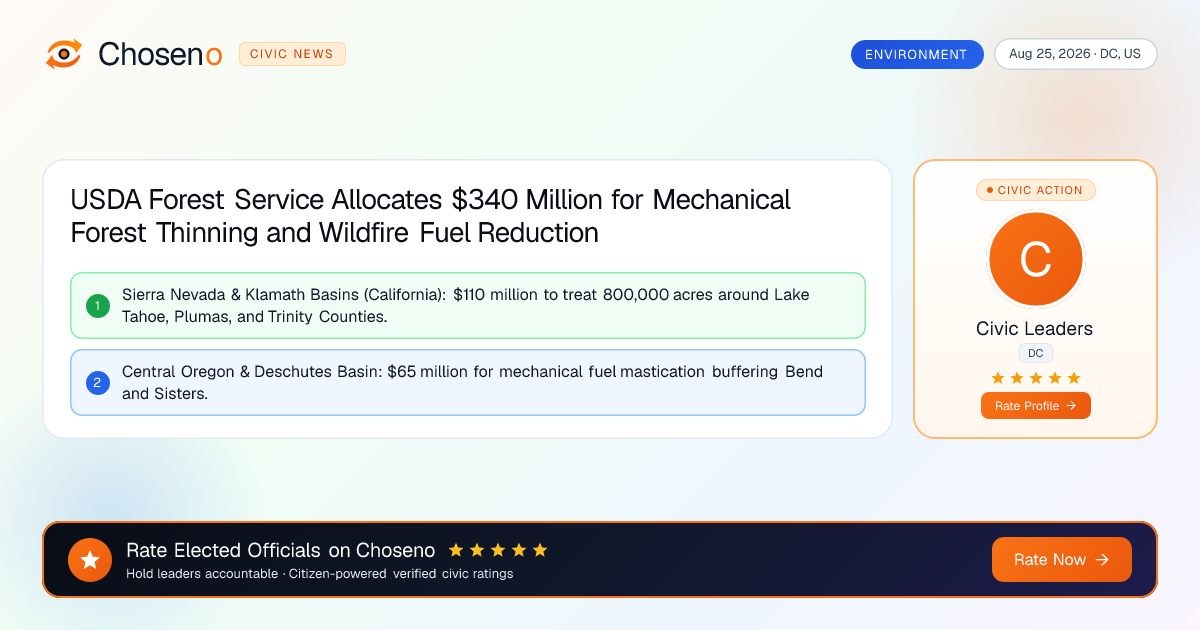
USDA Forest Service Allocates $340 Million for Mechanical Forest Thinning and Wildfire Fuel Reduction
Agriculture Secretary Tom Vilsack and Forest Service Chief Randy Moore direct $340 million from the Bipartisan Infrastructure Law to execute mechanical forest thinning, mastication, and prescribed fire treatments across 2.5 million acres of Western national forests.
Choseno Forestry & Natural Resources Bureau August 25, 2026 2 min read DC, US
★ Choseno Civic Briefing
Key Leaders
WASHINGTON — Secretary of Agriculture Tom Vilsack and U.S. Forest Service Chief Randy Moore announced on Monday the distribution of $340 million in federal wildfire risk reduction funding under the Confronting the Wildfire Crisis strategy to execute mechanical forest thinning, brush mastication, and cultural prescribed burns across 2.5 million high-risk acres adjacent to vulnerable Western communities in California, Oregon, Washington, Idaho, Montana, and Colorado.
The landscape-scale forestry treatments, administered through Good Neighbor Authority agreements with state forestry agencies and sovereign tribal nations, remove dense, overgrown ladder fuels and small-diameter timber that historically fueled catastrophic canopy megafires in overcrowded Western pine and fir forests.
Protecting Communities and Restoring Historical Forest Ecology A century of total fire suppression combined with prolonged climate droughts created unnaturally dense forests with over 500 trees per acre—ten times historical levels—creating explosive fuel loads that threaten municipal drinking water watersheds, electrical transmission corridors, and residential neighborhoods in the wildland-urban interface (WUI).
"Catastrophic wildfires are no longer just an environmental issue—they are an urgent public safety and economic crisis for millions of Western families," Secretary Tom Vilsack said during an announcement at the Plumas National Forest in Northern California. "This $340 million investment puts heavy forestry masticators and skilled sawyer crews into our most vulnerable forests, removing excess fuel, restoring healthy, open forest canopies, and creating defensive buffer zones that protect communities and give our wildland firefighters a safe tactical advantage."
Regional Forestry Landscape Allocations Key high-priority landscape awards include:
- Sierra Nevada & Klamath Basins (California): $110 million to treat 800,000 acres around Lake Tahoe, Plumas, and Trinity Counties.
- Central Oregon & Deschutes Basin: $65 million for mechanical fuel mastication buffering Bend and Sisters.
- Northern Rockies & Bitterroot Valley (Montana/Idaho): $60 million for collaborative cross-boundary fuelbreaks.
- Colorado Front Range Watershed Protection: $55 million for mechanical thinning protecting Denver and Fort Collins municipal water supply reservoirs.
- Tribal Forest Restoration Co-Stewardship: $50 million dedicated for tribal forestry departments implementing traditional ecological burning.
Wildland firefighting federations, Western governors, and municipal water authorities commended the federal investment, highlighting that proactive forest thinning dramatically reduces wildfire suppression costs and prevents destructive post-fire debris flows.
Related Coverage in Environment
See all Environment newsEnvironment
US Aug 25, 2026
NOAA Directs $210 Million for Ocean Acidification Sensors and Atlantic Hurricane Telemetry Buoys
Commerce Secretary Gina Raimondo and NOAA Administrator Richard Spinrad announce $210 million to deploy 150 automated deep-ocean observing buoys and seafloor ocean acidification telemetry arrays along the Atlantic and Gulf Coasts.
Read full article

Environment
US Aug 25, 2026
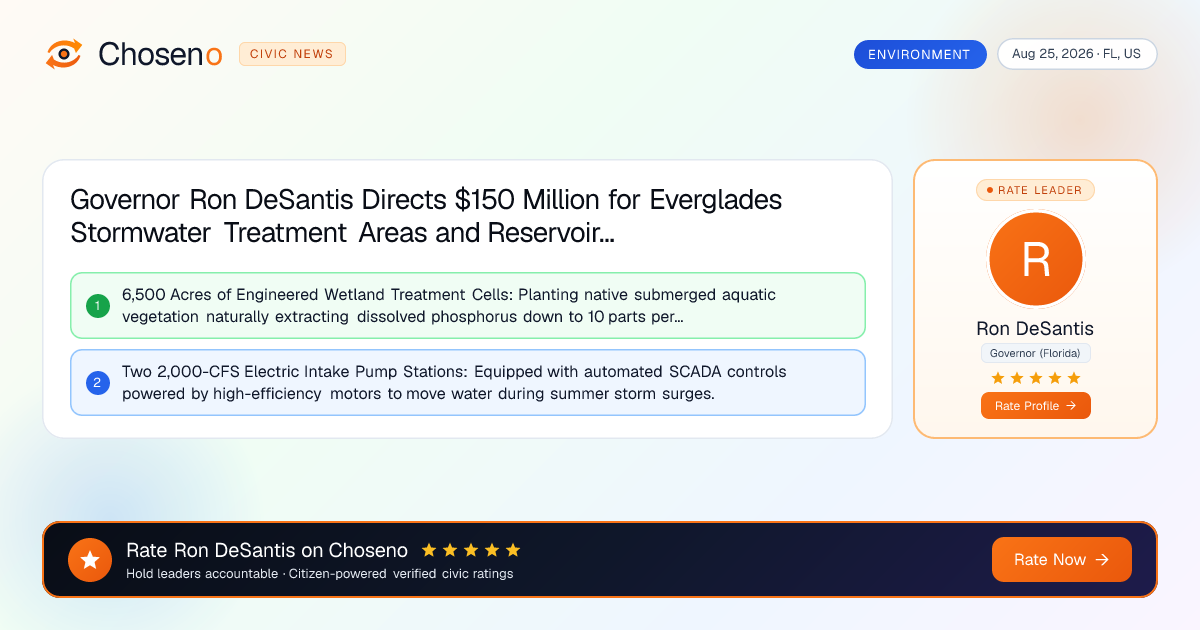
Governor Ron DeSantis Directs $150 Million for Everglades Stormwater Treatment Areas and Reservoir Inflows
Florida Governor Ron DeSantis and SFWMD allocate $150 million to expand Stormwater Treatment Areas and construct automated inflow pump stations for the Everglades Agricultural Area (EAA) Reservoir.
Read full article
Environment
US Aug 25, 2026
Governor Gretchen Whitmer Directs $125 Million to Accelerate Michigan Lead Water Pipe Replacements
Michigan Governor Gretchen Whitmer and EGLE allocate $125 million in state clean water grants to excavate and replace 25,000 lead drinking water service lines in Benton Harbor, Flint, Detroit, and Grand Rapids.
Read full article