Governor Patrick Morrisey Awards $1.17M for Rural Health Transformation in Parkersburg
West Virginia Governor Patrick Morrisey launches the Rural Health Transformation Program with a $1.17M award to Spotted Owl and Chesapeake Healthcare Center, linking healthcare access to workforce growth.
Choseno Appalachian Healthcare & Economy Desk September 4, 2026Updated September 6, 2026 3 min read WV, US
PARKERSBURG, W.Va. — West Virginia Governor Patrick Morrisey has announced the initial distribution of funding under the state's newly established Rural Health Transformation Program, awarding a $1.17 million grant to Spotted Owl Healthcare Organization in partnership with the Chesapeake Healthcare Center in Parkersburg. The grant marks the executive launch of Morrisey's broader Health to Prosperity agenda, an initiative designed to expand clinical care delivery in rural Appalachian communities while directly boosting state workforce participation.
Announcing the investment during a morning briefing at the Chesapeake Healthcare Center facility in Wood County, Governor Morrisey framed the rural transformation grants as a vital economic development strategy. West Virginia has historically faced acute public health challenges, including elevated rates of chronic illness, cardiovascular disease, diabetes, and opioid dependency, which have contributed to the state maintaining one of the lowest labor force participation rates in the United States. State officials argue that expanding preventive healthcare infrastructure to worksites, community hubs, and rural counties is critical to improving baseline quality of life and returning discouraged workers to the productive economy.
Under the partnership, Spotted Owl Healthcare will deploy its community wellness and care coordination teams alongside the clinical diagnostic capabilities of the Chesapeake Healthcare Center. The collaborative initiative focuses on establishing worksite-based health screenings, providing routine biometric checks, occupational health diagnostics, primary care referrals, and ongoing disease management. By providing direct access to nurse practitioners and preventative specialists at local employers, the program seeks to identify chronic conditions before they result in debilitating health crises or prolonged absences from the job.
A core component of the grant allocation focuses on integrating behavioral healthcare and substance use disorder recovery resources directly into primary care settings. Given West Virginia's prolonged struggle with the opioid epidemic and synthetic fentanyl proliferation, the program funds specialized recovery coaches and peer counselors to help individuals navigating addiction enter evidence-based outpatient treatment programs while maintaining gainful employment.
Executive Director Genise Lalos and Co-Owner Andy Yerrid of Chesapeake Healthcare Center emphasized that the funding provides health providers with the necessary resources to meet working families where they are, overcoming significant geographic and transportation barriers that frequently deter rural West Virginians from seeking timely preventative care. Leadership noted that by catching health risks before they escalate into acute medical emergencies, the program aims to alleviate overcrowding at regional hospital emergency departments while lowering long-term Medicaid expenditures for state taxpayers.
The Morrisey administration plans to roll out additional grant awards across southern and central West Virginia coalfield communities through the Rural Health Transformation Program over the coming fiscal quarters. The initiative is funded through a combination of state general revenue allocations and restructured federal Appalachian regional healthcare development grants authorized by the state legislature.
The program has drawn broad interest from regional healthcare administrators and local business chambers across the Mid-Ohio Valley. Business leaders have frequently cited health-related absenteeism and workforce shortages as serious impediments to attracting major manufacturing and industrial logistics investments to the state. By directly aligning public healthcare investments with employment retention, Governor Morrisey's administration seeks to demonstrate that proactive rural public health interventions serve as an indispensable pillar of regional economic competitiveness.
Rate the people mentioned in this article

Related Coverage in Public Health
See all Public Health newsPublic Health
US Sep 5, 2026
North Dakota Governor Kelly Armstrong Signs Law Banning Synthetic Kratom and Regulating Sales
Governor Kelly Armstrong signs House Bill 1628 following a special session, outlawing high-potency synthetic kratom compounds and restricting natural kratom to adults 21 and older.
Read full article
Public Health
US Sep 4, 2026
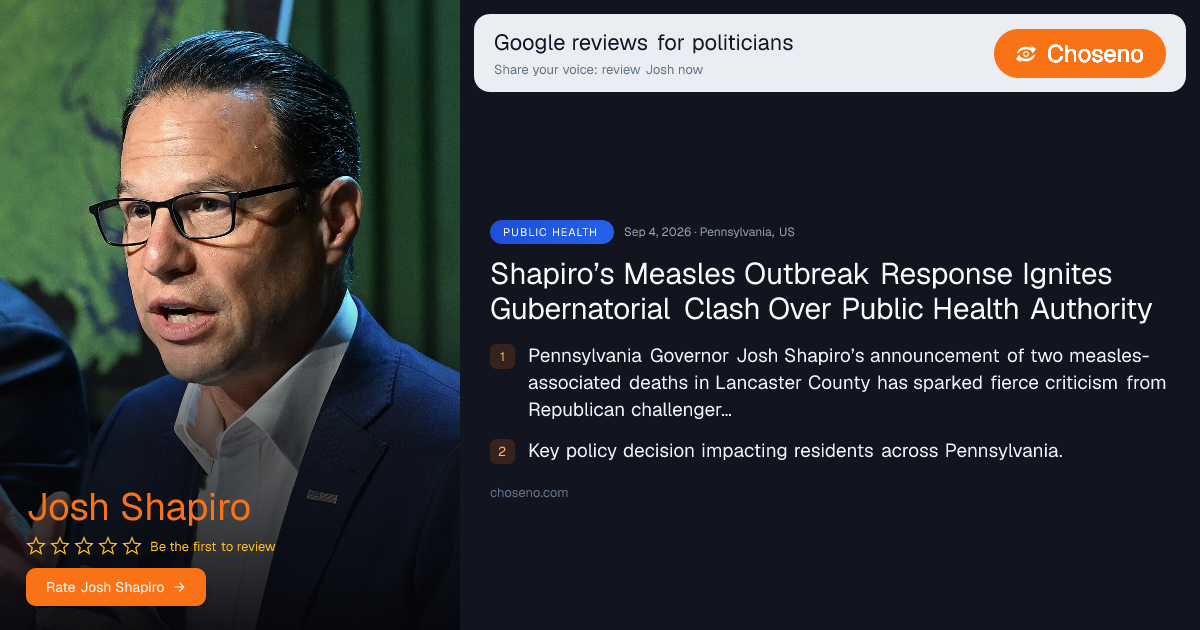
Shapiro’s Measles Outbreak Response Ignites Gubernatorial Clash Over Public Health Authority
Pennsylvania Governor Josh Shapiro’s announcement of two measles-associated deaths in Lancaster County has sparked fierce criticism from Republican challenger Stacy Garrity, who linked the administration’s public health directives to pandemic-era executive overreach.
Read full article
Public Health
US Aug 28, 2026
Allegations of Fabricated Measles Data in Pennsylvania Prompt Public Scrutiny of Health Reporting
Robert F. Kennedy Jr. has publicly questioned the legitimacy of measles death statistics reported by Pennsylvania health officials. The claims raise significant questions regarding the transparency and accuracy of state-level public health data reporting.
Read full article