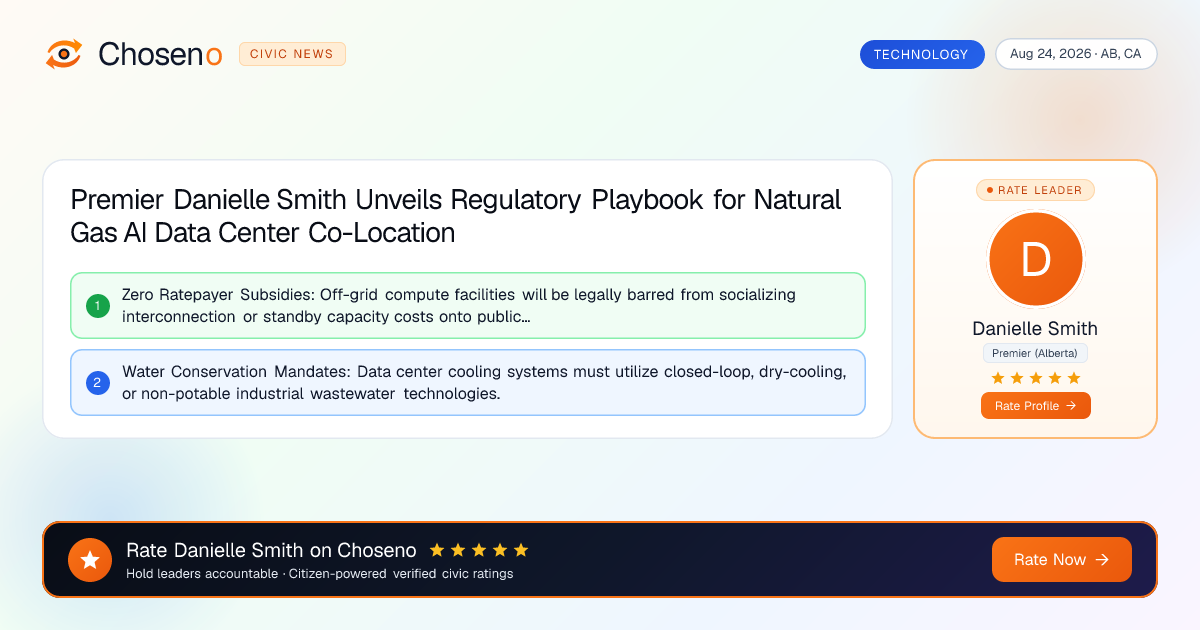
Premier Danielle Smith Unveils Regulatory Playbook for Natural Gas AI Data Center Co-Location
Alberta Premier Danielle Smith introduces a statutory framework permitting hyperscale AI compute clusters to co-locate directly at natural gas generation sites, insulating residential ratepayers from grid connection costs.
Choseno Western Energy Desk August 24, 2026 1 min read AB, CA
★ Choseno Civic Briefing
Key Leaders
EDMONTON — Alberta Premier Danielle Smith unveiled the province's Digital Refinery and High-Compute Strategy on Monday, outlining draft legislation that allows technology operators to build hyperscale artificial intelligence data centers directly adjacent to dedicated natural gas and geothermal generation plants.
The policy, developed in consultation with the Alberta Electric System Operator (AESO) and the Utilities Consumer Advocate, establishes an "islanded microgrid" regulatory designation. This framework permits data center operators to contract private, behind-the-meter generation without imposing transmission tariff burdens or capacity constraints on the provincial bulk electricity grid.
Attracting Global Compute Capital to Alberta Premier Smith emphasized that Alberta's abundant natural gas reserves, extensive fiber-optic connectivity, and low ambient temperatures provide a unique competitive advantage for global technology firms seeking gigawatt-scale power for AI model training.
"Artificial intelligence compute clusters require massive, continuous baseload power that renewable intermittency alone cannot provide," Premier Smith stated in Calgary. "Alberta has the energy, the technical workforce, and the deregulated market structure to become the premier compute jurisdiction in North America—all while fully protecting residential and small business consumers from transmission fee increases."
Ratepayer Safeguards and Carbon Capture Requirements Under the proposed legislation:
- Zero Ratepayer Subsidies: Off-grid compute facilities will be legally barred from socializing interconnection or standby capacity costs onto public transmission tariffs.
- Carbon Capture Readiness: Facilities exceeding 100 megawatts must incorporate post-combustion carbon capture utilization and storage (CCUS) infrastructure or execute long-term offset contracts within five years of commercial operation.
- Water Conservation Mandates: Data center cooling systems must utilize closed-loop, dry-cooling, or non-potable industrial wastewater technologies.
Technology industry associations and municipal leaders in Red Deer, Medicine Hat, and Grande Prairie expressed strong interest in the initiative, pointing to projected multi-billion-dollar capital investments and permanent engineering employment opportunities.
Rate the people mentioned in this article
Related Coverage in Technology
See all Technology newsTechnology
US Aug 25, 2026
Federal Communications Commission Enacts Mandatory Carrier Blocking Rules to Eliminate AI Robotext Scams
The FCC enacts landmark regulations requiring wireless mobile carriers to block illegal robotext messages at the network level and authenticate commercial text messaging traffic.
Read full article

Technology
US Aug 25, 2026
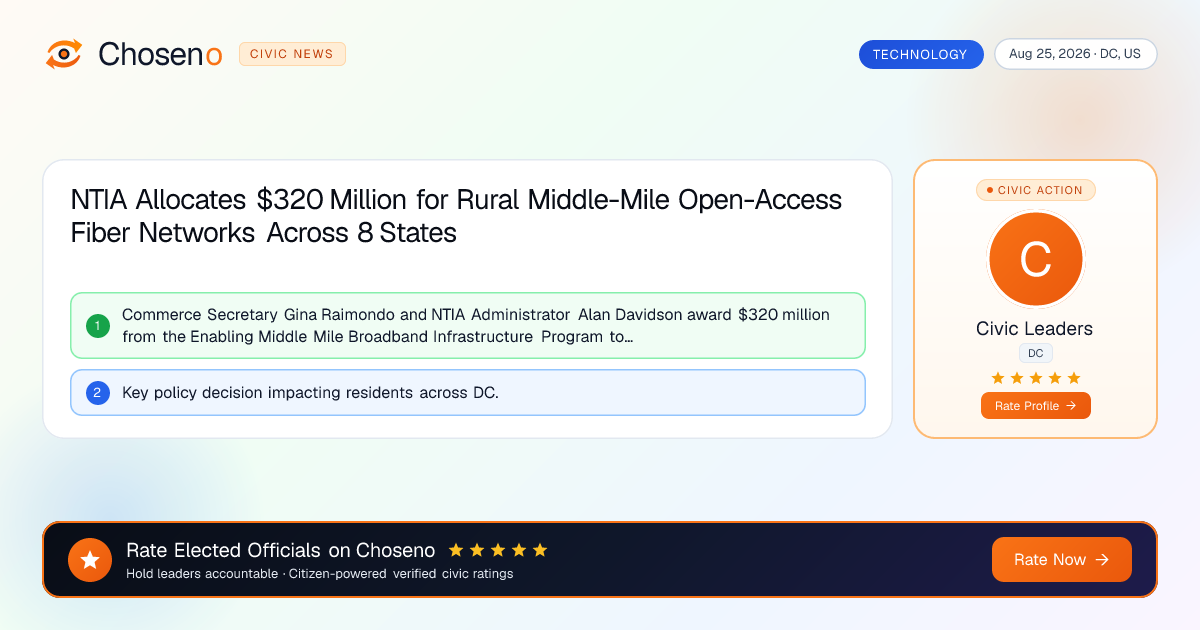
NTIA Allocates $320 Million for Rural Middle-Mile Open-Access Fiber Networks Across 8 States
Commerce Secretary Gina Raimondo and NTIA Administrator Alan Davidson award $320 million from the Enabling Middle Mile Broadband Infrastructure Program to construct 3,800 route-miles of open-access subterranean fiber optic backbones serving 45 rural and tribal communities.
Read full article
Technology
US Aug 25, 2026
Governor JB Pritzker Directs $110 Million for Chicago Quantum Foundries and Cryogenic Testing
Illinois Governor JB Pritzker announces $110 million in state capital grants through the Rebuild Illinois program to construct cryogenic testing facilities and specialized quantum qubit fabrication cleanrooms on Chicago's South Side.
Read full article