Premier David Eby Directs $35 Million for First Nations Forest Co-Management and Bio-Economy Hubs
B.C. Ministry of Forests deploys $35 million through the Indigenous Forest Bio-Economy Program, financing 16 First Nations-led wood innovation hubs producing bio-coal and natural fiber composites.
Choseno Indigenous Bio-Economy & Forestry Innovation Desk August 24, 2026 1 min read BC, CA
★ Choseno Civic Briefing
Key Leaders
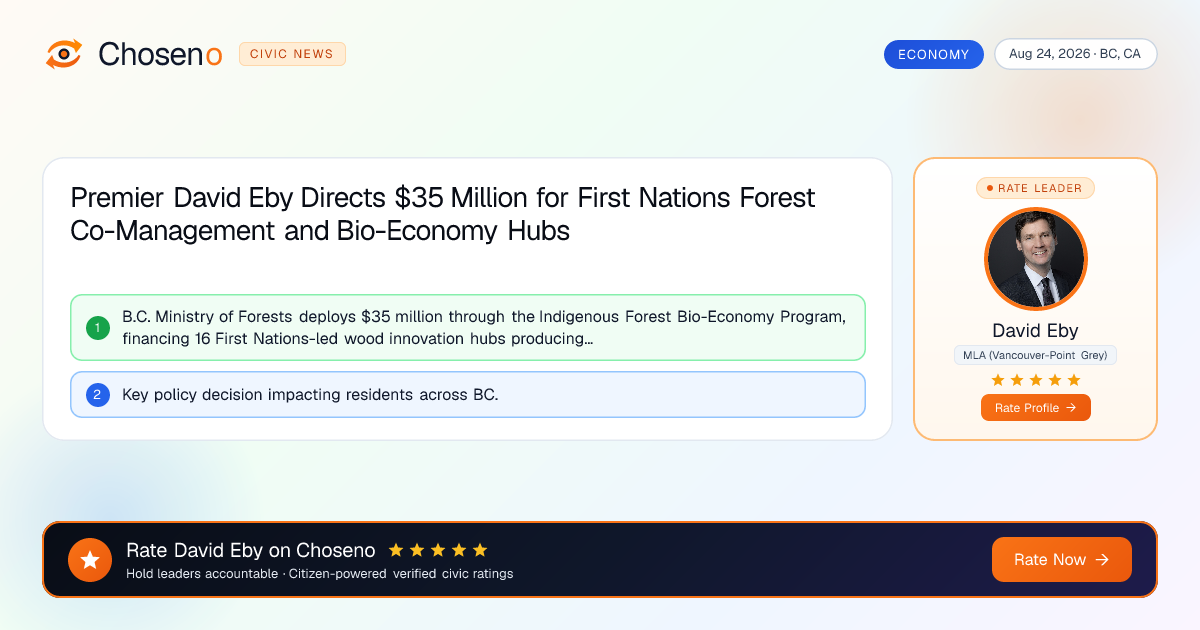
VICTORIA, BC — Premier David Eby and Minister of Forests Bruce Ralston announced the release of $35 million under the Indigenous Forest Bio-Economy Program (IFBP), delivering direct capital funding to 16 First Nations forestry corporations to construct advanced forest residue processing and clean biomaterials plants.
Transforming Forest Slash into High-Value Clean Biomaterials
The funding packages provide matching capital for Indigenous-owned facilities in Quesnel, Burns Lake, and Terrace to utilize roadside timber harvest slash and deadwood to manufacture biocoal, natural fiber insulation panels, biodegradable agricultural mulches, and pharmaceutical-grade tree resins. The bio-economy hubs divert 250,000 cubic meters of combustible forest slash from open-air burning, cutting seasonal wildfire risks and particulate air emissions while creating 320 full-time jobs in Indigenous communities.
Premier Eby affirmed that partnering with First Nations to lead the forest bio-economy creates sustainable jobs while advancing genuine economic reconciliation across rural British Columbia.
First Nations Forestry Council and Climate Researchers Praise
The First Nations Forestry Council commended the revenue-sharing and capital ownership model, ensuring Indigenous communities derive direct economic equity from their traditional forest territories.
University of British Columbia bio-products researchers highlighted that bio-coal directly replaces fossil metallurgical coal in commercial steelmaking.
Equipment Commissioning Timeline
Advanced biomaterial processing machinery will begin installation across all 16 Indigenous facilities in November 2026.
Sources
Rate the people mentioned in this article
Related Coverage in Economy
See all Economy newsEconomy Breaking
US Aug 24, 2026
Governor Mike DeWine Announces Approval of $1.1 Billion in Economic Projects Creating 3,550 Ohio Jobs
Ohio Tax Credit Authority approves 13 major economic development projects creating 3,553 new full-time jobs across advanced manufacturing, logistics, and technology.
Read full article
Economy
US Aug 24, 2026
Governor Josh Stein Secures $40 Million Lumber Treatment Facility in Scotland County
North Carolina Governor Josh Stein announces Great Southern Wood will invest $40 million and create 75 advanced timber manufacturing jobs in Laurinburg with state rail grant support.
Read full article
Economy Breaking
US Aug 24, 2026
Governor JB Pritzker Signs HB 4758 Barring Employers from Requiring Drivers Licenses
Illinois Governor JB Pritzker signs House Bill 4758 into law, amending employment opportunity statutes to prohibit employers from requiring a driver's license for jobs that do not involve driving.
Read full article