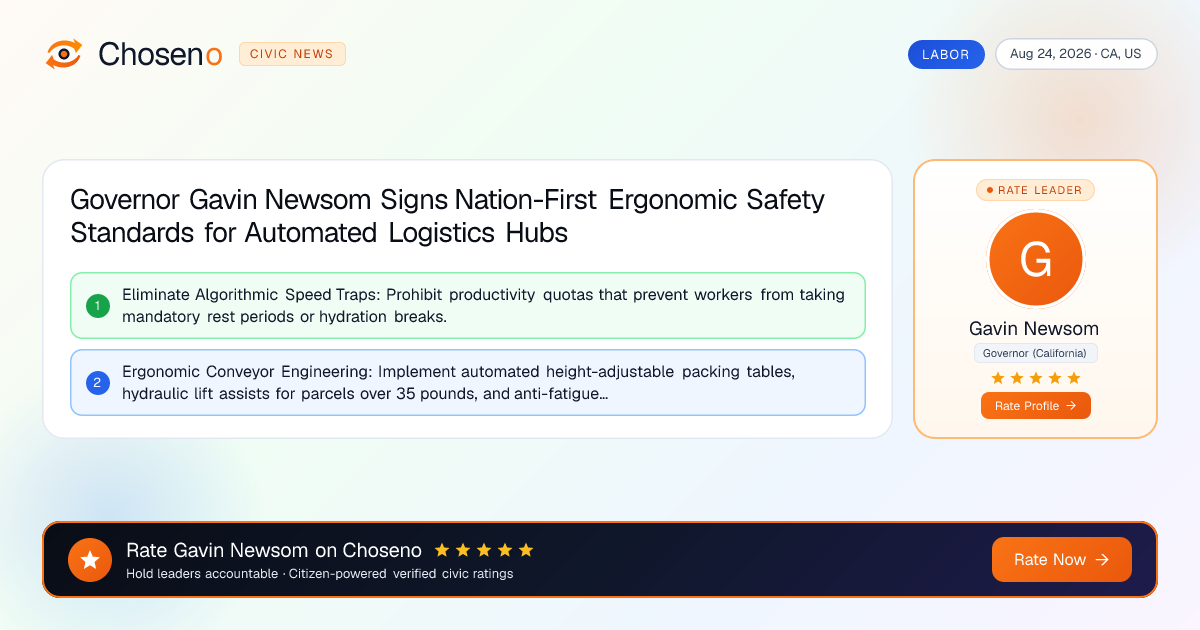
Governor Gavin Newsom Signs Nation-First Ergonomic Safety Standards for Automated Logistics Hubs
California Governor Gavin Newsom and Assemblymember Buffy Wicks enact Assembly Bill 1820, mandating automated speed limits on conveyor systems and establishing strict ergonomic injury caps in commercial logistics warehouses.
Choseno Sacramento Bureau August 24, 2026 2 min read CA, US
★ Choseno Civic Briefing
Key Leaders
LOS ANGELES — Governor Gavin Newsom signed Assembly Bill 1820 into law on Monday, enacting first-in-the-nation occupational safety and ergonomic standards for commercial distribution centers, mega-warehouses, and automated e-commerce fulfillment hubs across California.
The legislation, authored by Assemblymember Buffy Wicks and backed by the California Labor Federation and the Teamsters, directs the California Division of Occupational Safety and Health (Cal/OSHA) to establish binding ergonomics rules limiting repetitive-motion musculoskeletal stress on warehouse pickers, packers, and automated equipment operators.
Curbing High Musculoskeletal Injury Rates in Logistics Hubs State workplace safety data from the Inland Empire and Central Valley logistics corridors demonstrated that automated fulfillment center workers suffer severe musculoskeletal injuries at rates more than double those of conventional industrial manufacturing facilities due to algorithmic quota tracking and hyper-accelerated conveyor workflows.
"California's logistics workers move billions of dollars in goods every single day, keeping our supply chains moving and our store shelves stocked," Governor Newsom said at an Inland Action workforce roundtable in San Bernardino. "Workers should never be forced to sacrifice their physical health or endure permanent spinal injuries for the sake of computer-driven fulfillment metrics. AB 1820 sets common-sense safety boundaries that protect workers while ensuring our distribution sector remains innovative and productive."
Key Workplace Safeguards Under AB 1820 Under the new statutory framework, warehouse operators employing more than 250 workers must:
- Eliminate Algorithmic Speed Traps: Prohibit productivity quotas that prevent workers from taking mandatory rest periods or hydration breaks.
- Ergonomic Conveyor Engineering: Implement automated height-adjustable packing tables, hydraulic lift assists for parcels over 35 pounds, and anti-fatigue flooring.
- Cal/OSHA Real-Time Reporting: Submit quarterly logs of repetitive strain injuries directly to state safety inspectors, triggering mandatory on-site ergonomic reviews when injury thresholds are exceeded.
Major e-commerce logistics corporations expressed concerns over compliance timelines, but labor economists noted that preventing chronic worker injuries will reduce worker compensation premiums and lower employee turnover costs.
Rate the people mentioned in this article

Related Coverage in Labor
See all Labor newsLabor
US Aug 23, 2026
Governor Shapiro Launches $28M Energy Workforce Initiative to Train Technicians for Nuclear and Natural Gas Facilities
Pennsylvania established state-backed union apprenticeship partnerships to train 1,200 skilled instrument technicians and welders for advanced baseload energy generation.
Read full article
Labor
US Aug 22, 2026
Washington State Department of Labor Issues Guidance on Workplace Heat and Smoke Protection
State labor regulators enacted emergency compliance audits for agricultural and construction employers, mandating paid rest breaks and clean-air respite during extreme weather.
Read full article
Labor
US Aug 21, 2026
Boeing Machinists Reject Contract Proposal as Labor Talks Reach Critical Juncture
Over 33,000 aerospace workers in Washington State vote down revised wage and pension terms, increasing the likelihood of production stoppages on commercial aircraft lines.
Read full article