California Lawmakers Stall Governor Newsom Push to Shield Utilities from Wildfire Insurer Lawsuits
High-stakes legislative negotiations collapsed in Sacramento as lawmakers rejected an eleventh-hour proposal backed by Governor Gavin Newsom to restrict insurance company subrogation lawsuits against electric utilities over wildfire damages.
Choseno Civic News Desk September 4, 2026 2 min read CA, US
Intense, closed-door negotiations in the California State Legislature concluded without passage of a major overhaul to the state utility wildfire liability framework, effectively blocking an eleventh-hour initiative advanced by Governor Gavin Newsom to shield investor-owned utilities from multi-billion-dollar insurer lawsuits.
The legislative impasse, which unfolded as lawmakers concluded the regular legislative session in Sacramento, centered on the contentious legal doctrine of insurance subrogation. Under current California law and judicial interpretations of inverse condemnation, property insurers that compensate policyholders for wildfire losses can sue electric utility companies—such as Pacific Gas and Electric (PG&E), Southern California Edison, and San Diego Gas & Electric—to recover payouts if utility equipment ignited the blaze, regardless of fault or negligence.
Governor Newsom and utility executives strongly advocated for statutory limits on subrogation lawsuits, warning that catastrophic liability exposure threatens the financial stability of California electric utilities, depresses their credit ratings, and directly escalates consumer electric bills. The administration argued that mounting debt service and legal liabilities compound existing rate pressures on households that are already paying some of the highest retail electricity rates in the continental United States.
However, the proposal sparked fierce resistance from a broad coalition of insurance carriers, consumer advocacy organizations, and wildfire survivor coalitions. Insurance representatives warned that prohibiting carriers from recovering payouts from utility equipment operators would force insurers to further restrict coverage or sharply increase homeowners insurance premiums across the state, exacerbating California already fragile property underwriting crisis.
A late compromise framework floated by legislative leadership attempted to balance interests by proposing an expedited fast-pay compensation fund for fire victims, prohibiting private equity claims trading, and restricting executive bonuses at utilities involved in fatal ignitions. Nonetheless, the compromise disintegrated as both utility stakeholders and reform advocates concluded the measure failed to resolve underlying structural disputes.
With lawmakers adjourning without taking a floor vote in the State Assembly, the existing strict-liability framework remains in place. Governor Newsom expressed disappointment with the lack of legislative consensus, emphasizing that comprehensive structural reform will remain necessary to prevent utility insolvency and stabilize energy costs. Legislative leaders indicated that the complex policy debate may be revisited in future sessions or through specialized regulatory hearings.
Rate the people mentioned in this article

Related Coverage in Energy
See all Energy newsEnergy
CA Sep 8, 2026
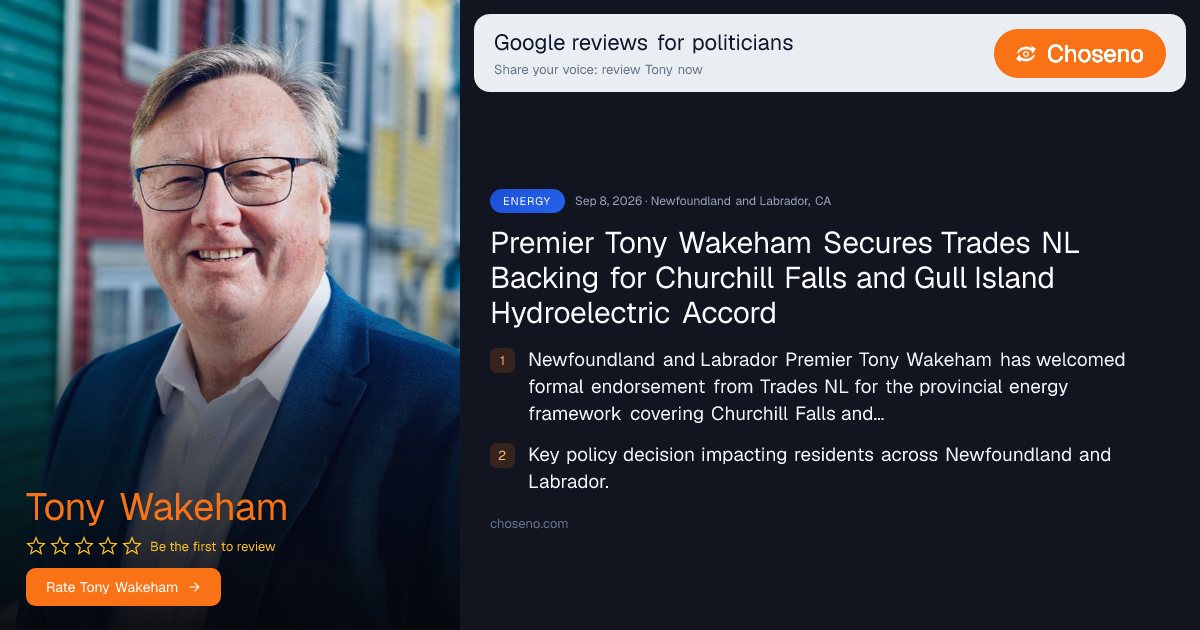
Premier Tony Wakeham Secures Trades NL Backing for Churchill Falls and Gull Island Hydroelectric Accord
Newfoundland and Labrador Premier Tony Wakeham has welcomed formal endorsement from Trades NL for the provincial energy framework covering Churchill Falls and Gull Island, securing an eighty-five percent local labor procurement requirement for major clean energy construction projects.
Read full article
Energy
CA Aug 25, 2026
Industry Minister François-Philippe Champagne Directs $380 Million for Canadian SMR Nuclear Tooling Hubs
Innovation Minister François-Philippe Champagne allocates $380 million through the Strategic Innovation Fund to scale nuclear-grade precision manufacturing lines for Small Modular Reactors (SMRs) across Ontario, Quebec, and Saskatchewan.
Read full article

Energy
US Aug 25, 2026
Department of Energy Awards $220 Million for Superhot Rock Deep Geothermal Power Drilling
Energy Secretary Jennifer Granholm and ARPA-E allocate $220 million to construct commercial deep-well drilling rigs capable of penetrating 500°C crystalline granite at depths of six kilometers for next-generation baseload geothermal electricity.
Read full article