BREAKING
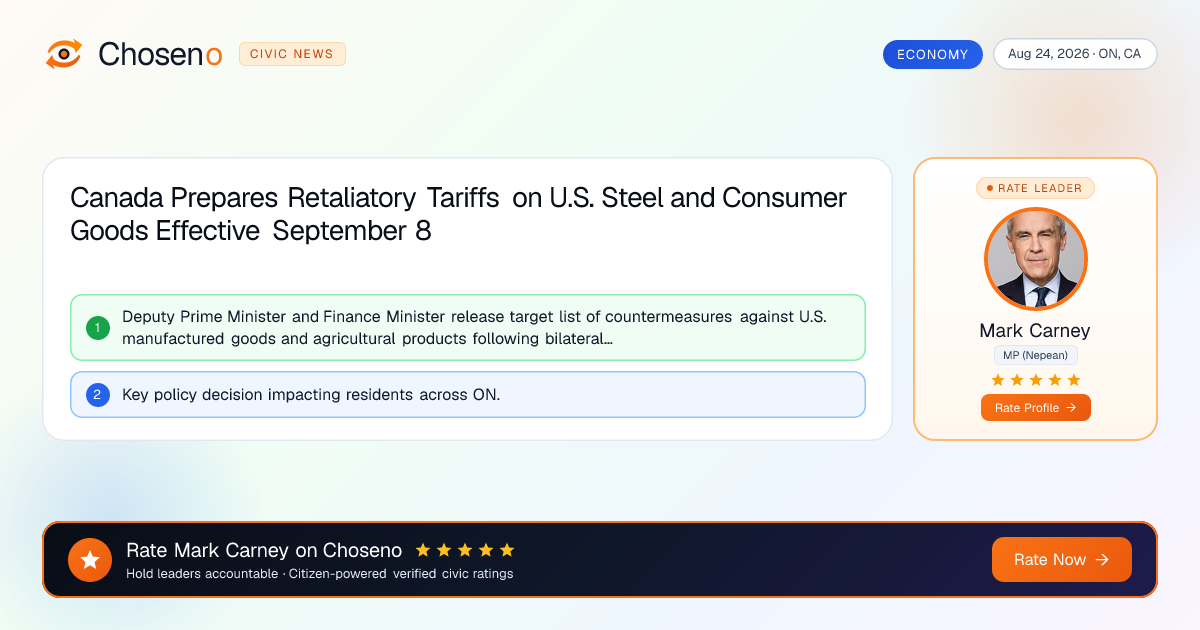
Canada Prepares Retaliatory Tariffs on U.S. Steel and Consumer Goods Effective September 8
Deputy Prime Minister and Finance Minister release target list of countermeasures against U.S. manufactured goods and agricultural products following bilateral tariff negotiations.
Choseno International Trade & Macroeconomics Bureau August 24, 2026 1 min read ON, CA
★ Choseno Civic Briefing
Key Leaders
OTTAWA, ON — The Government of Canada published an official list of targeted reciprocal tariff countermeasures under the Customs Tariff Act, preparing to apply 25% retaliatory duties on $3.6 billion in American steel, aluminum, manufactured appliances, and agricultural food products starting September 8, 2026.
Defending Canadian Workers and Integrated Supply Chains
The Canadian countermeasures respond directly to unilateral cross-border trade restrictions and threatened 50% tariffs on Canadian energy and industrial exports. The Department of Finance confirmed the countermeasures are designed to be dollar-for-dollar reciprocal while minimizing cost disruptions for Canadian domestic supply chains by exempting essential automotive parts and critical medicines.
Prime Minister Mark Carney affirmed that Canada will always stand up for its domestic industries, workers, and businesses while remaining at the negotiating table to achieve fair, reciprocal trade under CUSMA.
Canadian Manufacturers and Steel Producers Support
Canadian Steel Producers Association (CSPA) and Canadian Chamber of Commerce strongly supported the federal government’s resolute defense of integrated bilateral trade.
Agricultural exporter federations urged continued diplomatic engagement to resolve cross-border trade friction before the September 8 deadline.
Countermeasure In-Force Date
Reciprocal customs tariffs take legal effect at Canadian ports of entry on September 8, 2026, unless a negotiated bilateral accord is finalized.
Rate the people mentioned in this article

Related Coverage in Economy
See all Economy newsEconomy Breaking
US Aug 24, 2026
Governor JB Pritzker Signs HB 4758 Barring Employers from Requiring Drivers Licenses
Illinois Governor JB Pritzker signs House Bill 4758 into law, amending employment opportunity statutes to prohibit employers from requiring a driver's license for jobs that do not involve driving.
Read full article
Economy Breaking
CA Aug 24, 2026
Premier Danielle Smith Finalizes Care-First Auto Insurance System Cutting Premiums by $400
Alberta Finance Minister Nate Horner publishes final regulations under the Insurance Amendment Act, establishing a care-first no-fault injury model that caps legal fees and lowers average annual premiums.
Read full article
Economy
US Aug 24, 2026
Governor Henry McMaster Certifies $14 Billion South Carolina Budget with $1.2B Infrastructure Focus
South Carolina Governor Henry McMaster issues budget line-item vetoes, protecting a historic $1.2 billion allocation for bridge replacements, water utility grants, and port expansions.
Read full article