Prime Minister Mark Carney Pledges Expanded Federal Support for Wildfire Readiness During Northern Ontario Visit
Touring a regional wildfire management facility in Thunder Bay, Prime Minister Mark Carney affirmed that Ottawa must expand interagency coordination and equipment investments to confront severe climate-driven wildfire seasons.
Choseno Civic News Desk September 5, 2026 2 min read CA
THUNDER BAY, Ont. — Concluding a regional tour across Northwestern Ontario, Prime Minister Mark Carney visited frontline emergency personnel at the Thunder Bay Wildfire Management Centre, affirming that the federal government must deepen its investments in aerial suppression assets, interprovincial resource sharing, and Indigenous community protection to combat increasingly severe wildfire seasons.
The visit followed a summer marked by intense fire activity across northern boreal forests, triggering multiple localized community evacuations and prolonged air quality advisories across Ontario, Manitoba, and western provinces. During his briefing with incident commanders and provincial initial attack crews, Carney acknowledged that climate-induced drought conditions and extreme temperature spikes have stretched conventional provincial suppression capabilities beyond historic baselines.
Addressing reporters at the facility, Prime Minister Carney emphasized that federal disaster preparedness must shift from reactive emergency deployments to sustained, year-round mitigation and modernized equipment procurement.
"Our frontline firefighters and emergency crews perform extraordinary, heroic work under dangerous and exhausting conditions, but more can and must be done at the federal level to support them," Prime Minister Mark Carney said in Thunder Bay. "Climate change is making fire seasons longer, more erratic, and significantly more destructive. We need permanent intergovernmental coordination, faster deployment mechanisms for Canadian Armed Forces logistical support, and dedicated funding to help northern and First Nations communities build defensible fire breaks and resilient local infrastructure."
Earlier in his Thunder Bay itinerary, Carney highlighted federal industrial policy and regional economic resilience, announcing a multi-billion dollar manufacturing contract for VIA Rail passenger cars at the local Alstom plant to support skilled manufacturing employment in the region.
Municipal leaders and First Nations chiefs across northwestern Ontario welcomed the prime minister’s focus on wildfire safety, pointing out that remote fly-in communities face disproportionate health risks from smoke inhalation and vulnerable single-road evacuation corridors during peak summer fire activity. Regional leaders called for federal commitments to upgrade all-weather access roads and expand community-based Indigenous firefighting brigades.
Federal officials confirmed that discussions on wildfire mitigation, disaster financial assistance arrangements, and emergency management interoperability will form a central agenda topic when cabinet convenes for its autumn planning retreat ahead of the parliamentary sitting.
Rate the people mentioned in this article

Related Coverage in Federal Governance
See all Federal Governance newsFederal Governance
CA Sep 5, 2026
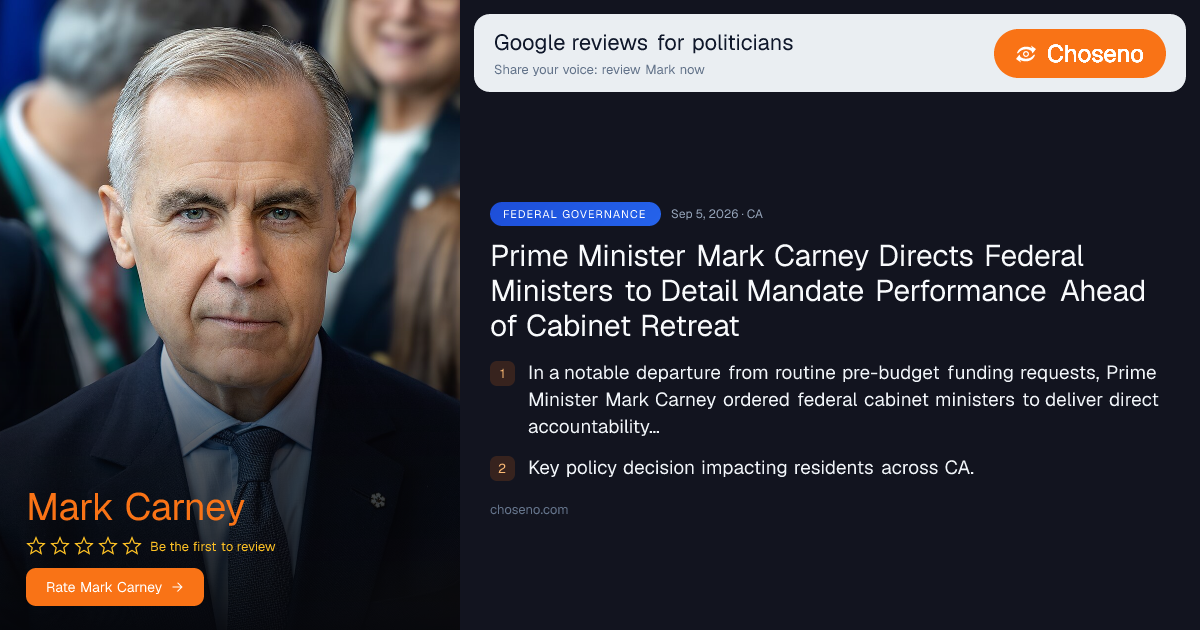
Prime Minister Mark Carney and Alberta Premier Danielle Smith Advance Landmark West Coast Pipeline Implementation Agreement
Prime Minister Mark Carney and Alberta Premier Danielle Smith formalized a landmark intergovernmental energy accord, expediting federal approvals for a million-barrel-per-day West Coast oil pipeline corridor with Indigenous equity participation.
Read full article
Federal Governance
CA Sep 5, 2026
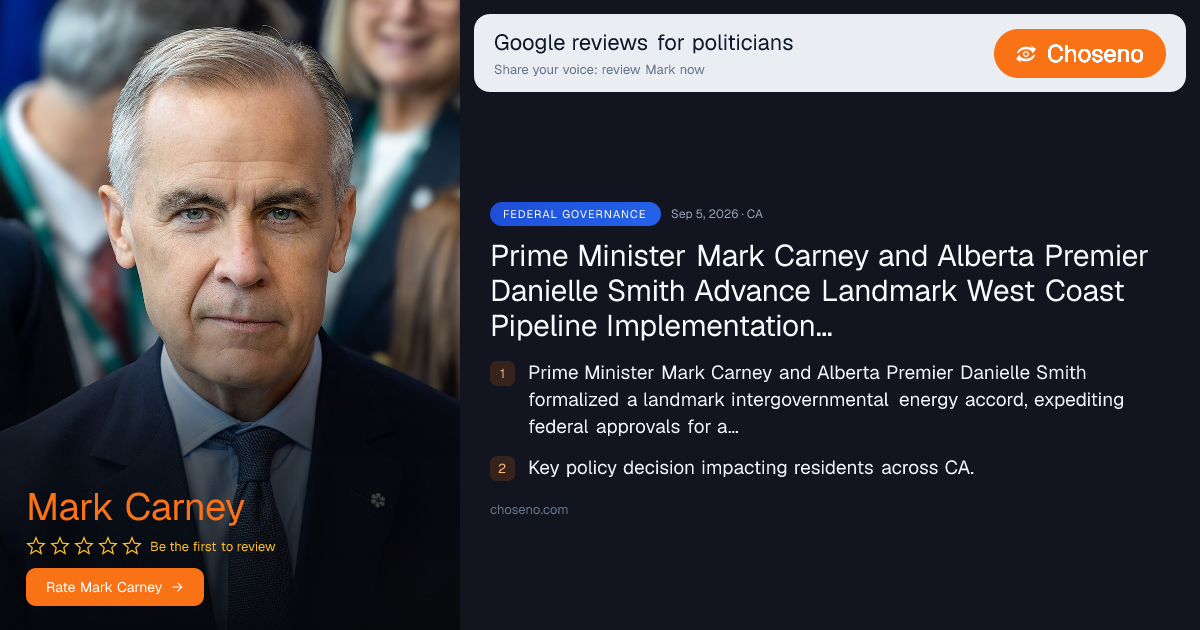
Prime Minister Mark Carney Directs Federal Ministers to Detail Mandate Performance Ahead of Cabinet Retreat
In a notable departure from routine pre-budget funding requests, Prime Minister Mark Carney ordered federal cabinet ministers to deliver direct accountability assessments tracking core mandate benchmarks ahead of next week’s cabinet retreat.
Read full article